
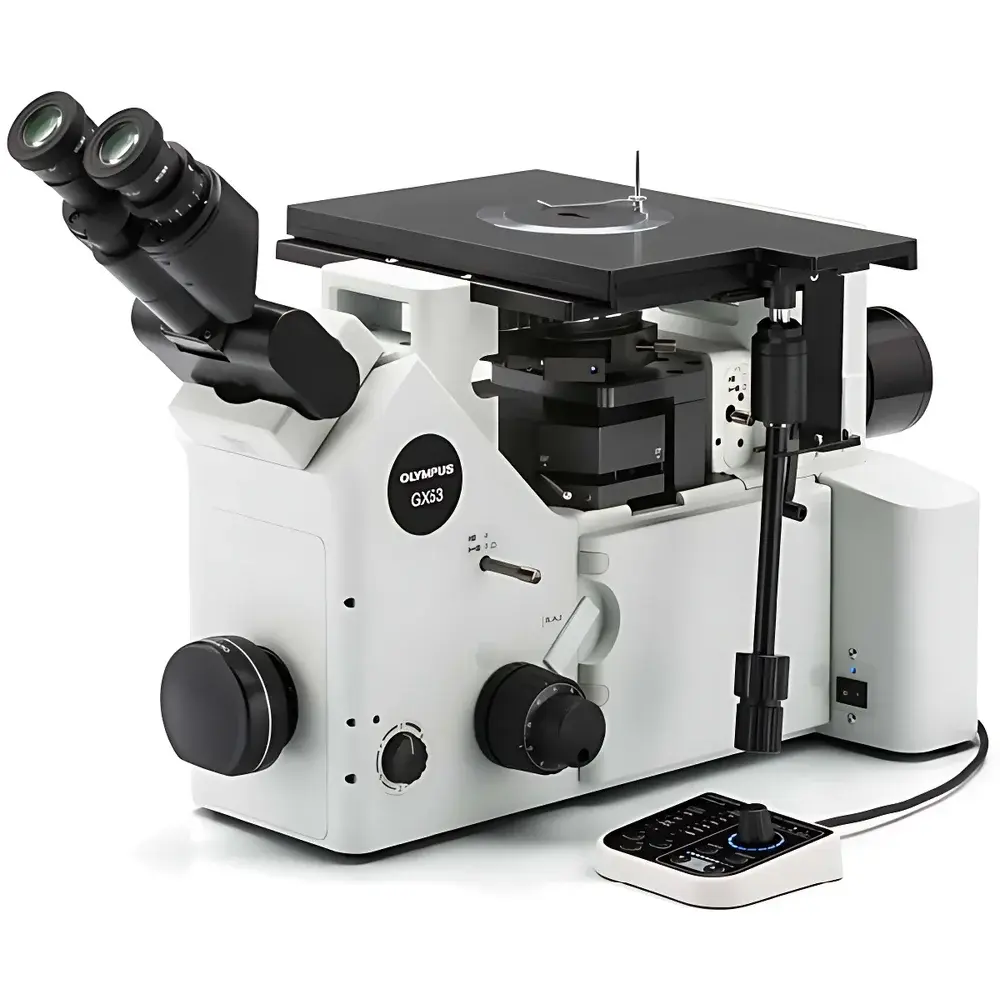
Olympus GX53 Inverted Metallurgical Microscope
| Brand | Olympus |
|---|---|
| Origin | Japan |
| Model | GX53 |
| Configuration | Inverted |
| Total Magnification | 1000× |
| Eyepiece Port | Dual (Binocular/Trinocular) |
| Objective Turret | 6-Position Manual or Coded |
| Optical System | UIS2 Infinity-Corrected |
| Illumination | Reflected White LED (with Light Intensity Manager), Optional Transmitted Light |
| Compliance | IEC 60664-1 Pollution Degree 2, Installation Category II |
| Weight | ~25 kg |
| Operating Environment | 5–40 °C, RH ≤80% (non-condensing) |
Overview
The Olympus GX53 Inverted Metallurgical Microscope is an engineered solution for high-precision microstructural analysis of opaque, polished, and etched metallic specimens. Designed specifically for metallurgy, materials science, and failure analysis laboratories, the GX53 employs a robust inverted optical architecture—positioning the objective lenses beneath the specimen stage—to accommodate large, heavy, or irregularly shaped samples (up to 5 kg) without interference from objective clearance constraints. Its UIS2 infinity-corrected optical system ensures diffraction-limited resolution across all magnifications (up to 1000×), with wavefront aberration control and image shading correction delivering consistent contrast and flat-field fidelity. The system supports multiple contrast modalities—including brightfield, darkfield, differential interference contrast (DIC), simple polarizing, and MIX observation (4-directional darkfield)—enabling comprehensive defect identification, grain boundary delineation, phase distribution mapping, and inclusion analysis in accordance with ASTM E3, ISO 643, and USP guidelines for metallographic evaluation.
Key Features
- Inverted ergonomics: Objective turret located below the stage enables unobstructed access to large specimens, ideal for castings, welds, and cross-sectioned components requiring mechanical stability during long-duration imaging.
- Modular illumination architecture: Integrated white LED illumination (with Light Intensity Manager) provides stable, flicker-free, color-temperature-consistent (6000 K) reflected light; optional halogen or mercury lamp modules support fluorescence and high-intensity applications.
- Multi-modal contrast flexibility: Manual mirror unit allows rapid switching between brightfield and darkfield; coded or manual 6-position nosepiece accommodates specialized objectives including long-working-distance (LWD) and high-NA metallurgical lenses.
- Advanced digital imaging suite: Fully compatible with Olympus Stream software for EFI (Extended Focus Imaging), MIA (Multiple Image Alignment), and HDR (High Dynamic Range) acquisition—enabling quantitative height mapping, seamless panoramic stitching of large-area microstructures (e.g., carburized case depth assessment), and glare-free visualization of high-contrast features such as oxide layers or porosity.
- Precision mechanical design: Rack-and-pinion focusing mechanism with coaxial coarse/fine controls (7 mm coarse stroke, 100 µm fine rotation increment), torque-adjustable coarse focus, and upper-limit stopper ensures repeatable Z-axis positioning for serial sectioning and layer-by-layer analysis.
- Regulatory-ready data handling: Stream software supports audit-trail logging, user-access controls, and metadata embedding compliant with GLP/GMP documentation requirements per FDA 21 CFR Part 11 when paired with optional BX3M-CBFM control box and coded hardware components.
Sample Compatibility & Compliance
The GX53 accommodates standard metallographic specimens up to 50 × 50 mm (X/Y travel) on its right-handle mechanical stage, with optional gliding or flexible left-handle configurations for specialized workflows. Specimen thickness is unrestricted due to the inverted geometry, supporting mounted samples, bulk alloys, coated substrates, and additively manufactured parts. All optical paths meet ISO 10934-1 for microscope performance verification, while electrical safety complies with IEC 60664-1 (Pollution Degree 2, Overvoltage Category II). Environmental operation is certified for laboratory use at 5–40 °C and ≤80% relative humidity (non-condensing), aligning with ISO 14644-1 Class 8 cleanroom ambient specifications for QC environments.
Software & Data Management
Olympus Stream software serves as the central platform for image acquisition, measurement, annotation, and reporting. It natively supports EFI acquisition using either manual or motorized Z-axis control, generating both composite extended-focus images and quantitative height maps (µm-scale vertical profiling). MIA functionality enables automated panorama creation via stage coordinate registration—critical for assessing heat-affected zones (HAZ) or large-area corrosion patterns. HDR mode dynamically balances exposure across heterogeneous reflectivity regions (e.g., matrix vs. intermetallic phases), eliminating saturation artifacts without post-processing interpolation. All measurements are auto-calibrated against stage-encoded scale references, and reports export in PDF, TIFF, or CSV formats with embedded calibration metadata, instrument configuration logs, and operator credentials—ensuring traceability for ISO/IEC 17025-accredited testing laboratories.
Applications
- Metallographic evaluation of ferrous and non-ferrous alloys per ASTM E3/E407
- Case depth analysis (carburizing, nitriding) using EFI-based depth profiling
- Weld inspection and HAZ microstructure characterization
- Inclusion rating (ASTM E45, ISO 4967) with automated particle detection modules
- Failure analysis of fracture surfaces, fatigue cracks, and stress corrosion cracking
- Quality control of sintered metals, powder metallurgy parts, and thermal spray coatings
- Research-grade microstructural quantification in academic and industrial R&D settings
FAQ
Is the GX53 compatible with motorized stages and Z-drives?
Yes—the GX53 supports optional motorized XY stages (e.g., U-SC30) and Z-axis drives (U-ZSEF) for automated scanning, EFI, and repeatable multi-location imaging.
Can transmitted light be added to the inverted configuration?
Yes—transmitted light illumination is available via the IX2-ILL100 stand and PMG3-LWCD condenser, enabling brightfield and polarized observation of thin sections or transparent coatings on metallic substrates.
Does the system support DIC and polarized light out-of-the-box?
DIC and simple polarizing require dedicated sliders (U-DICR, U-ANT) and strain-free objectives; these are optional accessories but fully integrated into the UIS2 optical path.
What camera interfaces are supported?
The GX53 offers reversed-image front port (for DP-series cameras) and upright-image side port, both compatible with USB 3.0 and HDMI output via Olympus DP core cameras and third-party sensors meeting C-mount standards.
Is firmware and software update support provided internationally?
Olympus provides global firmware updates and Stream software version releases through authorized service centers, with documentation localized in English, German, French, Japanese, and Chinese—ensuring compliance with regional regulatory expectations.




