
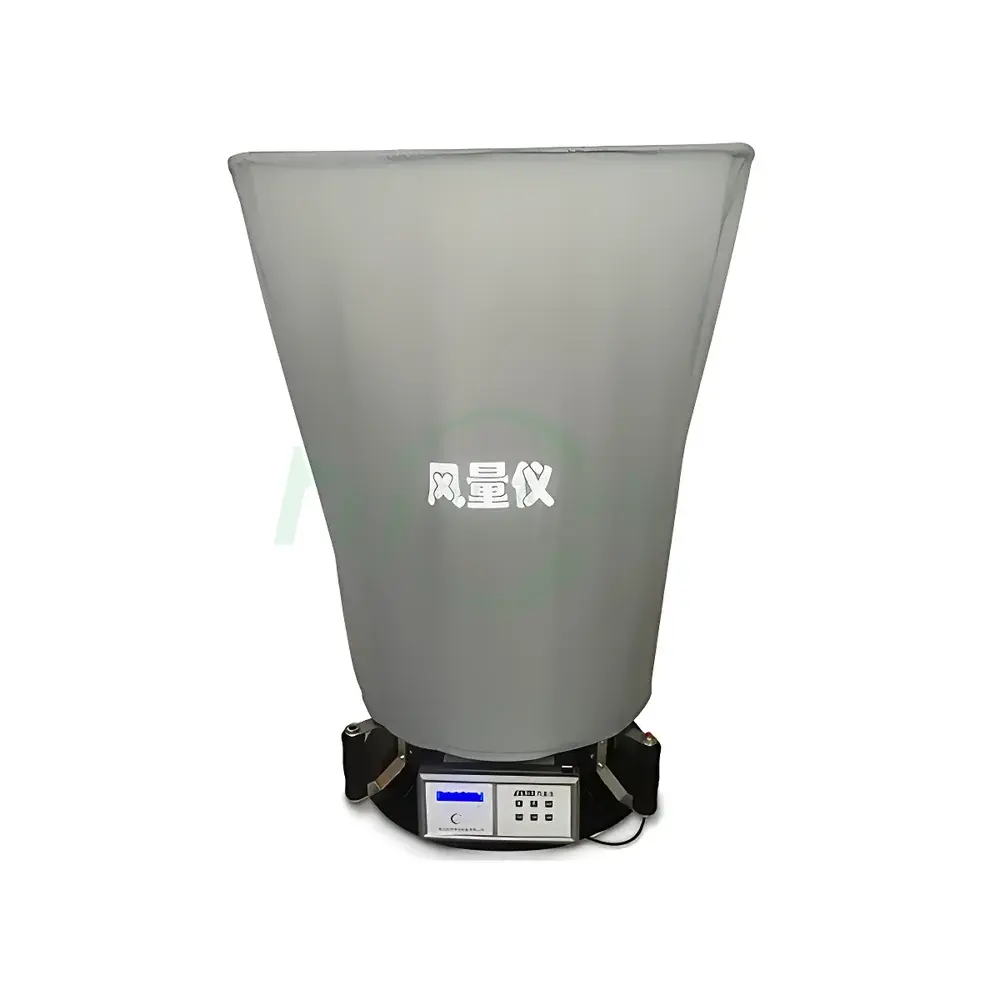
HJ FLY-1 Pitot-Style Air Flow Meter
| Brand | HJ |
|---|---|
| Origin | Zhejiang, China |
| Manufacturer | HJ Purification Equipment Co., Ltd. |
| Model | FLY-1 |
| Instrument Type | Pitot Tube Anemometer |
| Flow Range | 100–3500 m³/h |
| Resolution | 100–3500 m³/h |
| Accuracy | ±5% FS |
| Operating Temperature | 5–35 °C |
| Operating Humidity | 15–70% RH |
| Internal Battery Life | 30 h |
| Data Retention After Power Loss | 4 h |
| Pressure Drop Across Probe | ≤5 Pa |
| Memory Capacity | 1000 airflow records |
| Display | LCD with print interface |
| Standard Accessories | 570×570 mm & 830×830 mm flow hoods, 7.2 V rechargeable battery + charger, external thermal printer, height-adjustable tripod (max extended height: 3.1 m including instrument) |
| Optional | PC-based data analysis software |
Overview
The HJ FLY-1 Pitot-Style Air Flow Meter is a precision-engineered instrument designed for direct, in-situ volumetric airflow measurement in HVAC ducts, terminal air devices, and cleanroom supply or return registers. It operates on the fundamental principle of differential pressure sensing via a calibrated pitot-static probe array integrated into standardized flow hoods. By capturing dynamic and static pressure differentials across multiple sampling points—and applying Bernoulli’s equation with empirically validated discharge coefficients—the FLY-1 computes average volumetric flow rate (m³/h) with high reproducibility under turbulent and transitional flow regimes typical of low-velocity ventilation systems. Its compact, portable architecture enables rapid deployment in constrained mechanical rooms, ceiling plenums, and ISO-classified clean environments where real-time airflow verification supports regulatory compliance, commissioning protocols (e.g., ASHRAE Guideline 1, ISO 14644-3), and preventive maintenance scheduling.
Key Features
- Integrated pitot-static sensor array with multi-point spatial averaging to minimize turbulence-induced measurement uncertainty
- High-stability, low-pressure-drop (<5 Pa) flow hoods (570×570 mm and 830×830 mm) optimized for laminarized inlet conditions per ISO 14644-3 Annex B
- Backlit LCD display with real-time m³/h readout, unit toggle, and status indicators for battery level, memory fullness, and calibration validity
- Onboard non-volatile memory storing up to 1000 discrete measurement records—including timestamp, hood ID, location tag, and raw differential pressure values—with 4-hour data retention after power interruption
- Rechargeable 7.2 V lithium-ion battery providing continuous operation for ≥30 hours; compatible with universal AC/DC charging adapter
- Modular tripod mounting system supporting vertical extension from 1.2 m to 3.1 m (inclusive of instrument height), enabling safe, ergonomic access to ceiling-mounted diffusers and grilles without ladders
- RS-232 print interface compliant with industry-standard thermal printers for immediate hard-copy documentation during field audits
Sample Compatibility & Compliance
The FLY-1 is validated for use with non-corrosive, particle-laden air streams within Class D–A cleanrooms (ISO 14644-1), hospital HVAC zones, laboratory fume hood exhaust systems, and commercial VAV box terminals. It complies with measurement traceability requirements outlined in ISO/IEC 17025:2017 for accredited laboratories performing airflow verification. Each unit undergoes factory calibration using a NIST-traceable, 0.5-class wind tunnel certified to ISO 5167-4:2019 (differential pressure standards) and ASHRAE RP-1147 test procedures. Calibration certificates include multi-point linearity verification at 10%, 50%, and 100% of full scale (100–3500 m³/h), with documented uncertainty budgets. The instrument is not rated for explosive atmospheres (ATEX/IECEx), saturated steam, or chemically aggressive gases (e.g., chlorine, ammonia, or solvent vapors).
Software & Data Management
An optional Windows-compatible data analysis suite provides secure import of .csv-formatted measurement logs, automated report generation (PDF/Excel), statistical summary (mean, SD, CV%), and trend visualization across multiple test locations. The software enforces audit-trail functionality per FDA 21 CFR Part 11 requirements—including user login authentication, electronic signatures, and immutable record timestamps—making it suitable for GMP-regulated pharmaceutical cleanroom validation (e.g., EU Annex 1, USP ). All firmware updates are delivered via signed USB firmware packages to prevent unauthorized modification.
Applications
- Commissioning and balancing of HVAC systems per TAB (Testing, Adjusting, and Balancing) protocols
- Annual airflow verification in ISO 14644-1 classified cleanrooms and controlled environments
- Supply/return register performance assessment in hospitals, laboratories, and data centers
- Leak testing support for ductwork integrity checks (when used with shutoff dampers)
- Baseline data acquisition for predictive maintenance models of AHUs and FCUs
- Educational use in HVAC engineering labs for hands-on fluid dynamics instruction
FAQ
What calibration standard is used for factory certification?
Each FLY-1 unit is calibrated against a 0.5-class reference wind tunnel accredited to ISO/IEC 17025, with traceability to national metrology institutes.
Can the FLY-1 measure bidirectional airflow (supply and return) without hardware modification?
Yes—the instrument automatically detects flow direction based on differential pressure polarity and displays signed m³/h values (±) for both supply and exhaust applications.
Is the battery replaceable by the end user?
The 7.2 V lithium-ion pack is field-replaceable using standard Torx T8 tools; replacement batteries are available as spare parts (P/N: FLY-BAT-7.2V).
Does the device support external data logging via USB or Bluetooth?
No—data export is exclusively via RS-232 serial interface to thermal printers or the optional PC software; no native USB or wireless connectivity is implemented.
What is the maximum allowable particulate loading for reliable operation?
The FLY-1 is rated for ambient air with ≤10⁶ particles/m³ ≥0.5 µm (equivalent to ISO Class 8); operation in higher-concentration environments requires periodic cleaning of pitot ports per maintenance schedule.
Related Products







