
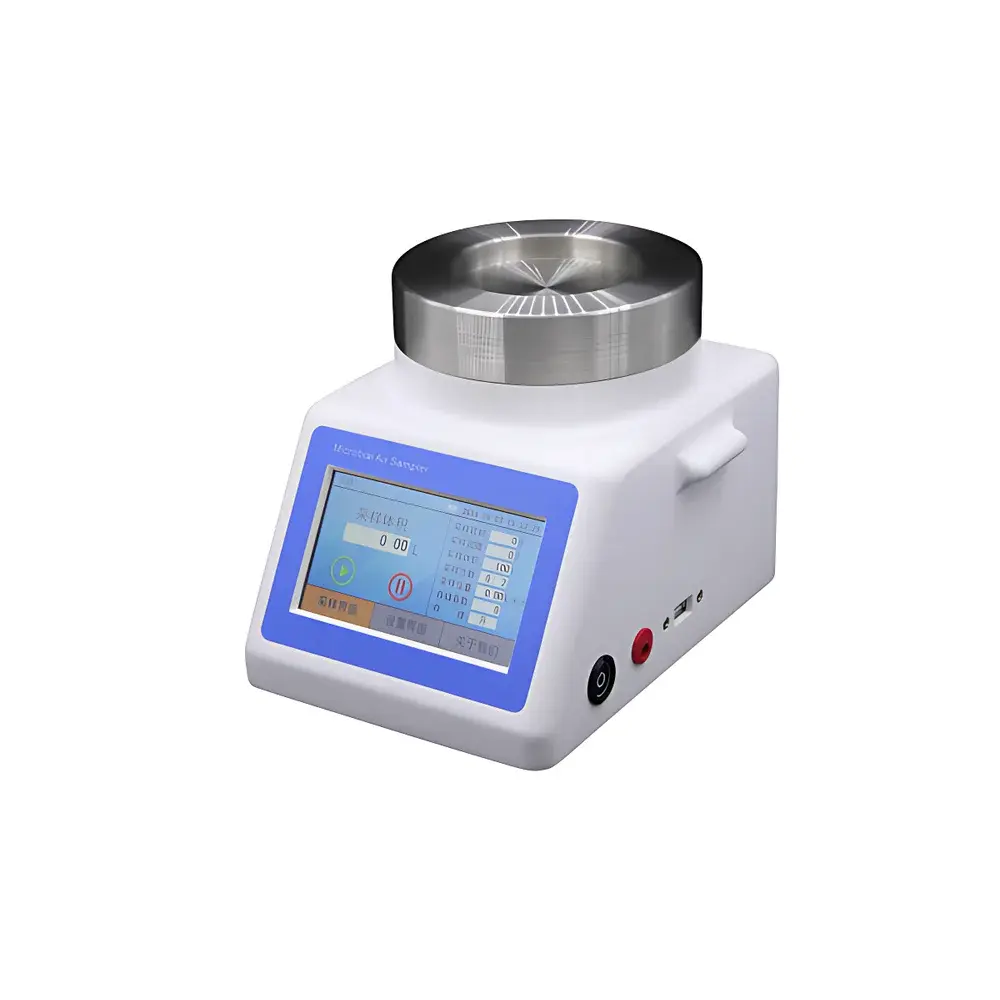
HJ FKC-2 Active Airborne Microbial Sampler
| Brand | HJ Purification |
|---|---|
| Origin | Zhejiang, China |
| Manufacturer Type | OEM/ODM Producer |
| Origin Category | Domestic (China) |
| Model | FKC-2 |
| Sampling Principle | Andersen-style inertial impaction (5-stage cascade impactor principle) |
| Flow Rate | 100 L/min ±5% |
| Flow Accuracy | ±5% at 100 L/min |
| Adjustable Sample Volume | 1–6000 L |
| Operating Temperature | 25–35 °C |
| Operating Relative Humidity | 65–85 %RH |
| Impact Velocity | 10.8 m/s |
| Sampling Head Material | SUS316L stainless steel |
| Data Storage | 1000 sample records |
| Interface | USB port |
| Display | Full-color capacitive touchscreen |
| Dimensions (W×D×H) | 130 × 130 × 160 mm |
| Weight | 2.0 kg |
| Battery Life | ≥8 h (optional DC 14.8 V operation) |
| Compliance | ISO 14698-1:2003, ISO 14698-2:2003, GB/T 16293–2010 |
Overview
The HJ FKC-2 Active Airborne Microbial Sampler is a precision-engineered, portable active air sampler designed for quantitative monitoring of viable airborne microorganisms in controlled environments. Unlike passive sedimentation methods—such as settle plates—which rely on gravitational deposition and suffer from low collection efficiency, poor reproducibility, and strong dependence on ambient airflow—the FKC-2 employs a validated inertial impaction principle based on the Anderson cascade impactor design (Stage V). This enables high-efficiency capture of culturable bacteria and fungi directly onto standard 90 mm Petri dishes with minimal particle bounce or re-aerosolization. The device operates at a calibrated nominal flow rate of 100 L/min, generating an impact velocity of 10.8 m/s at the final stage, ensuring reliable separation of particles ≥0.6 µm aerodynamic diameter. Its compact footprint (130 × 130 × 160 mm), lightweight construction (2.0 kg), and dual-power capability (AC 220 V / DC 14.8 V) support flexible deployment across cleanrooms, isolators, aseptic processing suites, environmental monitoring labs, and HVAC validation studies.
Key Features
- High-precision active sampling via 5-stage Andersen-type inertial impaction—optimized for recovery of mesophilic aerobic microorganisms per ISO 14698-1 and GB/T 16293–2010.
- 397-mesh stainless steel sampling head (SUS316L) with 0.7 mm orifices—engineered to minimize microbial overlap and improve colony isolation fidelity.
- Full-color capacitive touchscreen interface supporting intuitive parameter configuration, real-time display of cumulative volume, elapsed time, and instantaneous flow status.
- User-programmable sampling volume range: 1–6000 L in 1-L increments—enabling compliance with facility-specific EM plans requiring defined air volumes per location.
- Onboard non-volatile memory stores up to 1000 complete sampling records—including date/time stamp, set volume, actual volume, duration, and flow deviation—accessible via USB export for audit-ready data transfer.
- Modular Petri dish access: quick-release sampling head allows rapid replacement of standard φ90 × 15 mm agar plates without tools or recalibration.
- Integrated flow control circuitry with proprietary sampling chip ensures stable 100 L/min delivery across variable inlet resistance and battery discharge cycles.
Sample Compatibility & Compliance
The FKC-2 is validated for use with conventional microbiological growth media—including Tryptic Soy Agar (TSA), Sabouraud Dextrose Agar (SDA), and malt extract agar—loaded into commercially available 90 mm Petri dishes. Its impactor geometry and velocity profile align with the particle size cut-points specified in ISO 14698-2 for viable airborne particle assessment. The instrument conforms to the performance and procedural requirements of GB/T 16293–2010 “Test method for airborne microbial count in pharmaceutical clean rooms and clean areas” and supports routine environmental monitoring under EU GMP Annex 1 (2022), USP , and FDA Aseptic Processing Guidance. All materials in contact with sampled air meet USP Class VI biocompatibility criteria; the SUS316L sampling head withstands repeated sterilization via vaporized hydrogen peroxide (VHP), 70% isopropyl alcohol (IPA), or saturated steam.
Software & Data Management
While the FKC-2 operates as a standalone hardware platform without cloud connectivity, its embedded firmware implements GLP-aligned data integrity safeguards. Each sampling event generates a timestamped record containing actual measured volume (integrated from real-time flow sensor output), programmed volume, duration, and percent deviation from nominal flow. These records are retained in tamper-resistant internal memory and exported in CSV format via USB mass storage mode—compatible with laboratory information management systems (LIMS) and electronic batch record (EBR) platforms. Audit trail functionality includes automatic logging of parameter changes, power-on/off events, and error codes (e.g., flow instability, door open detection). For regulated environments, the device supports 21 CFR Part 11-compliant workflows when paired with validated third-party data review software that enforces electronic signatures and change control.
Applications
- Routine environmental monitoring (EM) in Grade A/B/C/D cleanrooms per ISO 14644-1 and EU GMP Annex 1.
- Media fill simulations and aseptic process validation—providing quantitative baseline and intervention data.
- HVAC system qualification, including filter integrity testing and airflow pattern verification.
- Bioburden assessment in upstream/downstream bioprocessing areas and sterile manufacturing suites.
- Research-grade airborne microbiome profiling in hospital isolation rooms, pharmaceutical R&D labs, and biosafety level 2 (BSL-2) containment facilities.
- Post-decontamination verification following VHP or chlorine dioxide fumigation cycles.
FAQ
What sampling principle does the FKC-2 use, and how does it differ from settle plates?
The FKC-2 uses active inertial impaction—drawing air through a multi-stage nozzle array at 100 L/min to accelerate particles onto agar surfaces. This provides quantitative, volume-based recovery independent of air currents, unlike passive settle plates which yield only qualitative, time-dependent deposition data.
Is the FKC-2 compliant with international regulatory standards for pharmaceutical EM?
Yes—it meets the technical and procedural requirements of ISO 14698-1/2 and GB/T 16293–2010, and its performance characteristics support alignment with EU GMP Annex 1, USP , and FDA aseptic guidance when operated within validated parameters.
Can the FKC-2 be used in high-humidity environments such as wet process areas?
It is rated for continuous operation at 65–85 %RH; however, condensation on the impactor surface or agar medium may compromise viability recovery. Pre-drying of plates and short-duration sampling (80 %RH conditions.
Does the device require annual calibration or third-party certification?
Per ISO 14698-2, users must verify flow accuracy prior to each sampling campaign using a NIST-traceable flow calibrator (e.g., dry gas meter or electronic bubble meter); full system calibration is advised annually or after impactor cleaning/replacement.
How is data integrity ensured during USB export?
Exported CSV files include digital checksums and retain original timestamps with millisecond resolution; no metadata is editable post-export, preserving ALCOA+ principles (Attributable, Legible, Contemporaneous, Original, Accurate, Complete, Consistent, Enduring, Available).
Related Products







