
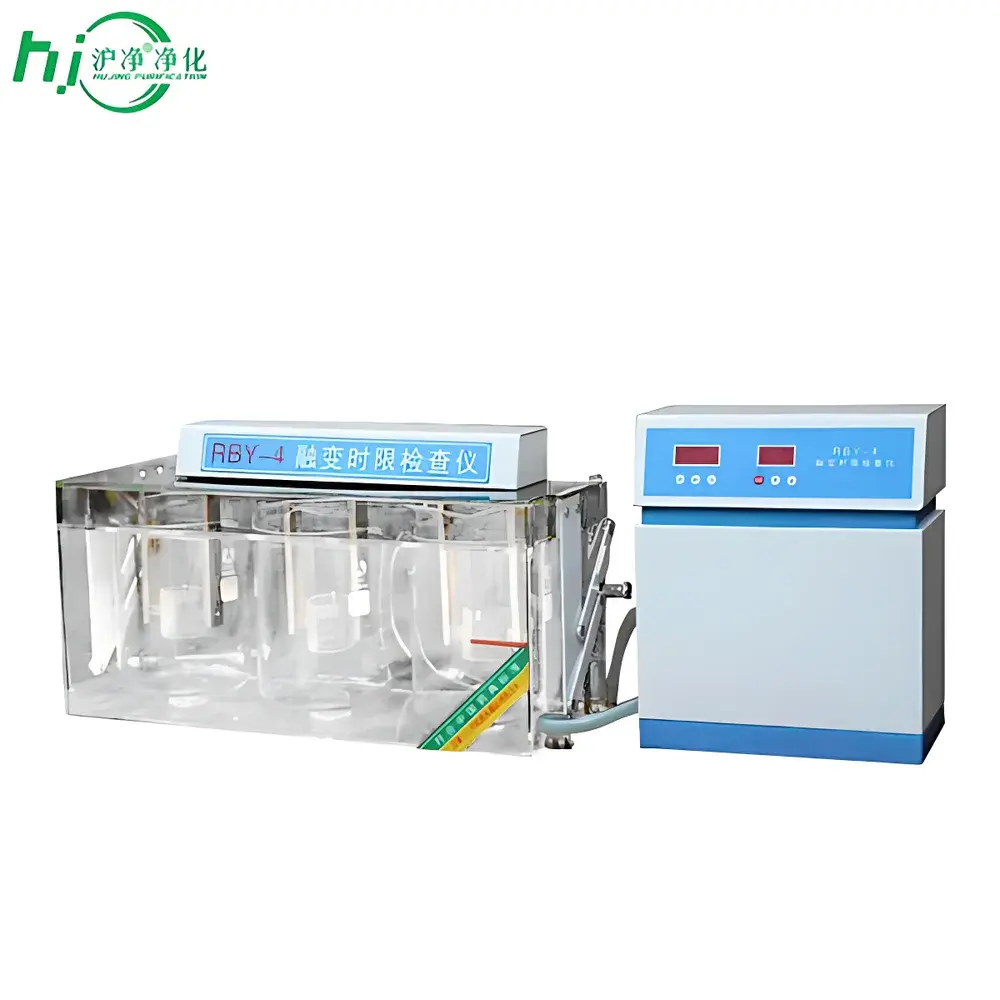
HJ RBY-4 Automatic Drug Disintegration Tester
| Brand | HJ |
|---|---|
| Origin | Shanghai, China |
| Manufacturer Type | Manufacturer |
| Country of Origin | China |
| Model | RBY-4 |
| Quotation | Upon Request |
| Temperature Control Accuracy | 37 °C ± 0.3 °C |
| Setpoint Range | 30–40 °C |
| Cylinder Dimensions | Ø52 mm × 60 mm |
| Metal Rack Dimensions | Ø50 mm, Aperture 4 mm, Plate Spacing 30 mm |
| Disintegration Timers | P1 (30 min, rack inversion every 10 min) |
| Beaker Capacity | 5 L (3 standard beakers included) |
| Heating Power | 1300 W |
| Power Supply | 220 V ± 10 %, 50 Hz |
Overview
The HJ RBY-4 Automatic Drug Disintegration Tester is a microprocessor-controlled pharmaceutical testing instrument engineered to perform standardized disintegration testing of solid dosage forms—including suppositories, vaginal tablets, and effervescent tablets—in accordance with the Chinese Pharmacopoeia (ChP) General Chapter 0921 “Disintegration Time Limit Test”. It operates on the principle of simulating physiological conditions in the human body by maintaining a precisely regulated water bath at 37 °C ± 0.3 °C, thereby enabling reproducible assessment of tablet or suppository breakdown under defined thermal and mechanical agitation conditions. The system employs a vertically oriented cylindrical test chamber housing a motorized metal rack that lifts and inverts at programmable intervals, replicating mild mechanical stress analogous to peristaltic movement or mucosal contact. Designed for routine QC laboratories in pharmaceutical manufacturing, contract testing organizations (CTOs), and regulatory-compliant R&D facilities, the RBY-4 delivers deterministic timing, consistent thermal uniformity, and full traceability of test parameters—critical for GLP- and GMP-aligned operations.
Key Features
- Microcontroller-based temperature regulation with PID feedback loop ensures stable bath temperature at 37 °C ± 0.3 °C across all three 5-L test beakers.
- Three preconfigured disintegration protocols (P1, P2, P3) support flexible method execution without manual intervention—enabling compliance with ChP monographs requiring 30-min or 60-min observation windows.
- Automated rack inversion mechanism executes precise 180° rotation at user-defined intervals (e.g., every 10 minutes), minimizing operator variability and eliminating timing inconsistencies inherent in manual methods.
- Stainless-steel test cylinders (Ø52 mm × 60 mm) and perforated metal racks (Ø50 mm, 4-mm apertures, 30-mm plate spacing) conform dimensionally to ChP specifications for mechanical consistency and fluid dynamics fidelity.
- Integrated audible/visual alarm signals termination of each test cycle, with non-volatile memory retaining last-used settings for rapid method re-initiation.
- Robust 1300 W heating system achieves rapid thermal equilibration and maintains stability even during ambient fluctuations—validated over continuous 8-hour operation cycles.
Sample Compatibility & Compliance
The RBY-4 accommodates standard suppository bases (e.g., cocoa butter, PEG, Witepsol), vaginal tablets, and orally disintegrating tablets (ODTs) within its fixed-dimension test apparatus. All mechanical and thermal parameters align strictly with ChP 0921, and the instrument’s design principles are compatible with parallel interpretation under USP Disintegration and EP 2.9.1 Disintegration of Tablets and Capsules. While not inherently 21 CFR Part 11 compliant out-of-the-box, its deterministic timer logic, non-modifiable runtime logs, and physical audit trail (e.g., printed test records via optional thermal printer interface) support documentation practices required for FDA inspections and internal quality audits. Routine calibration verification against NIST-traceable thermistors and stopwatch standards satisfies ISO/IEC 17025 metrological requirements for accredited testing labs.
Software & Data Management
The RBY-4 operates via embedded firmware with no external PC dependency—ensuring operational continuity, cybersecurity resilience, and minimal validation burden. All test parameters (selected protocol, start time, bath temperature, inversion count, end time) are timestamped and stored in internal EEPROM with retention exceeding 10,000 cycles. Optional RS-232 or USB-to-serial interface enables export of CSV-formatted test logs for integration into LIMS or ELN systems. For fully auditable workflows, users may pair the device with a validated electronic lab notebook (ELN) platform to capture contextual metadata—such as analyst ID, batch number, sample ID, and environmental conditions—meeting ALCOA+ data integrity criteria.
Applications
- QC release testing of suppositories and vaginal tablets per ChP monographs and internal specifications.
- Formulation development studies evaluating excipient impact on disintegration kinetics (e.g., surfactant concentration, binder type, compression force).
- Stability program monitoring—assessing disintegration time shifts across accelerated and long-term storage conditions.
- Comparative bioequivalence support: correlating in vitro disintegration profiles with in vivo dissolution or pharmacokinetic data.
- Educational use in pharmacy schools for hands-on instruction in pharmacopeial testing methodology and regulatory science fundamentals.
FAQ
Does the RBY-4 comply with international pharmacopoeias beyond the Chinese Pharmacopoeia?
Yes—the mechanical dimensions, temperature control tolerance, and timing logic are functionally equivalent to USP and EP 2.9.1 requirements; however, formal compliance declarations require site-specific qualification and documented risk assessment.
Can the instrument accommodate non-standard sample geometries, such as oversized pessaries?
No—the fixed cylinder and rack dimensions are designed exclusively for ChP-specified samples; deviation requires custom engineering and revalidation.
Is calibration certificate included with shipment?
A factory calibration report (covering temperature accuracy and timer deviation) is provided; users must perform periodic in-house verification using certified reference standards per their SOPs.
What maintenance is required to ensure long-term performance?
Monthly descaling of the heating element using diluted acetic acid, biannual inspection of rack drive gears, and annual verification of thermal sensor drift using a calibrated RTD probe.
Is remote monitoring or network connectivity supported?
Not natively—but with optional serial-to-Ethernet gateway hardware and middleware configuration, real-time status polling and alarm notification via SNMP or Modbus TCP can be implemented.
Related Products







