
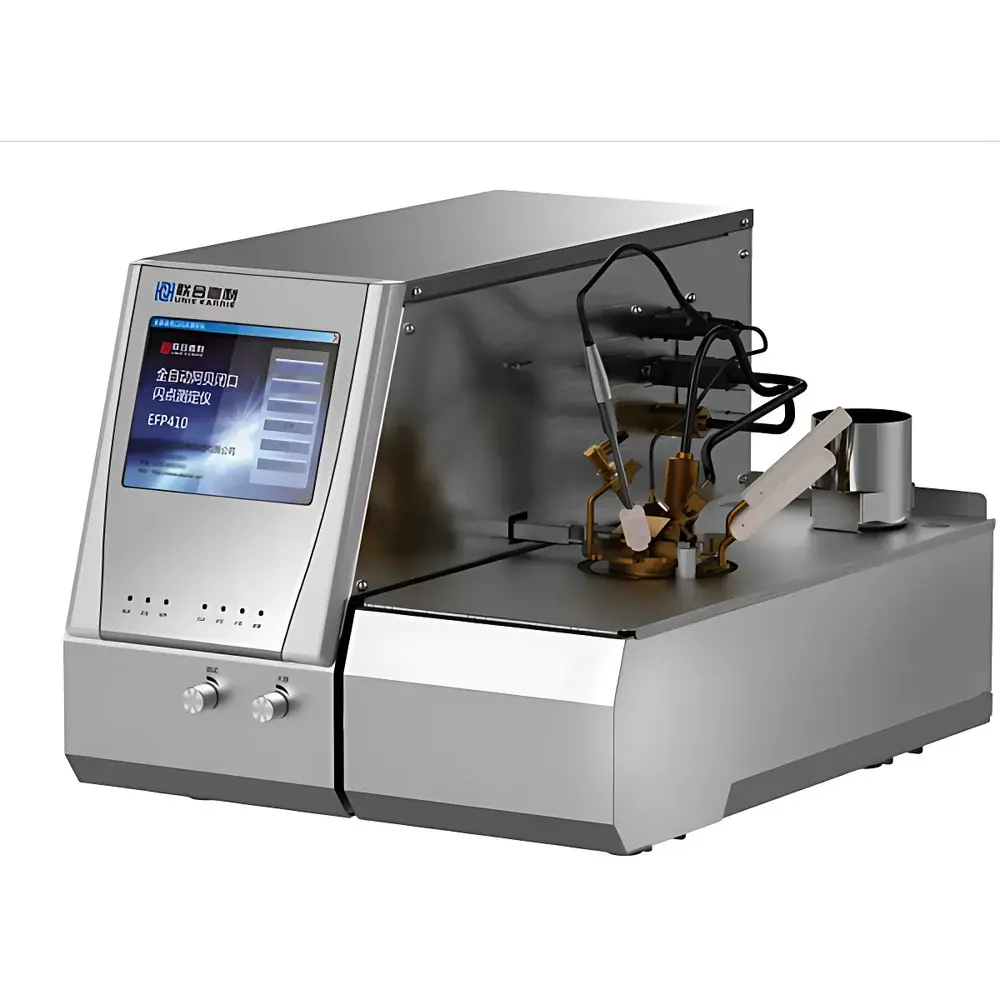
Karrie EFP510 Automated Tag Closed-Cup Flash Point Tester
| Brand | Karrie |
|---|---|
| Model | EFP510 |
| Detection Method | Closed-Cup (Tag Method) |
| Operation Mode | Fully Automatic |
| Temperature Range | –30 °C to 100 °C |
| Temperature Sensor | PT100 Platinum Resistance Thermometer |
| Heating Rate | 1 °C/min or 3 °C/min (compliant with ASTM D56 and GB/T 21929) |
| Ignition Source | Electronic Spark or Gas Flame |
| Display | 6.4″ TFT LCD (24-bit true color, touchscreen) |
| Power Supply | AC 220 V ±10%, 50 Hz |
| Ambient Operating Conditions | 10–40 °C, ≤80% RH |
| Weight | 25 kg |
| Compliance | GB/T 21929, ASTM D56, ISO 2719, IP 170 |
Overview
The Karrie EFP510 Automated Tag Closed-Cup Flash Point Tester is a precision-engineered instrument designed for the accurate and repeatable determination of flash point in petroleum products, solvents, biodiesel blends, and other volatile liquid substances within the range of –30 °C to 100 °C. It operates strictly in accordance with the Tag closed-cup method—standardized under GB/T 21929, ASTM D56, ISO 2719, and IP 170—ensuring regulatory alignment for quality control laboratories in refineries, petrochemical plants, third-party testing facilities, and R&D centers. The instrument employs a controlled heating protocol (1 °C/min or 3 °C/min), real-time temperature monitoring via a calibrated PT100 sensor, and dual ignition options (electronic spark or gas flame), all synchronized to detect the lowest temperature at which vapors above the sample ignite momentarily when exposed to an ignition source under defined atmospheric conditions. Its closed-cup configuration minimizes vapor loss and enhances measurement reproducibility—critical for safety classification (e.g., UN GHS Category 1–4), transportation compliance (IMDG Code, ADR), and formulation validation.
Key Features
- Dual-control architecture: A rugged industrial PC (256 MB RAM, 4 GB SSD, Windows 10 IoT) manages system coordination, data logging, and UI rendering, while a dedicated microcontroller handles real-time thermal regulation, sensor acquisition, and actuator sequencing—ensuring deterministic response and metrological stability.
- True-color 6.4″ TFT touchscreen interface with intuitive English-language software; supports on-device parameter configuration, real-time curve plotting (temperature vs. time), and dynamic rate verification per ASTM D56 §7.2.2.
- Modular mechanical design: Separately replaceable cup assembly (brass with gold-plated finish), flash sensor module, and PT100 probe enable field-level maintenance without recalibration—reducing downtime and lifecycle cost.
- Comprehensive self-diagnostic suite: On power-up, the system verifies flash sensor continuity, PT100 resistance baseline, electronic igniter output voltage, thermal fuse integrity, stirrer motor function, and heater/cooler actuation—reporting anomalies via audible alarm and on-screen fault code (e.g., “Igniter Open Circuit — Check Connection”).
- Triple-layer thermal safety: Programmable pre-alarm threshold (user-definable), hard-stop cutoff at user-set safety limit (≤400 °C absolute), and forced-air cooling activation upon over-temperature event—fully compliant with IEC 61010-1 safety requirements for laboratory equipment.
- Multi-protocol connectivity: RS-232, USB 2.0, and RJ-45 Ethernet ports support direct integration into LIMS environments, local network data aggregation, remote firmware updates, and direct printing via USB-connected laser printers.
Sample Compatibility & Compliance
The EFP510 accommodates standard Tag test cups (54 mL capacity) and accepts samples ranging from light naphthas and aviation turbine fuels to heavy distillates and bio-based solvents—provided viscosity remains below 15 mm²/s at 40 °C. All test procedures adhere to mandatory calibration traceability requirements under ISO/IEC 17025:2017. Instrument validation includes documented as-found/as-left checks against NIST-traceable reference standards (e.g., hexadecane, heptane, and cyclohexane mixtures). Data audit trails meet FDA 21 CFR Part 11 criteria when operated with enabled electronic signature and user-access controls. Environmental operation is certified for ambient temperatures between 10 °C and 40 °C, relative humidity ≤80% non-condensing—suitable for ISO Class 8 cleanroom-adjacent QC labs.
Software & Data Management
Embedded firmware provides full GLP-compliant data handling: each test record stores timestamp, operator ID, sample ID, atmospheric pressure (with automatic correction), observed flash point, heating rate, ignition mode, and raw temperature/time arrays. Over 10,000 test results are retained locally with SQL-based indexing—searchable by date range, sample batch, operator, or custom metadata tags. Export formats include CSV, PDF (print-ready reports), and XML for LIMS ingestion. Optional network deployment enables centralized database synchronization and role-based access control (RBAC) for QA supervisors and lab technicians—supporting internal audit readiness and external accreditation reviews (CNAS, UKAS, A2LA).
Applications
- Refinery QC: Verification of gasoline, kerosene, and diesel flash points prior to blending or shipment.
- Aviation fuel certification: Routine testing of Jet A-1 and JP-8 per ASTM D1655 Annex A2.
- Chemical manufacturing: Safety data sheet (SDS) generation for organic solvents (e.g., acetone, toluene, MEK).
- Biofuel development: Flash point assessment of FAME (biodiesel) and hydrotreated vegetable oils (HVO).
- Regulatory submission: Generation of compliant test evidence for EPA, ECHA REACH dossiers, and transport authorities (DOT, ECE).
FAQ
Does the EFP510 comply with ASTM D56 and ISO 2719?
Yes—the instrument implements the exact heating profile, cup geometry, and ignition timing specified in both standards, and includes built-in verification routines for method adherence.
Can test data be exported to LIMS without manual re-entry?
Yes—via RS-232 or Ethernet using ASTM WK50287-compliant ASCII messaging or configurable TCP/IP socket protocols.
Is calibration traceable to national standards?
All factory calibrations use NIST-traceable reference materials; certificate of calibration includes uncertainty budget per ISO/IEC 17025.
What maintenance is required for long-term accuracy?
Annual verification of PT100 linearity and flash sensor sensitivity is recommended; cup cleaning with solvent and visual inspection of gold plating integrity should occur after every 50 tests.
Can the instrument operate unattended overnight?
Yes—scheduled start times, auto-shutdown after completion, and thermal fail-safes permit unmonitored operation within validated environmental limits.





