
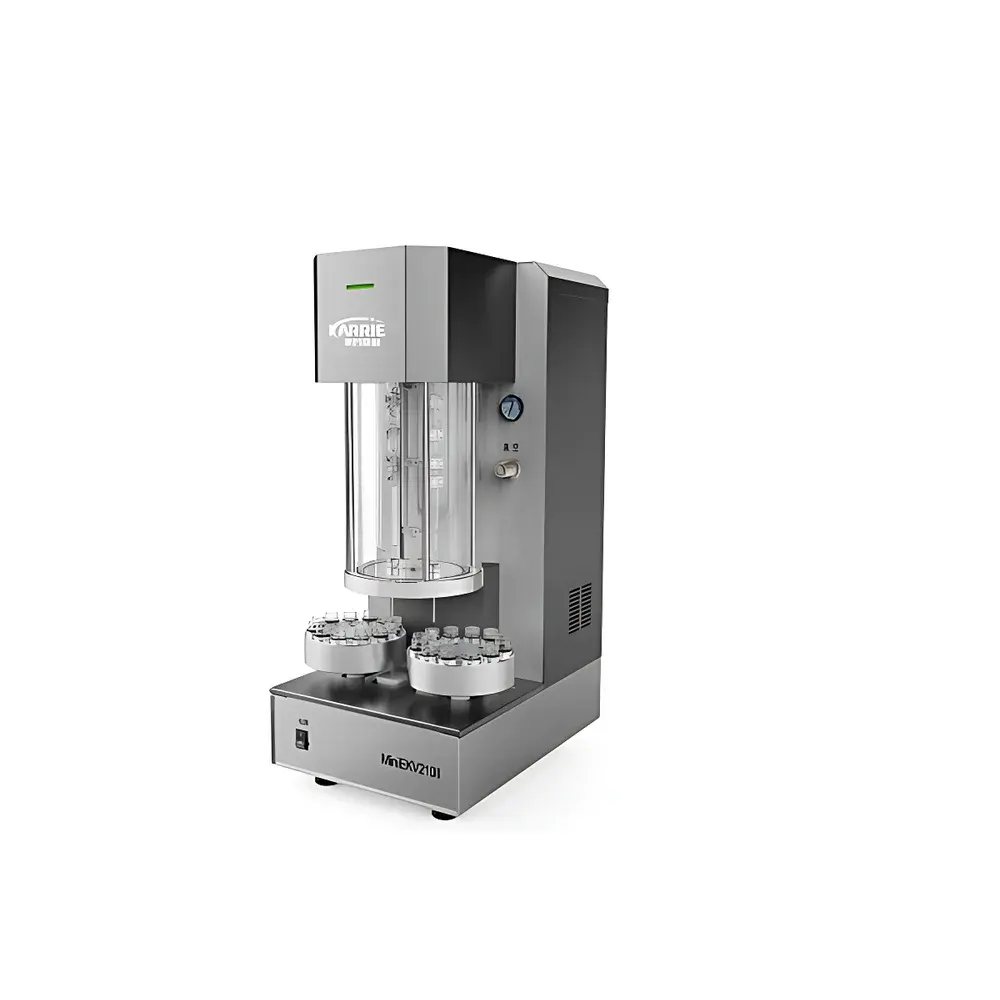
Karrie MINI EKV210II Kinematic Viscosity Tester
| Brand | Karrie |
|---|---|
| Model | MINI EKV210II |
| Standards Compliance | ASTM D445, ISO 3104, GB/T 265 |
| Sample Capacity | 2 × 12 positions |
| Temperature Range | 20–100 °C |
| Temperature Stability | ±0.01 °C |
| Temperature Resolution | 0.01 °C |
| Detection Method | Photocell or thermistor timing (±0.01 s) |
| Bath Medium | 10# methyl silicone oil |
| Cooling Medium | Anhydrous ethanol |
| Temperature Sensor | PT100 |
| Power Supply | AC 220 V, 50 Hz |
| Total Power Consumption | 1500 W |
| Dimensions (W×D×H) | 500 × 360 × 800 mm |
| Weight | 20 kg |
| Viscosity Tube Configuration | Dual capillary viscometers, each with triple-bulb design (100× measurement range per tube) |
| Calibration | Pre-calibrated with NIST-traceable kinematic viscosity reference oils (Cannon–Fenske type), user-reconfigurable via software |
| Interface Options | RS-232, USB, RJ-45 Ethernet |
| Operating System | Windows 7 (multilingual UI support: English, Chinese, Russian) |
| LIMS Integration | Supported via ASTM E1384 / ASTM E2500-compliant data export and HL7/CSV protocols |
| Data Security | Audit trail enabled |
Overview
The Karrie MINI EKV210II Kinematic Viscosity Tester is a fully automated, dual-station capillary viscometer engineered for precise, repeatable determination of kinematic viscosity in petroleum-based liquids—including crude oil, distillates, lubricants, fuel additives, and residual fuels—per ASTM D445, ISO 3104, and GB/T 265. It operates on the fundamental principle of gravity-driven laminar flow through calibrated glass capillary tubes, where kinematic viscosity (ν, in mm²/s or cSt) is calculated from the efflux time (t) and tube-specific calibration constant (C): ν = C × t. The instrument integrates a high-stability thermostatic bath (20–100 °C), dual 12-position autosamplers, and dual Cannon–Fenske-type viscometers—each featuring a triple-bulb configuration enabling a 100-fold dynamic viscosity range without manual tube swapping. Its architecture eliminates operator-dependent timing errors and thermal drift, delivering traceable, GLP-compliant results suitable for QC release testing, refinery process monitoring, and regulatory submissions.
Key Features
- Fully automated workflow: auto-sampling, capillary filling, efflux timing, solvent rinse, and nitrogen purge—no manual intervention required after sample loading.
- Dual independent viscometer stations with pre-calibrated, NIST-traceable capillary tubes (0.8 mm and 1.25 mm nominal bore); each tube certified using Cannon-certified reference oils.
- High-precision temperature control: ±0.01 °C stability over 20–100 °C range, achieved via PID-regulated immersion heater and PT100 feedback sensor immersed directly in 10# methyl silicone oil bath medium.
- Redundant detection options: photocell-based optical timing or thermistor-based thermal transition detection—both achieving 0.01 s temporal resolution.
- Integrated cooling system using anhydrous ethanol as secondary coolant for rapid bath temperature ramp-down between high- and low-temperature tests.
- ARM microcontroller + Windows 7 host architecture ensures deterministic real-time timing, robust I/O management, and secure local data storage (≥10,000 test records).
- Comprehensive self-diagnostic suite: automatic leak detection, bath level monitoring, capillary blockage alert, and calibration drift warning with configurable thresholds.
Sample Compatibility & Compliance
The MINI EKV210II accepts transparent and opaque liquid petroleum products—including base oils, aviation turbine fuels (Jet A-1, JP-8), marine distillates (DMA, DMZ), heavy fuel oils (HFO), and additive packages—without requiring pre-filtration or dilution. Its dual-capillary design accommodates kinematic viscosity ranges from 0.2 to 25,000 mm²/s (cSt) across standard test temperatures (e.g., 40 °C and 100 °C). All hardware and firmware comply with electromagnetic compatibility (EMC) requirements per IEC 61326-1 and safety standards per IEC 61010-1. For regulated laboratories, the system supports audit-trail-enabling configurations aligned with FDA 21 CFR Part 11, EU Annex 11, and ISO/IEC 17025 documentation requirements when deployed with appropriate validation protocols and role-based access controls.
Software & Data Management
The embedded Windows 7 application provides a multilingual GUI (English, Chinese, Russian) with intuitive test setup, real-time bath temperature visualization, and live efflux timing display. Data export conforms to ASTM E1384 (Standard Practice for Laboratory Information Management Systems) and supports CSV, XML, and PDF report generation. Raw timing data, calibration coefficients, environmental logs (bath temp, ambient humidity), and user action timestamps are stored with cryptographic integrity. RS-232, USB, and RJ-45 interfaces enable seamless integration into existing LIMS or MES platforms; optional OPC UA gateway modules support Industry 4.0-ready data federation. Software updates are delivered via signed firmware packages with SHA-256 verification.
Applications
- Refinery quality assurance: routine viscosity verification of naphtha, kerosene, diesel, and lube base stocks against specification limits (e.g., ASTM D975, D2880, D445).
- Lubricant formulation R&D: monitoring shear-thinning behavior and thermal stability across multi-temperature profiles.
- Fuel certification labs: compliance testing for aviation fuels per ASTM D1655 and marine fuels per ISO 8217.
- Third-party testing facilities: accredited kinematic viscosity measurements under ISO/IEC 17025 scope, including uncertainty budgeting per GUM (JCGM 100).
- Contract manufacturing: batch release testing with full electronic record retention for FDA, EPA, or CNCA audits.
FAQ
What standards does the MINI EKV210II officially support?
ASTM D445, ISO 3104, and GB/T 265 are hard-coded into the test method library; additional custom methods may be defined via editable protocol templates.
Can the instrument operate unattended overnight?
Yes—its 24-sample capacity, automated cleaning cycle, and thermal recovery algorithm enable continuous 24/7 operation with minimal supervision.
Is calibration traceable to national metrology institutes?
Each viscometer is factory-calibrated using Cannon-certified reference oils with NIST-traceable certificates; users may perform in-house recalibration using their own certified standards.
How is data integrity ensured during power interruption?
The ARM controller maintains volatile timing registers via supercapacitor backup; all completed test records are written to non-volatile flash memory before power loss.
Does the system meet cybersecurity requirements for network-connected lab instruments?
When configured with static IP, disabled unused services, and enterprise-grade authentication, it satisfies IEC 62443-3-3 SL2 baseline requirements for laboratory network endpoints.






