
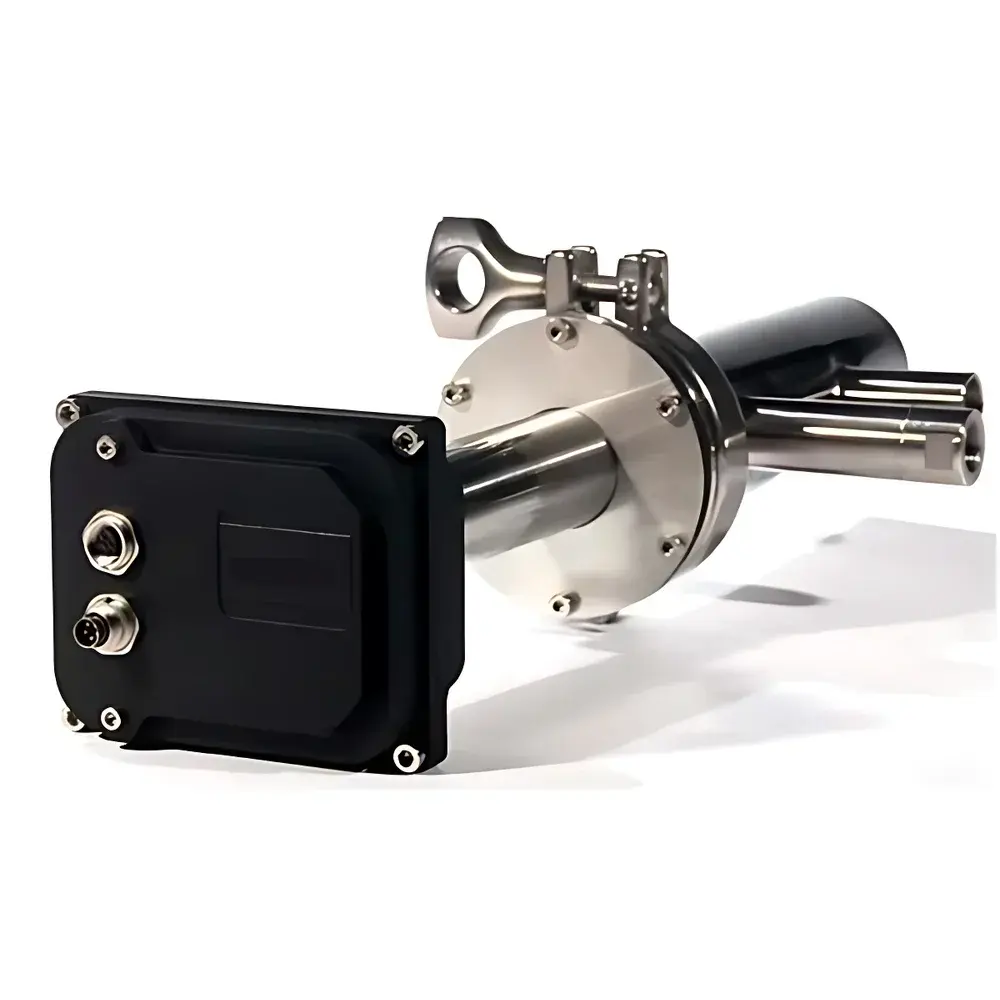
PPS Portable Particulate Sensor by TCT
| [Origin | Finland |
|---|---|
| Manufacturer Type | Authorized Distributor |
| Origin Category | Imported |
| Model | PPS |
| Instrument Type | Portable |
| Measurement Principle | Electrospray Ionization + Charged Particle Detection |
| Max. Permissible Error | ±1% FS |
| Zero Drift | ±1% FS/24h |
| Span Drift | ±1% FS/24h |
| Repeatability | ±1% FS] |
Overview
The PPS Portable Particulate Sensor by TCT is an advanced, field-deployable instrument engineered for real-time, quantitative measurement of airborne particulate matter (PM) mass and number concentration across demanding industrial and environmental applications. Unlike optical or beta-attenuation-based systems, the PPS employs a proprietary electrospray ionization and charged-particle detection principle—enabling direct, undiluted sampling of raw exhaust and process streams without conditioning, dilution, or filter collection. This methodology ensures high-fidelity response to ultrafine particles (UFPs) down to several nanometers in diameter, making the PPS uniquely suited for regulatory-compliant PM0.1, PM2.5, and nucleation-mode monitoring under dynamic thermal and pressure conditions.
Key Features
- Real-time, continuous operation with 100 Hz data acquisition capability for transient emission profiling (e.g., WLTC, RDE cycles)
- Detection range spanning 3–23 nm (adjustable via corona voltage) up to 2.5 µm—covering nucleation, Aitken, and accumulation modes
- Immunity to sampling flow rate, pressure (1–10 bar abs), and temperature fluctuations (sample gas: −20 °C to +800 °C with high-temp variant)
- Direct-inlet architecture eliminates need for dilution tunnels, impactors, or thermal denuders—reducing system complexity and calibration drift
- Stainless-steel robust housing rated for harsh industrial environments; IP65-rated electronics compartment
- Simultaneous output of mass concentration (µg/m³) and particle number concentration (cm⁻³) with traceable calculation algorithms
- Plug-and-play integration via USB 2.0; optional 4–20 mA or 0–10 V analog outputs for SCADA and PLC interfacing
- Response time ≤300 ms (dependent on sample line length), enabling closed-loop control and rapid diagnostic feedback
Sample Compatibility & Compliance
The PPS is validated for use with untreated, hot, humid, and chemically aggressive gas matrices—including diesel and gasoline exhaust, biomass combustion flue gas, cement kiln emissions, and semiconductor process effluents. Its design complies with core requirements of ISO 29463-3 (high-efficiency filter testing), EN 16454 (portable PM monitors for ambient air), and supports method development aligned with EPA Method 202 (condensable particulate matter) and EU 2017/1151 Annex VI (RDE particle number measurement). While not a certified reference method per ISO 12103-1 or ISO 20623, the PPS serves as a performance-verified screening and engineering-grade monitor suitable for GLP-aligned QA/QC protocols and pre-compliance verification prior to certification testing.
Software & Data Management
The included PSS Data Acquisition Software (v3.2+) provides real-time visualization, configurable averaging intervals (100 ms to 60 s), and automated export to CSV, HDF5, or SQL-compatible formats. The software implements NIST-traceable calibration curves and supports multi-sensor synchronization for spatial mapping networks. Audit trails, user access levels, and electronic signature functionality align with FDA 21 CFR Part 11 requirements when deployed in regulated manufacturing or research settings. Firmware updates are delivered over USB with SHA-256 integrity verification; no internet connection required during field operation.
Applications
- Automotive Emission Testing: Engine dynamometer validation, on-road RDE compliance monitoring, OBD-II correlation studies, DPF and GPF filtration efficiency quantification
- Industrial Stack Monitoring: Continuous emission monitoring (CEM) of kilns, incinerators, and metal smelters where traditional gravimetric methods lack temporal resolution
- Indoor Air Quality (IAQ) & Occupational Health: Real-time exposure assessment in cleanrooms, welding fume zones, pharmaceutical production suites, and HVAC ductwork
- Research & Development: Nanoparticle synthesis characterization, aerosol reactor optimization, and combustion chemistry kinetics studies requiring sub-second particle dynamics resolution
- Urban Sensor Networks: High-density deployment for hyperlocal PM hotspot identification, traffic emission modeling, and policy impact evaluation
FAQ
What is the minimum detectable particle size under standard operating conditions?
The PPS detects particles from ~3 nm upward, with lower-size cutoff adjustable between 3–23 nm depending on applied corona voltage and gas matrix conductivity.
Can the sensor operate continuously at 600 °C sample gas temperature?
Yes—the high-temperature variant (PPS-HT) is rated for continuous operation up to 800 °C; standard units support up to 200 °C.
Is dilution required for diesel exhaust applications?
No. The PPS is designed for direct, undiluted sampling of raw exhaust, eliminating dilution-related artifacts and calibration uncertainty.
How is calibration traceability maintained?
Calibration is performed using NIST-traceable polystyrene latex (PSL) nanoparticles and certified PM2.5 reference aerosols; certificates include uncertainty budgets per ISO/IEC 17025.
Does the system meet any regulatory approval for roadside enforcement use?
The PPS is not type-approved as a legal metrology device under MID or EPA equivalency programs; it is intended for engineering, R&D, and pre-certification monitoring.
Related Products







