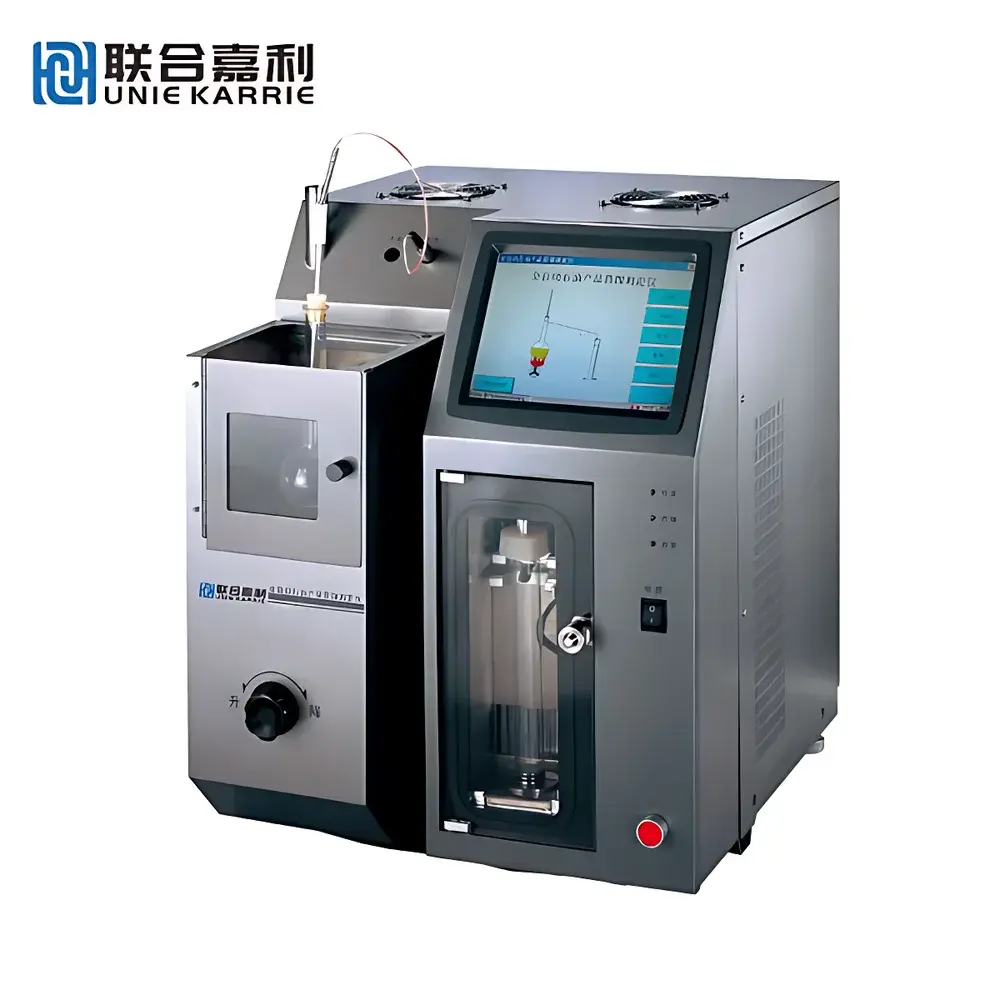
Karrie EDS110 Fully Automated Petroleum Distillation Apparatus Compliant with ASTM D86, ASTM D850, GB/T 6536, and ISO 3405
| Brand | Karrie |
|---|---|
| Model | EDS110 |
| Origin | Guangdong, China |
| Compliance | ASTM D86, ASTM D850, GB/T 6536, GB/T 7534, ISO 3405 |
| Temperature Range | Ambient to 370 °C |
| Temperature Accuracy | ±0.1 °C |
| Volume Measurement Resolution | 0.1 mL |
| Liquid Level Tracking Speed | Up to 12 mL/min |
| Cold Bath & Recovery Chamber Temperature Control | 0–60 °C (Peltier-based) |
| Display | 10.4″ TFT LCD, 640×480 pixels |
| Power Supply | AC 220 V, 50 Hz |
| Total Power Consumption | 2500 W |
| Heating Power | 1000 W |
| Operating Temperature | 0–40 °C |
| Storage Temperature | −20–50 °C |
| Max. Safety Temperature | 400 °C |
| Dimensions (L×W×H) | 565×515×660 mm |
| Weight | 55 kg |
Overview
The Karrie EDS110 Fully Automated Petroleum Distillation Apparatus is an engineered solution for standardized distillation analysis of volatile petroleum fractions in accordance with internationally recognized test methods—including ASTM D86 (Standard Test Method for Distillation of Petroleum Products at Atmospheric Pressure), ASTM D850 (Standard Test Method for Distillation of Industrial Aromatic Hydrocarbons), GB/T 6536 (Chinese national standard equivalent to ASTM D86), GB/T 7534, and ISO 3405. It implements a controlled atmospheric-pressure batch distillation process, where sample vaporization, condensation, and volumetric recovery are continuously monitored and regulated in real time. The system integrates precise temperature sensing (PT100 four-wire configuration), dynamic liquid-level tracking via industrial-grade infrared optical sensors, and Peltier-based thermal management for both cold bath and recovery chamber—eliminating refrigerants and enabling bidirectional (cooling/heating) temperature control within ±0.1 °C accuracy. Designed for routine QC/QA laboratories in refineries, fuel testing centers, and petrochemical R&D facilities, the EDS110 delivers repeatable, auditable, and method-compliant distillation curves without manual intervention after initial sample loading.
Key Features
- Dual-architecture control system: A dedicated microcontroller handles real-time distillation dynamics (heating ramp, vapor temperature acquisition, level detection), while a rugged industrial PC (256 MB RAM, 4 GB flash storage, Windows CE 5.0 OS) manages user interface, data logging, and system diagnostics—ensuring deterministic response and long-term stability.
- True-color 10.4″ touchscreen interface with optional keyboard/mouse support; intuitive Chinese/English bilingual software with full graphical distillation curve visualization during test execution.
- Peltier-cooled cold bath and recovery chamber (0–60 °C programmable), offering rapid thermal response, zero ozone-depleting substances, and energy-efficient bidirectional temperature regulation—superior to compressor-based systems requiring auxiliary heaters for setpoint stabilization.
- Comprehensive calibration suite: Steam temperature, ambient pressure, cylinder volume, cold bath, and recovery chamber temperature corrections are all configurable and traceable—supporting method-specific adjustments per ASTM D86 Annex A1 or GB/T 6536 Clause 9.
- Flexible distillation program editor: Supports up to 16 standard volume–temperature endpoints (IBP, EP, 10–90% recovered, FBP/dry point) plus 15 user-defined points—each selectable as either “volume-triggered temperature readout” or “temperature-triggered volume capture.” Stop conditions (e.g., max volume or max temperature) can be preconfigured to terminate partial-range tests.
- Automated self-diagnostic startup sequence: Validates steam, heating zone, cold bath, and recovery chamber PT100 sensors; verifies fan operation, optical level sensor actuation, and mechanical positioning integrity. Real-time fault alerts (e.g., “Recovery chamber door open,” “No volume change for >120 s”) halt testing and log error codes with timestamps.
Sample Compatibility & Compliance
The EDS110 is validated for distillation analysis of light to mid-boiling petroleum products including but not limited to: stabilized natural gasoline (light hydrocarbons), automotive gasoline, aviation gasoline, jet fuels (Jet A, Jet A-1), naphthas, petroleum solvents, kerosene, diesel fuels (EN 590, ASTM D975), gas oil fractions, and related hydrocarbon mixtures. All operational parameters—including heating rate profiles, condenser cooling gradients, and volume collection timing—are aligned with the procedural constraints defined in ASTM D86 Section 7 and GB/T 6536 Clause 6. The instrument’s architecture supports GLP-compliant data integrity: audit trails record operator ID, test start/stop times, calibration events, and parameter modifications—all stored in non-volatile memory with tamper-resistant timestamps. Optional LIMS integration via RS-232, USB, or Ethernet (RJ-45) enables automated result export compliant with laboratory data governance policies.
Software & Data Management
The embedded Windows CE 5.0 platform hosts a purpose-built distillation application with dual-language UI (English/Chinese), fully compliant with 21 CFR Part 11 requirements when deployed with optional electronic signature modules. Test data—including raw sensor readings, corrected distillation curves, and metadata (sample ID, operator, ambient pressure, calibration offsets)—are stored in structured binary format with SHA-256 checksums. Over 10,000 test records can be retained onboard and queried by date range, sample identifier, analyst name, or method type. Export options include CSV, PDF (print-ready reports with embedded curves), and XML for LIMS ingestion. Firmware updates and data backup/restore are performed via USB mass storage mode—no external PC required. All print outputs (via integrated LPT port) include method reference, instrument ID, calibration status, and digital signature fields.
Applications
- Refinery process control: Monitoring cut point consistency in atmospheric distillation units (ADUs) and hydrotreater feedstocks.
- Fuel quality assurance: Verifying volatility specifications for gasoline (RVP, distillation curve shape per ASTM D86 Class D), jet fuel (flash point correlation), and diesel (90% recovery temperature).
- Regulatory compliance testing: Generating certified distillation reports for EPA, CNPC, Sinopec, or regional fuel standards (e.g., China VI, Euro 5/6).
- Research & development: Characterizing boiling point distributions of bio-blendstocks, synthetic fuels, or cracked fractions under reproducible thermal conditions.
- Contract laboratory services: High-throughput batch testing with automated report generation and secure data archiving for third-party certification.
FAQ
Does the EDS110 comply with ASTM D86 for referee testing?
Yes—the hardware design, sensor accuracy (±0.1 °C), volumetric resolution (0.1 mL), and thermal control fidelity meet all mandatory requirements of ASTM D86 Sections 5–8 for Type I and Type II apparatus.
Can the instrument perform partial-range distillations?
Yes—users may define custom stop conditions (e.g., “halt at 90% recovered volume” or “terminate if vapor temperature exceeds 250 °C”) without modifying core firmware.
Is ambient pressure correction applied automatically during testing?
Yes—integrated barometric pressure input (manual entry or optional digital sensor) triggers real-time correction of observed temperatures per ASTM D86 Annex A1.
What maintenance is required for the Peltier cooling system?
No consumables or refrigerant recharge—only periodic cleaning of heatsink fins and verification of thermal interface paste integrity every 12 months.
How is data security ensured during network connectivity?
All Ethernet/USB communications use authenticated protocols; local storage employs encrypted file headers and write-protected audit logs—fully compatible with ISO/IEC 17025 documentation requirements.