
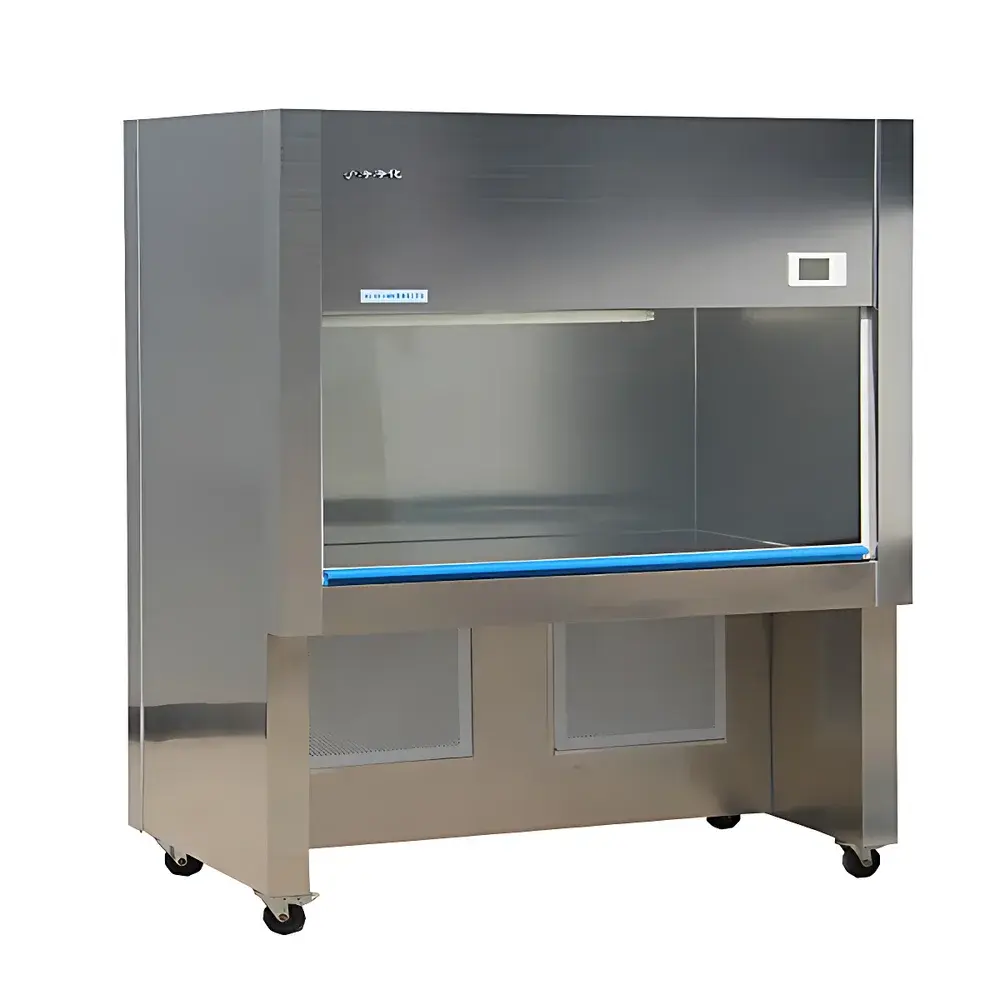
HJ VS-1300U Dual-Operator Vertical Laminar Flow Clean Bench
| Brand | HJ Purification |
|---|---|
| Origin | Shanghai, China |
| Manufacturer Type | Direct Manufacturer |
| Product Category | Domestic |
| Model | VS-1300U |
| Instrument Type | Vertical Laminar Flow Clean Bench |
| Cleanliness Class | ISO Class 5 (equivalent to Fed. Std. 209E Class 100 @ ≥0.5 µm) |
| Noise Level | ≤62 dB(A) |
| Operator Capacity | 2 persons |
| Airflow Pattern | Vertical Downflow |
| Pre-filter Material | Aluminum Alloy |
| HEPA Filter | Ultra-thin, Bagless, 1135×600×38 mm (1 unit) |
| Average Air Velocity | 0.25–0.45 m/s |
| Microbial Contamination | ≤0.5 CFU/plate·hour (90 mm Petri dish) |
| Vibration Amplitude | ≤5 µm (peak-to-peak, XYZ axes) |
| Illuminance | ≥300 lx |
| Power Supply | AC 220 V, 50 Hz |
| Max. Power Consumption | 800 W |
| Net Weight | 150 kg |
| Work Area Dimensions (W×D×H) | 1140×615×580 mm |
| Overall Dimensions (W×D×H) | 1290×765×1765 mm |
| Lighting | 30 W Fluorescent Lamp ×1 |
| UV Lamp | 30 W ×1 |
| Control Interface | LCD Touch Switch Panel |
| Pre-filter | Washable Aluminum Mesh |
| Surface Material | Aluminum-Plastic Composite Work Surface |
| Side Panels | Tempered Glass |
Overview
The HJ VS-1300U Dual-Operator Vertical Laminar Flow Clean Bench is an ISO Class 5-certified (Fed. Std. 209E Class 100) laminar airflow workstation engineered for consistent particulate control in non-sterile but contamination-sensitive laboratory operations. It employs a unidirectional vertical downflow of air—filtered through a single ultra-thin, bagless high-efficiency particulate air (HEPA) filter—to establish a continuous, low-turbulence protective curtain over the work surface. Unlike biological safety cabinets, this clean bench does not recirculate air nor provide personnel or environmental protection; it is purpose-built for product protection only. Its design adheres to fundamental principles of laminar flow physics, ensuring uniform velocity distribution (0.25–0.45 m/s) across the entire 1140 mm wide work area, minimizing eddy formation and particle resuspension. The system meets the microbial performance benchmark of ≤0.5 colony-forming units per 90 mm Petri dish per hour under standard ISO 14644-1 test conditions, validating its suitability for applications requiring controlled ambient cleanliness—such as electronics assembly, precision optics handling, pharmaceutical formulation support, and non-invasive cell culture preparation.
Key Features
- Ultra-compact static pressure chamber enabled by a proprietary ultra-thin, frameless HEPA filter (1135 × 600 × 38 mm), reducing internal volume while maintaining ≥99.995% filtration efficiency at 0.3 µm (tested per EN 1822-1).
- Aluminum-plastic composite work surface offering chemical resistance, non-porosity, and electrostatic dissipation—compatible with routine ethanol and isopropanol decontamination protocols.
- Tempered glass side panels (full-height, fixed) and front sash provide optical clarity and physical containment without compromising ergonomics or spatial perception.
- Digitally regulated variable-speed centrifugal blower system with real-time LCD interface, enabling precise airflow setpoint adjustment and continuous operational feedback.
- Dual independent lighting systems: a 30 W daylight-balanced fluorescent lamp (≥300 lx at work surface, per ISO 8596) and a 30 W germicidal UV-C lamp (254 nm) with interlocked safety cutoff when sash is raised above 150 mm.
- Integrated vibration-damping base structure limiting mechanical transmission to ≤5 µm peak-to-peak displacement across orthogonal axes—critical for micro-manipulation and optical alignment tasks.
Sample Compatibility & Compliance
The VS-1300U supports open-container processing of non-hazardous, non-volatile samples including semiconductor wafers, optical lenses, sterile media bottles, lyophilized vials, and non-pathogenic cell cultures. It is not rated for use with volatile organic solvents, radioactive isotopes, or biohazards requiring biosafety containment (BSL-2 or higher). Compliance documentation includes conformity with GB/T 16292–2010 (Chinese national standard for clean bench testing), ISO 14644-1:2015 (airborne particle classification), and IEC 61000-3-2 (harmonic current emissions). While not FDA 21 CFR Part 11–validated out-of-the-box, its digital control log can be integrated into GLP/GMP-compliant environments via external audit trail software when paired with time-stamped operator login protocols.
Software & Data Management
This clean bench operates via embedded firmware with no external PC dependency. The LCD control panel records runtime hours, UV exposure duration, and manual airflow adjustments—data retained for ≥12 months in non-volatile memory. Optional RS-485 Modbus RTU output enables integration into centralized facility monitoring systems (e.g., LabVantage, Siemens Desigo) for HVAC synchronization and preventive maintenance scheduling. No cloud connectivity or proprietary software installation is required; all configuration parameters remain accessible via physical keypad navigation with password-protected admin mode.
Applications
- Electronics: PCB soldering pre-assembly inspection, MEMS device packaging, and laser diode alignment under low-particulate conditions.
- Pharmaceuticals: Aseptic transfer of excipients, tablet coating station support, and analytical reference standard weighing (non-sterile).
- Academic Research: Plant tissue culture initiation, zebrafish embryo microinjection setup, and nanoparticle synthesis under inert gas purging (when used inside nitrogen gloveboxes).
- Quality Control Labs: Visual inspection of optical filters, calibration of photometric standards, and gravimetric analysis of high-purity reagents.
- Medical Device Manufacturing: Final assembly of implant-grade sensors, packaging line validation sampling, and sterility test media pour preparation (prior to autoclaving).
FAQ
Does the VS-1300U meet ISO Class 5 requirements for particle concentration?
Yes—it achieves ≤3,520 particles/m³ ≥0.5 µm under steady-state operation, verified per ISO 14644-1:2015 Annex B using calibrated airborne particle counters.
Can the HEPA filter be replaced in-house without specialized tools?
Yes—the top-mounted filter access panel uses quarter-turn cam locks; replacement requires only a torque-limited screwdriver and post-installation integrity testing (e.g., PAO scan per EN 1822-5).
Is UV irradiation validated for surface decontamination efficacy?
UV dose delivery (1.5 mJ/cm² at 254 nm, measured at 150 mm distance) complies with ISO 15714 for non-porous surfaces; however, shadowed areas and organic residue require supplemental wipe disinfection.
What electrical safety certifications does the unit carry?
It bears CCC (China Compulsory Certification) and conforms to GB 4793.1–2019 (equivalent to IEC 61010-1) for laboratory electrical equipment safety.
How often should the pre-filter be cleaned, and what is the recommended method?
The washable aluminum mesh pre-filter should be inspected weekly and cleaned with neutral detergent and compressed air every 2–4 weeks, depending on ambient dust load—documented in the maintenance log per GLP Annex 11 guidelines.



