
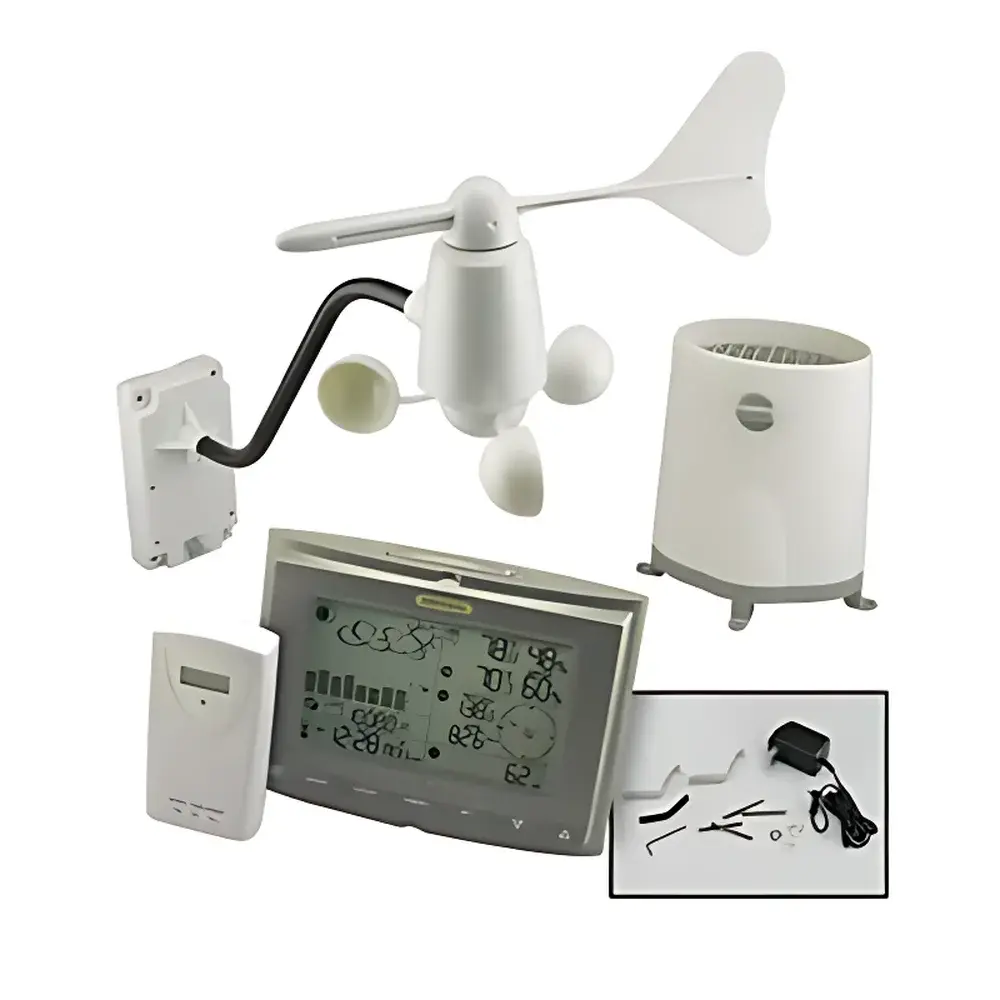
Cole-Parmer 23003 Professional Wireless Weather Station
| Brand | Cole-Parmer |
|---|---|
| Origin | USA |
| Manufacturer Type | Authorized Distributor |
| Origin Category | Imported |
| Model | 23003 |
| Pricing | Available Upon Request |
| Display | LED-backlit with ambient light sensor |
| RF Frequency | 433 MHz |
| Transmission Range | 30–100 m (free-field) |
| Power | AC/DC adapter (included) or 4 × AA batteries (display station) |
| Dimensions (Display Station) | 18.7 × 13.7 × 3.2 cm |
| Dimensions (Remote Temp/RH Sensor) | 6.0 × 10.2 × 2.5 cm |
| Barometric History | 24-hour graphical trend |
| Data Logging Option | Model 23003-76 supports up to 200 days of timestamped environmental records |
Overview
The Cole-Parmer 23003 Professional Wireless Weather Station is a calibrated, multi-parameter environmental monitoring system engineered for laboratory, greenhouse, and controlled facility applications where precise ambient condition awareness supports operational integrity and regulatory compliance. Operating on the established principles of passive atmospheric sensing—using thermistor-based temperature measurement, capacitive relative humidity transduction, piezoelectric rain detection, and electromagnetic anemometry—the station delivers synchronized, real-time readings across seven core meteorological parameters: indoor/outdoor temperature, relative humidity, barometric pressure, wind speed and direction, dew point, wind chill index, and accumulated rainfall. Its 433 MHz wireless architecture enables reliable telemetry from distributed sensors to the central display unit at distances up to 100 meters in open-field conditions—making it suitable for spatially extended environments such as research greenhouses, cleanroom perimeters, or outdoor lab enclosures. The device does not perform active sampling or analytical chemistry; rather, it functions as a continuous passive monitor, conforming to fundamental metrological practices for environmental parameter tracking under ISO/IEC 17025-aligned quality frameworks.
Key Features
- Simultaneous dual-location monitoring: Independent indoor and outdoor temperature/humidity acquisition via dedicated remote sensor (model 23003-RH), with automatic differential logging and threshold-triggered alerts.
- Barometric pressure tracking with 24-hour graphical history display—enabling short-term trend analysis critical for HVAC validation and atmospheric stability assessment in sensitive experimental zones.
- Programmable alarm system supporting configurable thresholds for temperature extremes, rapid pressure drops (storm onset indication), and dew point excursions—each event logged with timestamp and severity level.
- Atomic clock synchronization via WWVB signal reception ensures traceable time-stamping of all measurements, meeting GLP requirements for chronological integrity in environmental logs.
- Backlit LED display with ambient light sensor automatically adjusts brightness—ensuring legibility under low-light conditions typical in controlled-environment laboratories or nighttime monitoring scenarios.
- Modular power architecture: AC/DC adapter included for continuous operation; battery backup (4 × AA for display, 6 × AA for sensors) provides uninterrupted functionality during utility outages or mobile deployment.
Sample Compatibility & Compliance
The 23003 station is designed for non-invasive, ambient air monitoring only—no sample introduction, fluid handling, or chemical exposure is required. All sensors comply with IPX4-rated ingress protection for outdoor use and operate within standard atmospheric pressure (80–110 kPa) and temperature ranges (−20 °C to +60 °C for remote RH sensor; −10 °C to +50 °C for display unit). While not certified to IEC 61000-4 EMC standards as a standalone medical device, its RF emissions fall within FCC Part 15 Class B limits for commercial environments. For GxP-regulated facilities, the optional data-logging variant (23003-76) supports audit-trail-capable record retention when used with validated WeatherView PC software—facilitating alignment with FDA 21 CFR Part 11 expectations for electronic records when combined with appropriate organizational SOPs.
Software & Data Management
The 23003-76 configuration includes WeatherView PC software—a Windows-based application enabling long-term archival (up to 200 days), CSV export, custom graphing, and automated report generation. All logged entries contain embedded timestamps synchronized to NIST atomic time, along with sensor ID metadata and measurement units per SI convention. Software-generated files support manual verification against raw display-unit outputs, fulfilling ALCOA+ data integrity criteria (Attributable, Legible, Contemporaneous, Original, Accurate). No cloud connectivity or third-party API integration is provided; data remains local unless exported manually—reducing cybersecurity exposure in regulated lab networks.
Applications
- Environmental validation of plant growth chambers and tissue culture rooms, where diurnal RH/temperature excursions must remain within ±5% RH and ±1 °C tolerances.
- Preventive maintenance triggers in HVAC-dependent labs—e.g., correlating sustained dew point elevation with coil condensation risk or filter saturation.
- Field-deployable baseline monitoring for outdoor analytical instrument shelters, ensuring ambient conditions are documented prior to spectroscopic or chromatographic runs.
- Educational meteorology instruction, providing students with hands-on access to real-time atmospheric variables while reinforcing concepts of sensor calibration, signal drift, and environmental uncertainty propagation.
- Compliance documentation for ISO 14644-1 cleanroom classification audits, where ambient pressure differentials and temperature stability across anterooms are prerequisite evidence.
FAQ
What is the maximum recommended distance between the display station and remote sensors?
The specified free-field transmission range is 30–100 meters at 433 MHz; performance may decrease in reinforced concrete structures or high-EMI environments.
Does the barometric pressure reading require manual altitude correction?
Yes—users must input local elevation manually via the front-panel interface to convert absolute pressure to sea-level-referenced values for comparative meteorological analysis.
Can the 23003-76 data logger meet FDA 21 CFR Part 11 requirements out-of-the-box?
No—while the hardware and software support audit trails and electronic signatures, formal Part 11 compliance requires site-specific validation, administrative controls, and documented procedures per organizational quality systems.
Is the rain gauge calibrated to ASTM D1941 or ISO 9261 standards?
The tipping-bucket rain collector meets general-purpose accuracy specifications (±4% typical), but no formal certification to ASTM or ISO meteorological standards is provided by Cole-Parmer.
How frequently are sensor readings updated on the display?
Indoor/outdoor temperature and RH refresh every 10 seconds; wind speed/direction and rainfall accumulate continuously with 1-second sampling resolution; barometric pressure updates every 30 seconds.
Related Products







