
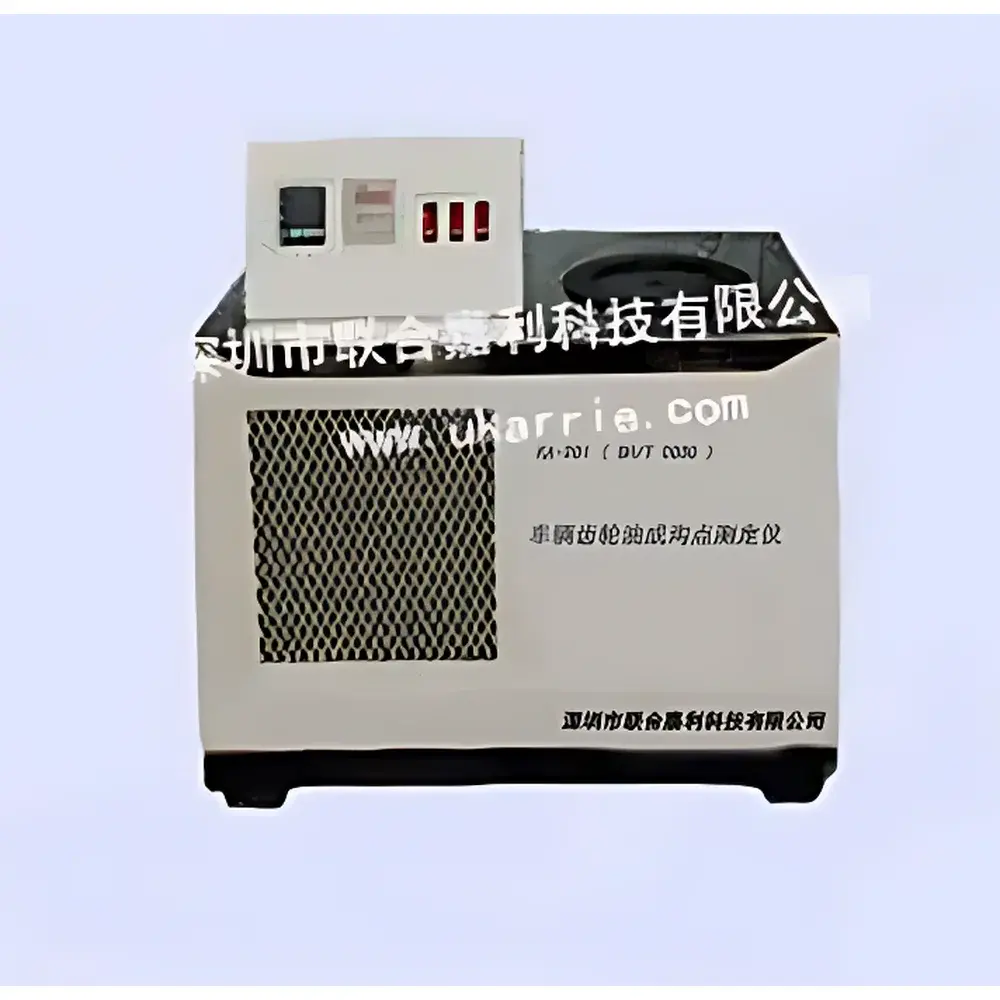
KA-201 Karrie Vehicle Gear Oil Grooving Point Tester
| Brand | Karrie |
|---|---|
| Origin | Shenzhen, China |
| Model | KA-201 |
| Applicable Standard | SH/T 0030 |
| Temperature Control Range | –70 °C ± 0.1 °C |
| Cooling Method | Dual-stage imported hermetic compressors with eco-friendly refrigerant (R507/R23 cascade system) |
| Temperature Controller | Digital PID display controller |
| Timing Function | Digital timer (0–99 min 59 s, resolution: 1 s) |
| Bath Construction | Double-walled stainless steel cold bath with integrated heat-transfer medium |
| Accessories | Dedicated steel刮刀 (grooving blade), sample container holder, and insulated handling tools |
| Compliance | Designed for ASTM D1831 (equivalent methodology), supports GLP-compliant test documentation |
Overview
The KA-201 Karrie Vehicle Gear Oil Grooving Point Tester is a precision laboratory instrument engineered to determine the grooving point — a critical low-temperature rheological property — of automotive gear oils and industrial lubricants. Based on the principle of structural recovery under controlled thermal stress, the instrument evaluates the ability of a lubricant to retain a defined groove geometry after mechanical deformation at sub-ambient temperatures. This behavior directly correlates with the oil’s capacity to maintain film integrity and prevent metal-to-metal contact during cold-start conditions in heavy-duty transmissions and differentials. The test method follows SH/T 0030 (Chinese national standard, technically aligned with ASTM D1831), wherein a standardized sample is equilibrated at a specified low temperature for 18 hours, then manually grooved with a calibrated steel blade; recovery is assessed visually within 10 seconds. Unlike pour point or cloud point measurements, the grooving point reflects microstructural stability rather than phase separation, making it indispensable for formulating synthetic and semi-synthetic gear oils used in arctic-grade applications.
Key Features
- High-stability dual-stage refrigeration system using imported hermetic compressors and R507/R23 cascade refrigerants, enabling rapid cooldown to –70 °C with minimal thermal overshoot.
- Digital PID temperature controller with ±0.1 °C accuracy across the full operating range (–70 °C to +20 °C), featuring auto-tuning capability and real-time deviation compensation.
- Double-walled stainless steel cold bath with pre-filled, high-thermal-capacity heat-transfer medium — eliminating routine coolant top-ups and minimizing evaporation-related drift.
- Integrated digital timer with second-level resolution (0–99:59 format), synchronized with temperature stabilization logic to initiate timing only after thermal equilibrium is confirmed.
- Ergonomic, all-in-one benchtop architecture with dedicated accessories: ISO-calibrated grooving blade (2.0 mm width, 0.3 mm edge radius), sample cup holder with thermal isolation grips, and non-slip base plate.
- No external cryogens or liquid nitrogen required — fully self-contained operation compliant with ISO/IEC 17025 environmental safety requirements for routine lab use.
Sample Compatibility & Compliance
The KA-201 accommodates standard 50 mL cylindrical sample containers (ASTM D1831-compliant dimensions: Ø32 mm × H60 mm). It is validated for mineral-based, PAO, and ester-blended gear oils meeting API GL-4, GL-5, and SAE J2360 specifications. The instrument’s thermal profile and mechanical reproducibility support traceable testing per SH/T 0030, with documented equivalence to ASTM D1831 Annex A1. All temperature sensors are NIST-traceable (calibration certificate optional), and the system meets electromagnetic compatibility (EMC) requirements per IEC 61326-1. For regulated environments, audit trails (via optional RS232/USB data logging) support 21 CFR Part 11-compliant electronic records when paired with validated LIMS software.
Software & Data Management
While the KA-201 operates as a stand-alone instrument, its digital interfaces (RS232 and USB-B) enable seamless integration with laboratory information management systems (LIMS) or custom QC databases. Optional Karrie DataLink™ firmware (v2.1+) provides timestamped temperature logs, stabilization duration, operator ID fields, and pass/fail flags based on user-defined recovery thresholds. All exported data conform to ASTM E1382-compliant CSV structure, including metadata headers for method version, calibration status, and ambient lab conditions. No proprietary software installation is required for basic operation; configuration and diagnostics are accessible via front-panel menu navigation with multilingual UI (English, Chinese, Russian).
Applications
- Quality control of final gear oil batches prior to dispatch, especially for OEM-supply contracts requiring low-temperature structural integrity verification.
- R&D screening of additive packages (e.g., wax inhibitors, pour point depressants, and viscosity index improvers) affecting colloidal network resilience.
- Comparative evaluation of bio-based gear oils against petroleum-derived benchmarks under identical thermal-mechanical stress protocols.
- Supporting failure analysis in field complaints related to cold-weather gear noise or synchronizer drag.
- Validation of storage stability for long-term inventory of military-spec lubricants (MIL-PRF-2105E).
FAQ
What is the difference between grooving point and pour point?
The grooving point assesses structural recovery after localized shear deformation at low temperature, while pour point measures the lowest temperature at which a fluid will flow under gravity — a bulk-flow property governed by wax crystallization. They address distinct failure modes.
Can the KA-201 be used for greases or hydraulic fluids?
No. The method and fixture geometry are specifically validated for fluid gear oils per SH/T 0030 and ASTM D1831. Greases require cone penetration or block shear tests; hydraulic fluids are evaluated via low-temperature pumpability (ASTM D2889) or MRV (ASTM D4684).
Is calibration verification required before each test?
A daily verification using a certified NIST-traceable RTD probe at –40 °C and –60 °C is recommended per ISO/IEC 17025 Clause 6.5. Full recalibration is advised every 12 months or after compressor servicing.
Does the instrument meet CE or UKCA marking requirements?
Yes — the KA-201 complies with EU Machinery Directive 2006/42/EC and EMC Directive 2014/30/EU. CE marking is affixed; UKCA documentation is available upon request for shipments to Great Britain.





