
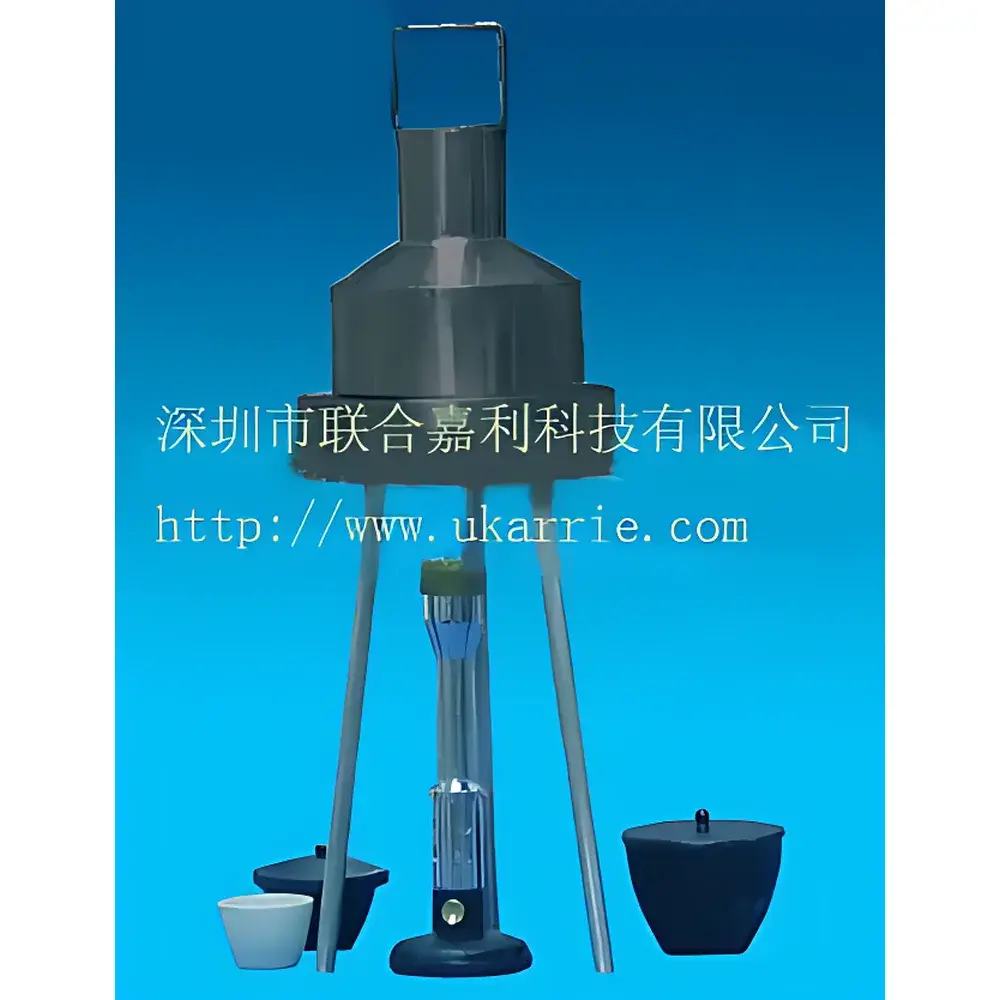
KA-118 Conradson Carbon Residue Tester (KARRIE)
| Brand | KARRIE |
|---|---|
| Origin | Shenzhen, China |
| Manufacturer Type | Authorized Distributor |
| Country of Origin | China |
| Model | KA-118 |
| Pricing | Available Upon Request |
| Standard Compliance | GB/T 268–2022 |
| Crucible Capacity | 29–31 mL (glazed porcelain) |
| Iron Shield Dimensions | Lower section Φ125 mm × 52 mm H |
| Flame Shield Dimensions | Φ160/Φ89/Φ83 mm × 34 mm H |
| Blow Lamp Orifice | Φ24 mm |
Overview
The KA-118 Conradson Carbon Residue Tester is a precision-engineered laboratory instrument designed and validated in strict accordance with GB/T 268–2022, the Chinese national standard equivalent to ASTM D189 for Conradson carbon residue (CCR) determination. It quantifies the carbonaceous residue formed after controlled evaporation and pyrolysis of petroleum products under standardized thermal conditions—providing a critical empirical indicator of coke-forming tendency during refining, combustion, or thermal stress exposure. The method relies on gravimetric analysis: a weighed sample is heated in a porcelain crucible inside a specially configured iron shield assembly, subjected to flame impingement from a calibrated blow lamp, followed by controlled cooling and weighing of the residual char. This test remains widely specified for lubricating oils, fuel oils, heavy distillates, and cracked stocks where thermal stability and deposit formation are key quality concerns.
Key Features
- Full mechanical and dimensional compliance with GB/T 268–2022 requirements—including precise geometry of the iron shield, flame shield, and crucible support structure.
- High-purity glazed porcelain crucibles (29–31 mL capacity), chemically inert and thermally stable up to 900 °C, ensuring consistent residue retention and minimal ash interference.
- Dual-layer iron crucible system (inner and outer iron crucibles) engineered to regulate heat transfer and minimize thermal gradients across the sample bed during pyrolysis.
- Optimized blow lamp with a precisely machined Φ24 mm orifice, delivering reproducible flame intensity and impingement geometry essential for method repeatability.
- Robust stainless steel construction (imported matte-finish grade) resistant to oxidation and thermal cycling degradation, supporting long-term operational integrity in routine QC labs.
- Modular, tool-free assembly design enabling rapid setup, cleaning, and verification—critical for high-throughput testing environments operating under ISO/IEC 17025 or refinery internal QA protocols.
Sample Compatibility & Compliance
The KA-118 is validated for use with liquid petroleum products including residual fuel oils (e.g., RMG 380, RMK 500), vacuum gas oils, coker feedstocks, and used lubricants. Samples must be homogeneous and free of suspended water prior to testing. The instrument satisfies all physical configuration and procedural constraints defined in GB/T 268–2022, and its methodology is technically aligned with ASTM D189, IP 14, and ISO 10370. While not an automated analyzer, its manual operation is fully compatible with GLP-compliant workflows when integrated with certified balances, calibrated thermometers, and documented SOPs. Traceability of crucible tare weights, sample masses, and final residue values supports audit readiness for regulatory submissions or internal quality audits.
Software & Data Management
The KA-118 operates as a benchtop manual test apparatus with no embedded electronics or digital interface. Data acquisition and reporting are performed externally using laboratory information management systems (LIMS) or spreadsheet-based templates compliant with ISO/IEC 17025 documentation requirements. Users are advised to record raw mass measurements (initial sample weight, tare crucible weight, post-pyrolysis residue weight), ambient barometric pressure, and lamp burn time per test cycle. For laboratories subject to FDA 21 CFR Part 11 or EU Annex 11, electronic records must include user authentication, audit trails, and version-controlled calculation sheets—functions supported via validated third-party LIMS platforms interfacing with analytical balances and environmental monitoring devices.
Applications
- Refinery process control: Monitoring CCR trends in crude assay fractions and coker feed blends to optimize furnace run length and coke drum cycle times.
- Fuel specification compliance: Verifying conformance of marine residual fuels against ISO 8217 Table 2 limits for carbon residue (max 18.0 wt% for RMK grades).
- Lubricant formulation development: Assessing base oil stability and additive package interactions under simulated high-temperature oxidative conditions.
- Used oil analysis: Diagnosing abnormal engine deposits or thermal degradation in in-service lubricants from power generation or marine diesel engines.
- Contract laboratory testing: Supporting third-party certification reports required for international trade documentation and customs clearance of petroleum cargoes.
FAQ
Is the KA-118 suitable for ASTM D189 testing?
Yes—the instrument’s geometry, crucible specifications, and heating configuration are functionally equivalent to ASTM D189 apparatus requirements, though formal ASTM validation requires concurrent use of ASTM-specified reagents and procedural adherence.
What calibration standards are recommended?
No chemical calibration standard exists for CCR; method accuracy is verified using reference materials with certified residue values (e.g., NIST SRM 1634c) and participation in interlaboratory proficiency testing programs.
Can the unit be used with alternative crucible materials?
No—GB/T 268 mandates glazed porcelain crucibles. Substitution with alumina or silicon carbide crucibles invalidates compliance and introduces systematic bias due to differing thermal emissivity and surface reactivity.
What maintenance is required for the blow lamp?
Regular inspection and cleaning of the orifice with calibrated wire drills (Φ24 mm tolerance ±0.1 mm) and periodic replacement of the brass nozzle are essential to maintain flame geometry and reproducibility.
Does the instrument include temperature monitoring capability?
No—GB/T 268 does not require real-time temperature measurement; endpoint determination is based on fixed heating duration and visual observation of flame extinction, followed by standardized cooling and weighing procedures.




