
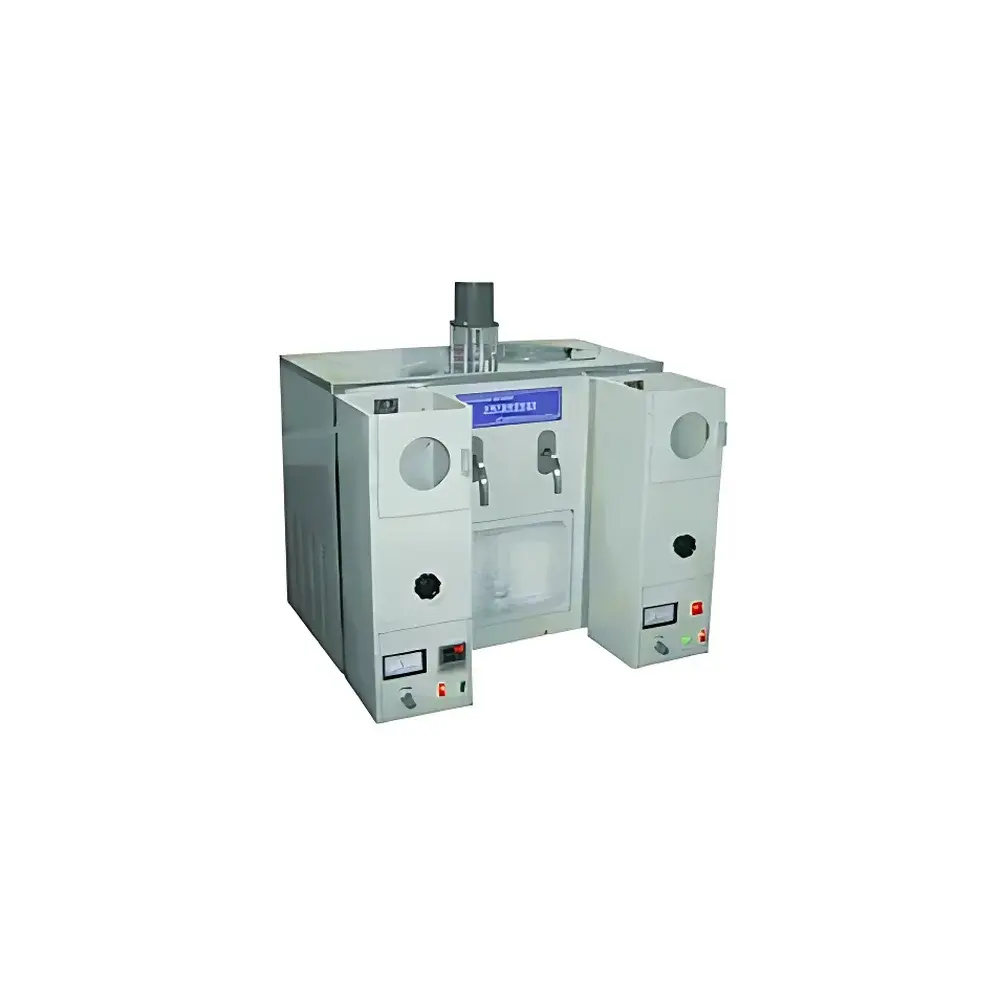
KARRIE KA-103 Petroleum Distillation Apparatus with Dual-Bend Condenser
| Brand | KARRIE |
|---|---|
| Origin | Shenzhen, China |
| Model | KA-103 |
| Standards | GB/T 6536, ASTM D86 |
| Temperature Control Range | 0–60 °C |
| Temperature Accuracy | ±0.5 °C |
| Dimensions | 572 × 486 × 507 mm |
| Weight | ~48 kg |
| Condenser Type | Dual-bend glass condenser |
| Heating Control | Solid-state voltage regulator + potentiometer |
| Cooling System | Integrated imported compressor |
| Bath Agitation | Motor-driven impeller |
| Display | Analog voltmeter + digital temperature indicator |
| Sample Types | Gasoline (motor, aviation), jet fuel, naphtha, kerosene, diesel, light distillates, and similar petroleum fractions |
Overview
The KARRIE KA-103 Petroleum Distillation Apparatus is a laboratory-grade instrument engineered for standardized atmospheric distillation testing of volatile petroleum products in accordance with GB/T 6536 and ASTM D86. It implements the classical batch distillation method—where a 100 mL sample is heated at a controlled rate while vapor temperature and recovered volume are recorded continuously—to determine key volatility characteristics including initial boiling point (IBP), 10%, 50%, 90% recovery temperatures, and final boiling point (FBP). The apparatus features a dual-bend condenser design to ensure consistent vapor path geometry, minimize reflux variability, and maintain thermal equilibrium between vapor and condensate—critical for reproducible distillation curves across repeated analyses. Its integrated refrigeration system, based on a high-efficiency imported compressor, enables precise bath temperature regulation from 0 °C to 60 °C, meeting the stringent cooling requirements specified in Clause 7.2 of ASTM D86 for Group 0–4 distillates.
Key Features
- Dual-bend glass condenser assembly—designed per ASTM D86 Figure 1 specifications to standardize vapor residence time and heat exchange surface area, reducing inter-laboratory variation in TBP (True Boiling Point) correlation.
- Motor-driven bath agitation system ensures uniform coolant distribution and eliminates thermal stratification in the condenser jacket, supporting stable temperature maintenance within ±0.5 °C across the full 0–60 °C range.
- Stepless heating control via solid-state voltage regulator and precision potentiometer delivers repeatable, low-drift power delivery to the distillation flask heater—minimizing overshoot and enabling compliance with ASTM D86 heating rate tolerances (e.g., 4–5 °C/min for Group 1 fuels).
- Digital temperature display with Pt100 sensor feedback loop provides real-time monitoring of condenser bath temperature, while analog voltmeter allows simultaneous verification of applied heating voltage—supporting operational transparency and troubleshooting.
- Robust mechanical architecture: stainless steel frame, borosilicate glassware set (including calibrated 100 mL flask, 24/40 joints, thermometer well, and dual-bend condenser), and IP54-rated electrical enclosure for lab environment durability.
Sample Compatibility & Compliance
The KA-103 is validated for use with light to mid-range petroleum distillates as defined in ASTM D86 Scope, including but not limited to: motor gasoline (unleaded and leaded), aviation gasoline (AVGAS), jet fuel (Jet A, Jet A-1), naphthas, petroleum solvents (e.g., Stoddard solvent), kerosene, diesel fuel (ASTM D975), and light cycle oils. It is not intended for heavy residues, crude oil, or vacuum-distilled fractions requiring reduced-pressure operation. All glass components conform to ASTM E200 and ISO 3585 standards for laboratory borosilicate glass. The instrument’s thermal control system satisfies the calibration and verification requirements outlined in ASTM D86 Annex A1 and GB/T 6536–2021 Section 6.3. Data acquisition—when paired with optional external recording devices—is compatible with GLP-compliant documentation workflows.
Software & Data Management
The KA-103 operates as a standalone benchtop instrument without embedded microprocessor control or proprietary software. Temperature and volume readings are captured manually per standard test procedure, ensuring full alignment with regulatory audit requirements where handwritten logs or validated third-party chart recorders are mandated (e.g., refinery QC labs under API RP 2550 or ISO/IEC 17025 accreditation). Optional integration with external USB data loggers or ASTM-compliant automated distillation systems (e.g., using thermocouple inputs and volumetric sensors) is supported via standard analog signal outputs. For laboratories operating under FDA 21 CFR Part 11 or EU Annex 11, manual entry into validated LIMS platforms remains the recommended practice—eliminating electronic signature and audit trail complexities inherent in closed-system instruments.
Applications
- Refinery process control: Monitoring distillation profile shifts during crude unit fractionation or hydrotreater feed blending.
- Fuel quality assurance: Verifying conformance of gasoline and diesel batches to specification limits (e.g., ASTM D439, D975, D1655) prior to release.
- Research & development: Correlating distillation behavior with engine performance parameters such as knock resistance (RON/MON) or cold-start volatility.
- Contract testing laboratories: Delivering accredited test reports compliant with CNAS-CL01 (equivalent to ISO/IEC 17025) for petrochemical certification.
- Educational institutions: Teaching fundamental principles of fractional distillation, vapor–liquid equilibrium, and standardized test methodology in chemical engineering and petroleum technology curricula.
FAQ
What standards does the KA-103 comply with?
It is fully aligned with GB/T 6536–2021 and ASTM D86–22 for atmospheric distillation of petroleum products.
Can it be used for biodiesel or ethanol-blended fuels?
Yes—provided the blend exhibits no phase separation during distillation and falls within the volatility range covered by ASTM D86 Groups 1–4; however, users must validate recovery linearity per ASTM D86 Annex A4 for oxygenated components.
Is the dual-bend condenser interchangeable with straight-tube designs?
No—the dual-bend geometry is integral to the instrument’s compliance with ASTM D86 dimensional tolerances and must not be substituted without revalidation.
Does the unit include calibration certificates?
Factory calibration documentation for the Pt100 sensor and voltmeter is provided; end-user traceable calibration against NIST-traceable references is required per ISO/IEC 17025 before first use.
What maintenance is required for the compressor cooling system?
Annual inspection of refrigerant charge, condenser coil cleaning, and verification of compressor oil level are recommended per manufacturer service guidelines.
Related Products






