
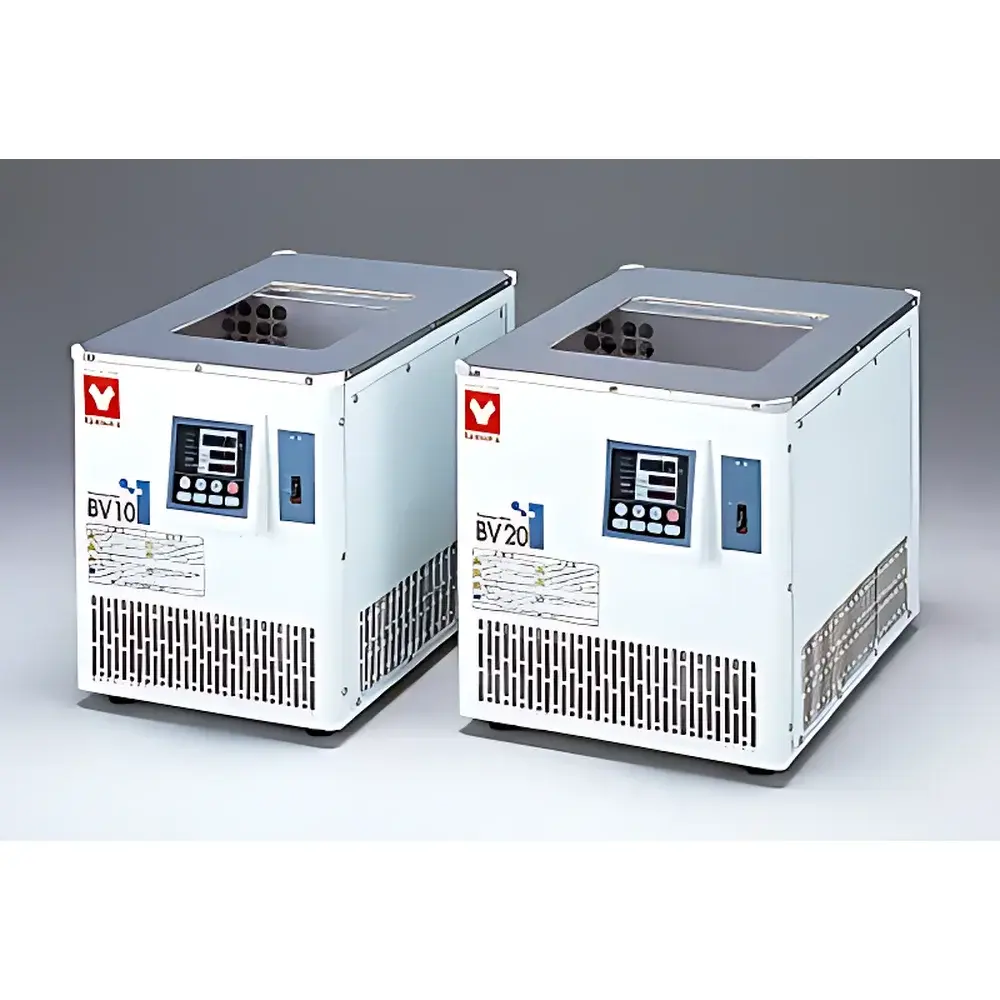
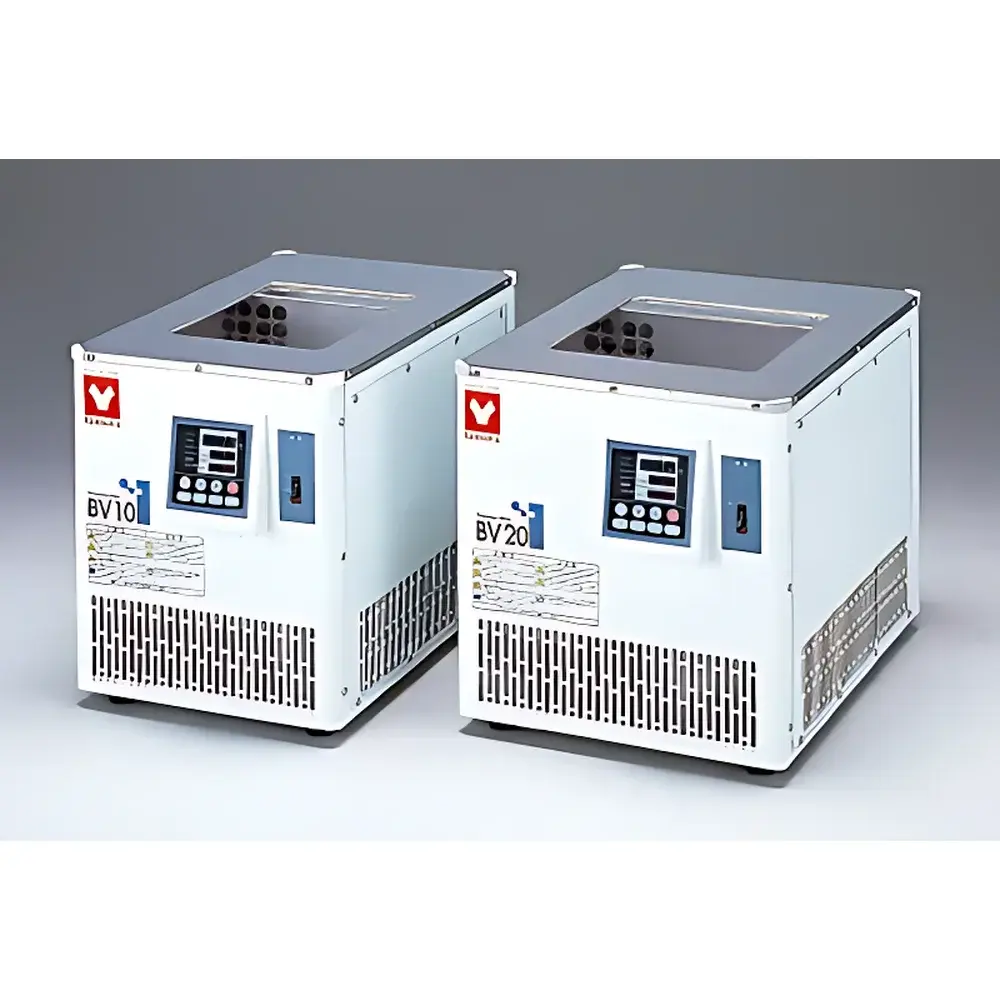
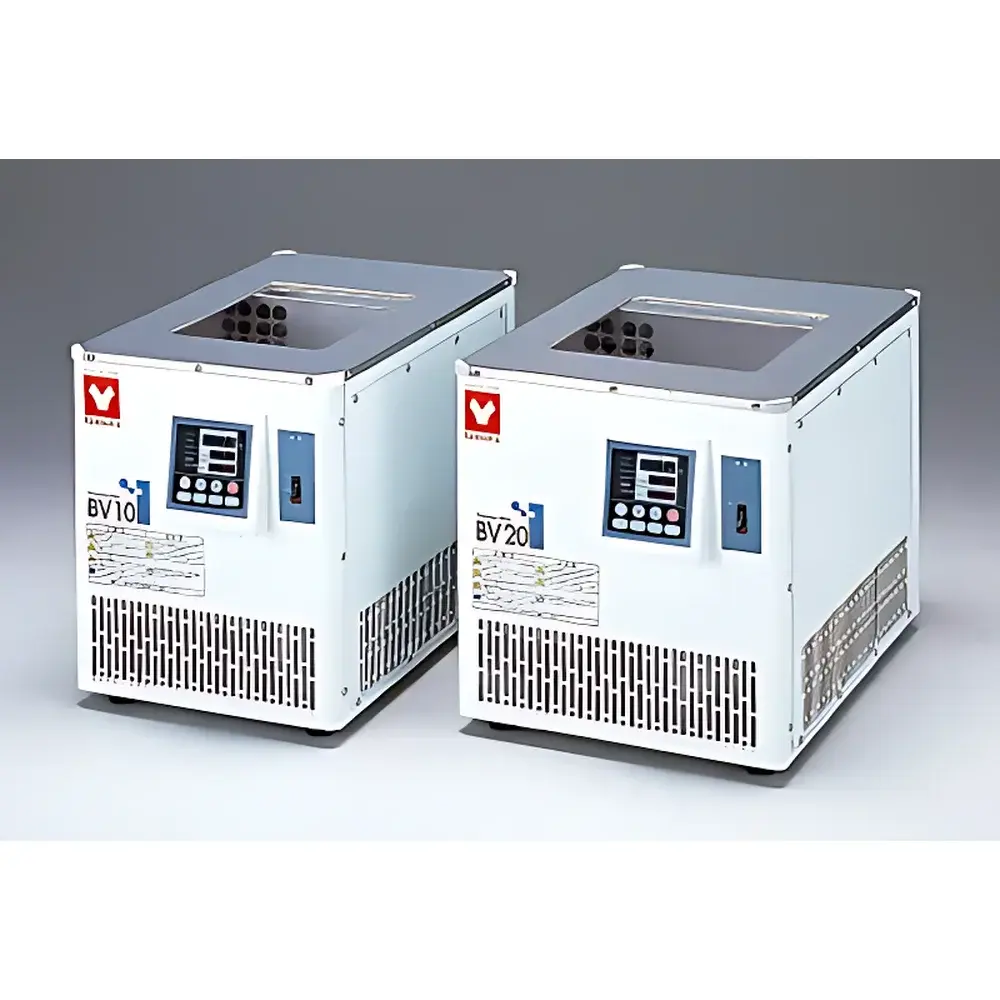
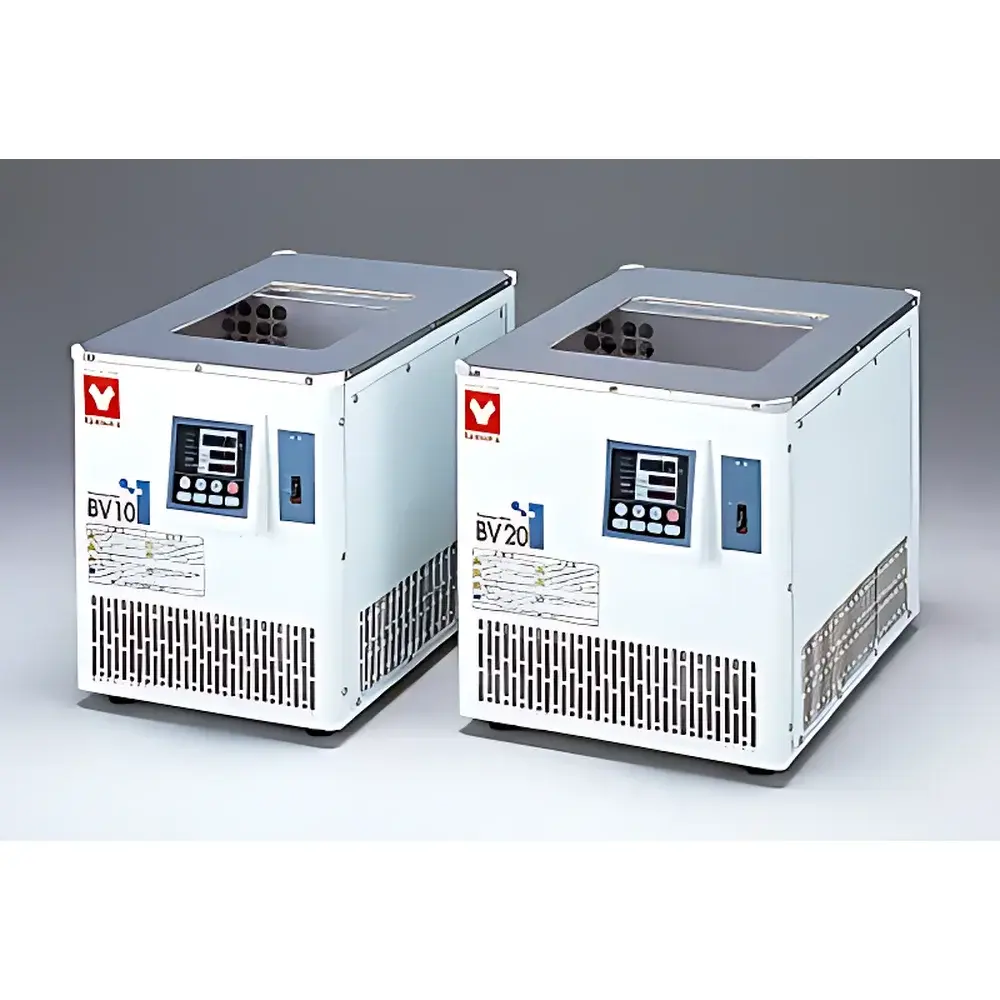
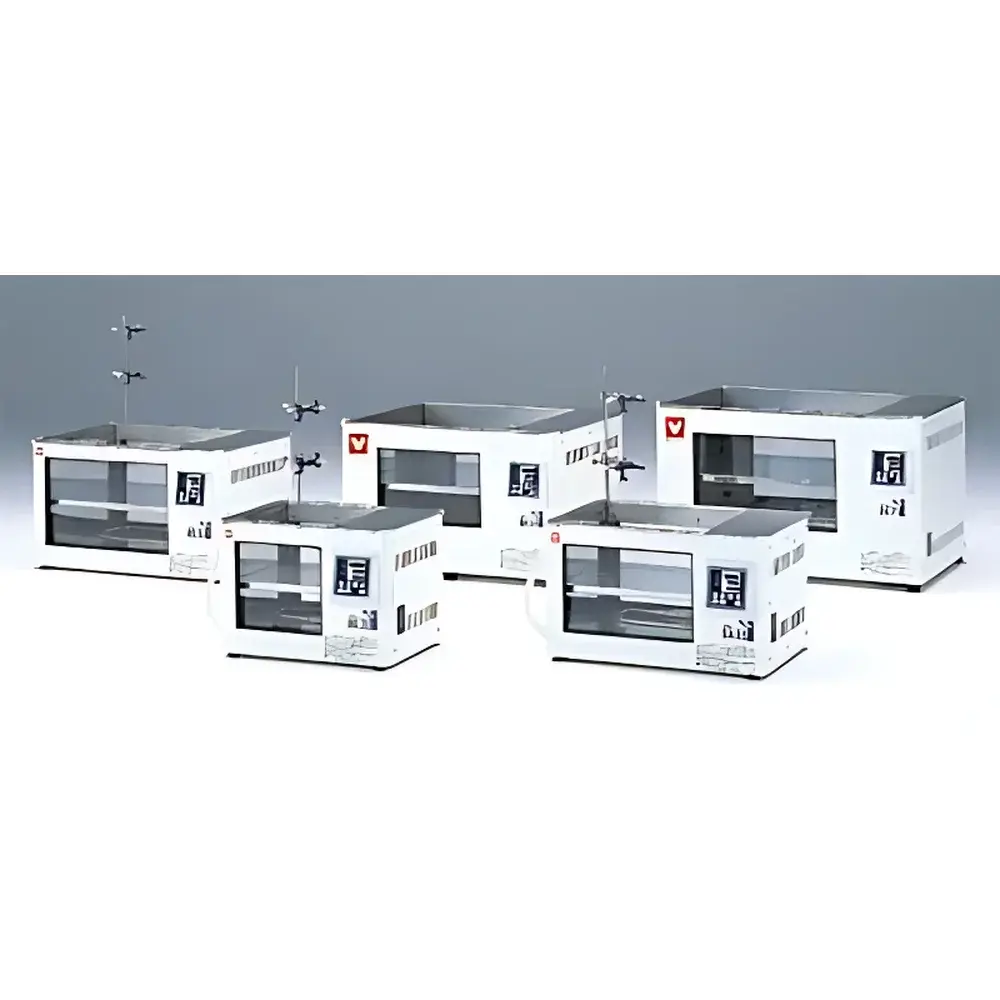
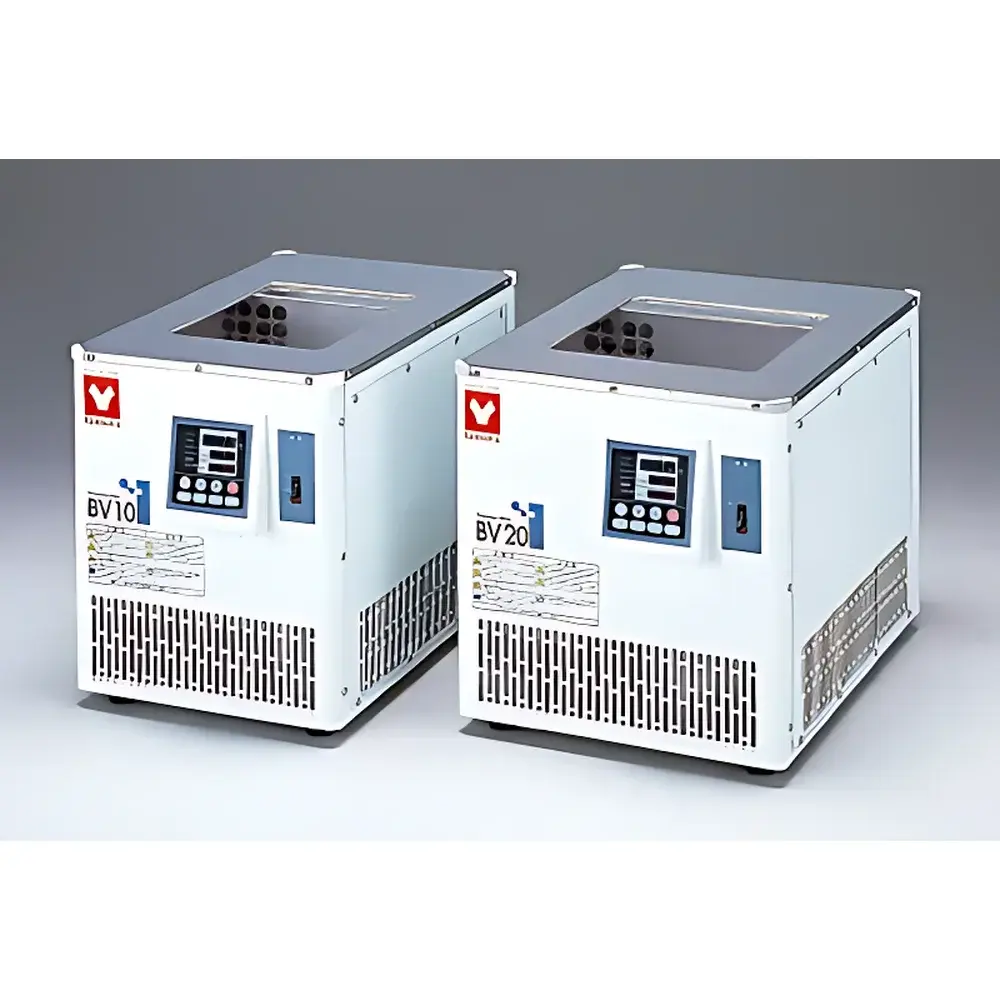
Yamato BV100/BV200/BV300/BV100S Peltier-Cooled Precision Circulating Water Bath
| Brand | Yamato |
|---|---|
| Origin | Japan |
| Model | BV100 / BV200 / BV300 / BV100S |
| Temperature Range | 0–80 °C (at ambient 23 °C, water 20 °C) |
| Temperature Control Accuracy | ±0.1 °C |
| Temperature Uniformity | ±0.1 °C |
| Cooling Method | Thermoelectric (Peltier) Modules (4 / 6 / 8 elements) |
| Heating Method | Nickel-Plated Copper Tube Heater (0.5 / 0.6 / 0.75 kW) |
| Circulation | Internal Electromagnetic Pump (3 W / 6 W) |
| Tank Capacity | 6 / 10 / 15 L |
| Internal Dimensions (W×D×H) | 200×220×180 / 250×220×180 / 380×220×180 mm |
| Power Supply | AC 100 V, 50/60 Hz, 10 / 14 / 18 A |
| Net Weight | 35 / 40 / 48 kg |
| Control System | Microprocessor-Based PID with Dual-Sensor Monitoring (Pt100 for control, K-type thermocouple for over-temperature protection) |
| Programmable Steps | 8-step × 2 programs or 16-step × 1 program |
| Timer Range | 1 min – 99 h 59 min or 1 min – 999 h 50 min |
| Safety Features | Dry-run prevention, heater open-circuit detection, SSR short-circuit monitoring, automatic over-temperature cutoff, earth-leakage circuit breaker |
Overview
The Yamato BV100, BV200, BV300, and BV100S series are precision circulating water baths engineered for stable, low-vibration thermal control in demanding laboratory environments. Unlike compressor-based systems, these units employ solid-state thermoelectric (Peltier) cooling modules—eliminating refrigerants such as CFCs or HCFCs and ensuring compliance with global environmental regulations including the Montreal Protocol and EU F-Gas Regulation. The integrated Peltier architecture delivers rapid thermal response, minimal mechanical vibration (<0.5 µm peak-to-peak), and compact footprint—critical for applications requiring microenvironmental stability, such as optical microscopy stages, spectroscopic cell holders, or sensitive biosensor calibration. Each model combines active heating (via nickel-plated copper tube heaters) with bidirectional Peltier temperature regulation, enabling seamless operation across a continuous range of 0 °C to +80 °C under standard ambient conditions (23 °C room temperature, 20 °C initial water temperature). The microprocessor-controlled PID algorithm—tuned with dual-sensor redundancy (Pt100 primary control sensor and independent K-type thermocouple for over-temperature fail-safe)—ensures long-term drift <±0.02 °C/24 h and repeatability within ±0.05 °C across repeated setpoint cycles.
Key Features
- Zero-ozone-depleting refrigerant design: Fully compliant with ISO 14001-certified environmental management systems and RoHS Directive 2011/65/EU.
- Low-vibration thermal platform: Electromagnetic circulation pump and rigid stainless-steel SUS304 tank minimize fluid-induced perturbations—validated per ASTM E2912-21 for vibration-sensitive instrumentation mounting.
- Dual-sensor safety architecture: Independent Pt100 (IEC 60751 Class A) and K-type thermocouple inputs enable real-time cross-verification and automatic shutdown if deviation exceeds 1.5 °C.
- Programmable thermal profiles: Supports up to 16-step single-sequence or 8-step dual-sequence ramp/soak protocols with timer-triggered start/stop—compatible with GLP/GMP audit trails when logged via optional RS-485 interface.
- Sealed top plate design: Flat, gasketed lid ensures vapor containment and reduces evaporation rate to <1.2 mL/h at 40 °C—critical for extended unattended operation and humidity-controlled enclosures.
- Self-diagnostic firmware: Monitors heater continuity, SSR integrity, coolant flow status, and power supply variance; logs fault codes with timestamp for traceability under FDA 21 CFR Part 11 Annex 11 requirements.
Sample Compatibility & Compliance
The BV-series accommodates a wide range of sample formats—including glass cuvettes (up to 10 mm path length), immersion probes, reaction vessels (max Ø90 mm), and custom jigs—within its uniform temperature field (±0.1 °C spatial distribution verified per ISO 17025-accredited calibration procedures). The SUS304 tank resists corrosion from aqueous buffers (pH 4–10), saline solutions, and low-concentration ethanol/water mixtures. Units meet IEC 61010-1:2010 safety standards for laboratory electrical equipment and carry PSE certification for Japan-market compliance. Optional accessories—including BN300-compatible vibration modules—enable integration into validated cold-shock incubation workflows per USP guidelines for biopharmaceutical stability testing.
Software & Data Management
While standalone operation requires no external software, the RS-485 port (standard on BV200/BV300; optional on BV100/BV100S) supports ASCII protocol communication with third-party SCADA or LIMS platforms. Temperature logs can be exported in CSV format with millisecond-resolution timestamps, including control output (% duty cycle), actual vs. setpoint deviation, and safety event flags. When connected to Yamato’s optional Datalogger-Link software (v3.2+), users may configure automated report generation aligned with ISO/IEC 17025 clause 7.7 requirements for measurement uncertainty documentation. All firmware updates are delivered via signed binary packages to prevent unauthorized modification—supporting ALCOA+ data integrity principles.
Applications
- Calibration of reference thermometers and RTDs against NIST-traceable standards (per ASTM E74-22).
- Thermal conditioning of optical components prior to interferometric alignment (e.g., laser cavity mounts, beam splitters).
- Controlled-rate cooling/heating of enzymatic assays where ΔT >0.05 °C induces measurable kinetic shifts (e.g., qPCR master mix equilibration).
- Stabilization of mass spectrometer ion sources during high-resolution LC-MS method development.
- Pre-conditioning of polymer films and thin-film solar cells for thermal expansion coefficient measurement (ASTM E831-20).
- Integration with shaker modules (e.g., BN300) to form certified low-temperature orbital incubators for psychrophilic microbial culture (ISO 11133:2014 Annex B).
FAQ
What is the minimum achievable temperature with the BV300 under standard lab conditions?
At ambient 23 °C and still water, the BV300 achieves a stable setpoint of 0 °C with ±0.1 °C control accuracy. Sub-zero operation is not supported due to risk of internal condensation and Peltier efficiency drop below dew point.
Can the unit maintain temperature uniformity with external fluid circulation?
No—the BV-series is configured for internal recirculation only. External pumping voids the warranty and compromises temperature uniformity; for external loop applications, Yamato recommends the GC-series chillers with insulated dual-circuit manifolds.
Is the BV100S functionally identical to the BV100?
The BV100S includes an enhanced electromagnetic pump (6 W vs. 3 W), upgraded fan speed control logic, and additional EEPROM memory for extended program storage—but shares identical tank geometry, Peltier count, and safety architecture.
Does the system support validation documentation per GxP requirements?
Yes. Factory-installed IQ/OQ protocols (including as-found/as-left calibration records, sensor linearity verification, and alarm response testing) are provided with each unit. PQ templates aligned with EU Annex 15 are available upon request.



