
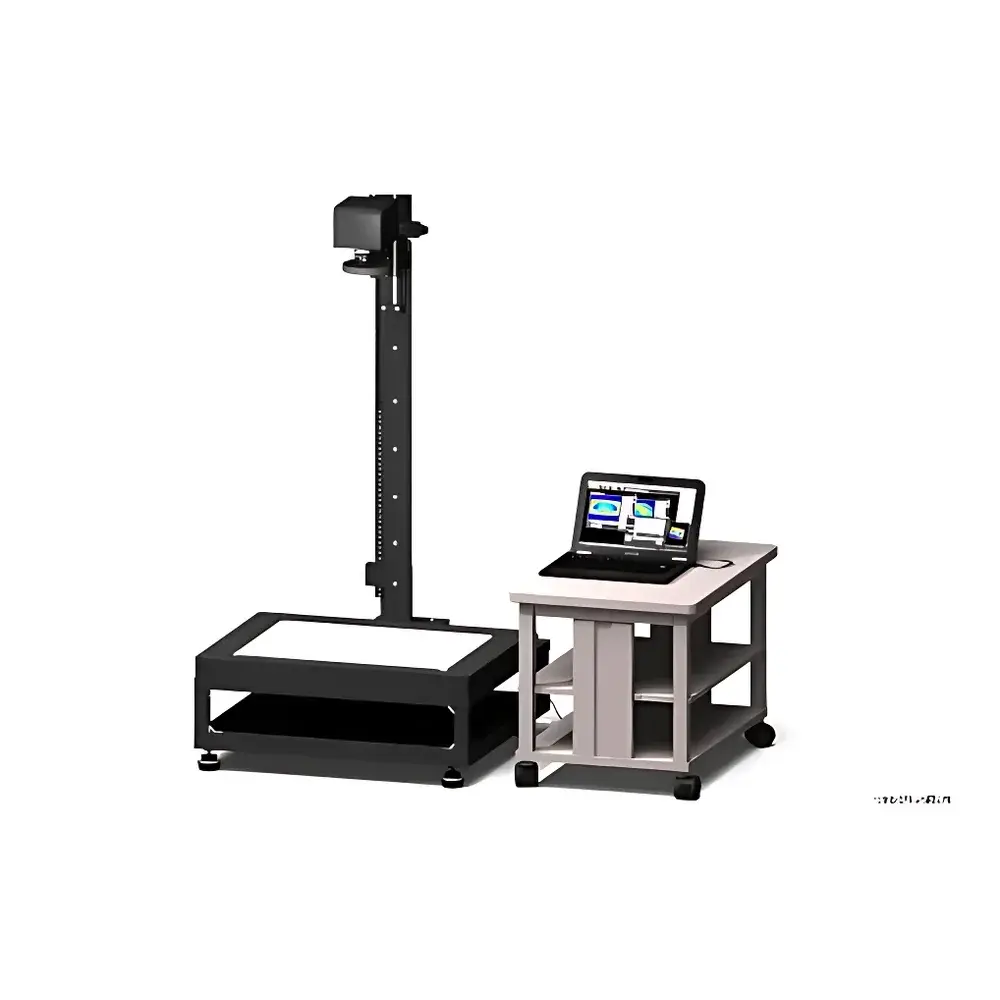
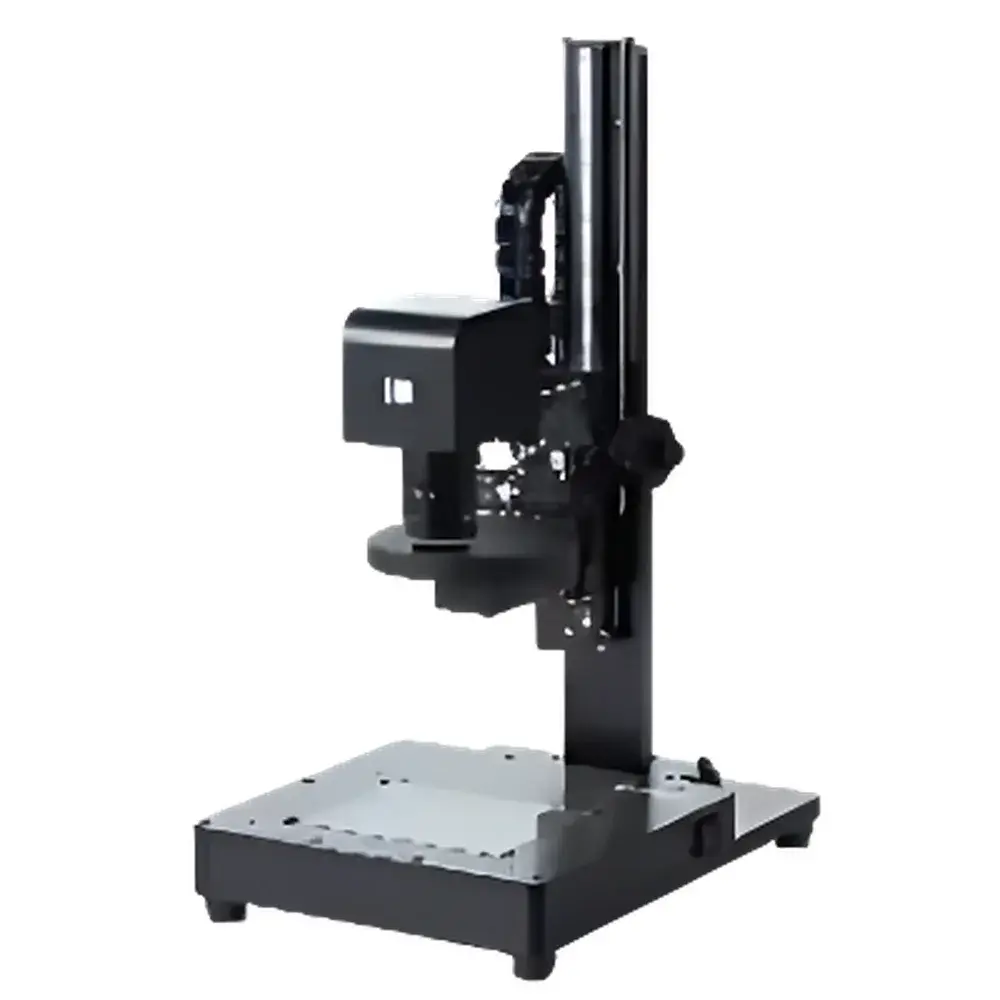
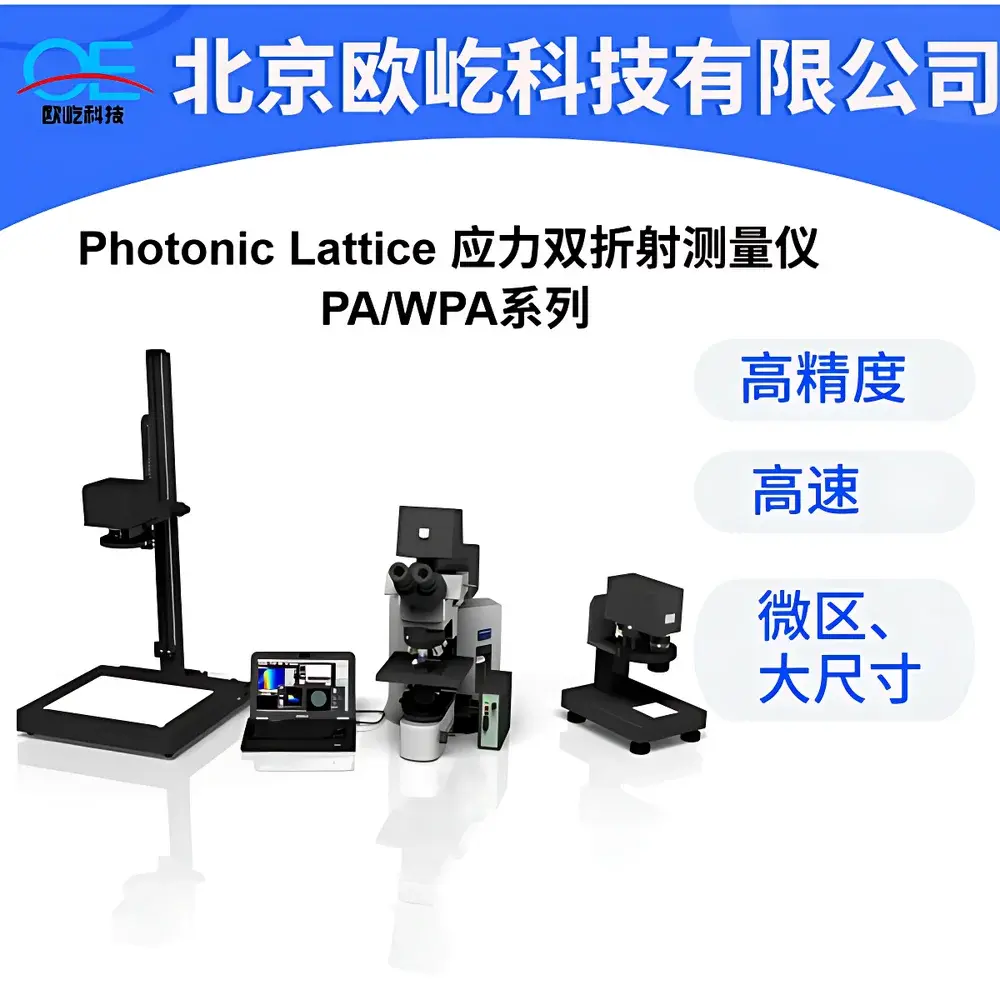
PHL WPA-200-XL Polarizing Stress Analyzer
| Brand | Photonic Lattice |
|---|---|
| Origin | Japan |
| Model | WPA-200-XL |
| Measurement Principle | Full-field photoelastic imaging at multiple wavelengths |
| Output | Retardation (nm), Fast-axis orientation (°), Stress-equivalent birefringence (MPa, optional) |
| Wavelengths | 520 nm, 543 nm, 575 nm |
| Birefringence Range | 0–3500 nm |
| Resolution | 0.001 nm |
| Repeatability | <0.1 nm (σ) |
| Field of View | 218 × 290 mm to 360 × 480 mm (standard) |
| Imaging Sensor | High-sensitivity CCD camera |
| Software Options | Real-time analysis module, Lens-specific evaluation suite, External control interface, CD-mode measurement mode |
| Compliance | Designed for ISO 11477 (plastics — determination of birefringence), ASTM D4093 (optical properties of transparent plastics), and GLP-aligned data integrity workflows |
Overview
The PHL WPA-200-XL Polarizing Stress Analyzer is a full-field, wavelength-tunable photoelastic imaging system engineered by Photonic Lattice for quantitative, non-contact birefringence characterization of transparent and semi-transparent materials. Based on advanced photonic crystal polarization optics and high-dynamic-range CCD acquisition, the instrument captures spatially resolved retardation and fast-axis orientation across its entire field of view in a single exposure—eliminating mechanical scanning or rotating polarizer mechanisms. Its core measurement principle leverages spectral interferometric photoelasticity: by sequentially illuminating samples with three discrete wavelengths (520 nm, 543 nm, and 575 nm), the system resolves phase retardation values up to 3500 nm with sub-milliradian angular precision in axis orientation. This enables direct conversion of measured optical path difference into stress-equivalent birefringence (MPa) when calibrated against material-specific stress-optic coefficients—critical for validating thermo-mechanical history in precision optics and injection-molded polymer components.
Key Features
- Single-shot full-field acquisition: Measures retardation and axis orientation simultaneously across 218 × 290 mm to 360 × 480 mm FOV without scanning or moving parts.
- Triple-wavelength illumination architecture: Enables robust phase unwrapping and eliminates 2π ambiguity in high-retardation samples (>1000 nm).
- Sub-nanometer resolution: Achieves 0.001 nm retardation resolution and <0.1 nm (σ) repeatability under controlled environmental conditions.
- Zero-mechanism optical design: No motorized waveplates or rotating polarizers—reducing maintenance, thermal drift, and alignment sensitivity.
- Real-time visualization: Live 2D false-color retardation maps with overlayable fast-axis vector fields and user-defined ROI masking.
- Modular software architecture: Supports optional modules including lens distortion correction, radial stress profiling, and automated defect flagging based on gradient thresholds.
Sample Compatibility & Compliance
The WPA-200-XL accommodates flat and gently curved transparent substrates up to 30 mm thickness, including optical glasses (BK7, fused silica, sapphire), crystalline materials (quartz, synthetic diamond), and polymeric systems such as PET, PC, PMMA, COP, COC, PVA, and acrylic resins. It is routinely deployed in production environments for incoming inspection of display cover lenses, automotive HUD combiners, medical packaging films, and LED lightguide plates. The system complies with ISO 11477 for birefringence quantification in thermoplastics and aligns with ASTM D4093 requirements for optical homogeneity assessment. Data export formats (TIFF, CSV, HDF5) support traceability under FDA 21 CFR Part 11 when used with validated software configurations and audit-trail-enabled analysis modules.
Software & Data Management
The native WPA Control Suite provides calibrated image acquisition, real-time retardation mapping, and batch processing of multi-sample datasets. All measurement metadata—including wavelength configuration, exposure time, temperature log (via optional external probe), and operator ID—is embedded in EXIF-compliant headers. Optional modules include Lens Analysis Pack (for radial symmetry deviation and edge stress gradient quantification) and External Control API (TCP/IP-based command set compatible with PLC-triggered inline inspection). Raw frame buffers are retained for reprocessing; processed results include statistical summaries per ROI (mean, std dev, max/min), cross-sectional line profiles, and comparative overlays between reference and test samples. Exported reports meet GLP documentation standards with electronic signature capability and immutable timestamping.
Applications
- Quality assurance of optical thin-film coatings: Detecting residual stress-induced delamination precursors and coating uniformity deviations.
- Injection molding process validation: Mapping frozen-in stress in automotive transparent components (e.g., sensor windows, headlamp lenses) to correlate with mold temperature gradients and packing pressure profiles.
- Display manufacturing: Verifying birefringence homogeneity in OLED encapsulation substrates and touch sensor ITO layers prior to lamination.
- Medical device packaging: Quantifying stress distribution in sterilizable PETG trays to ensure integrity under gamma irradiation and thermal cycling.
- Research on novel transparent ceramics: Characterizing anisotropic strain fields following hot-isostatic pressing or laser-induced crystallization.
FAQ
Does the WPA-200-XL require calibration with NIST-traceable retardation standards?
Yes—Photonic Lattice recommends annual calibration using certified quartz wedge standards (0–3000 nm range) traceable to NIST SRM 2085. Factory calibration certificates include uncertainty budgets per ISO/IEC 17025.
Can the system measure curved surfaces?
It supports gently curved plano-convex or plano-concave optics (radius > 500 mm) when used with optional telecentric lens adapters; steep curvature requires custom optical relay integration.
Is stress conversion to MPa supported out-of-the-box?
Stress-equivalent output is available as an optional software module requiring user-input of material-specific stress-optic coefficient (C) and thickness—validated against ASTM E177 for coefficient uncertainty propagation.
What environmental conditions affect measurement stability?
Ambient temperature fluctuations > ±0.5°C/hour or vibration exceeding ISO 23828 Class 2 may degrade repeatability; operation within climate-controlled labs (23 ± 1°C, RH 45–55%) is recommended for metrology-grade results.





