
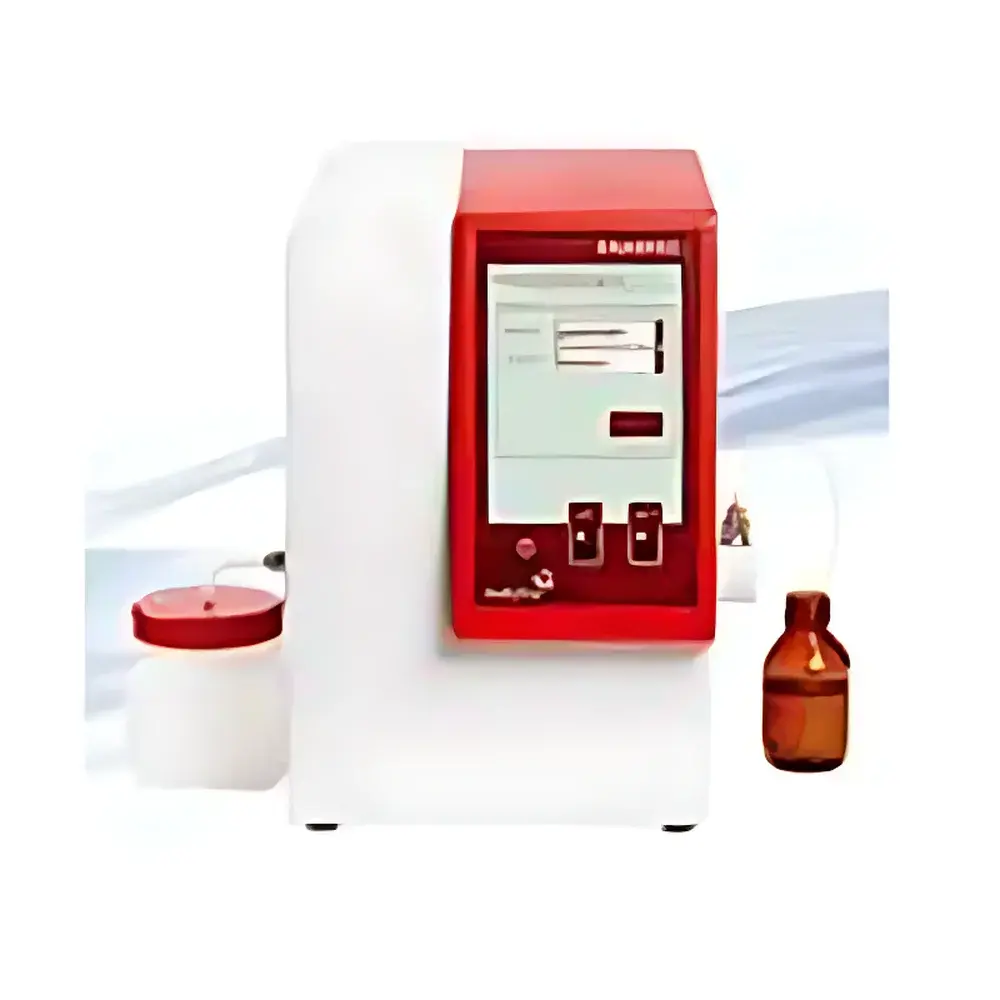
Karrie ERASPEC Mid-IR Gasoline Analyzer
| Brand | Karrie |
|---|---|
| Model | ERASPEC |
| Type | Mid-Infrared Spectroscopic Fuel Analyzer |
| Origin | Shenzhen, China |
| Compliance | ASTM D5845 (Benzene), ASTM D6277 (Oxygenates) |
| Sample Volume | 10 mL |
| Analysis Time | ≤60 s |
| Measurement Units | vol%, wt% |
| Density Accuracy | ±0.0001 g/cm³ (integrated Anton Paar density module) |
| Spectral Range | 4000–10000 cm⁻¹ (3000 data points) |
| Data Storage | ≥2000 results |
| Connectivity | 3× USB, 1× Ethernet, 1× RS232, LIMS interface |
| Power | 85–263 VAC, 47–63 Hz, 70 W |
| Optional DC Input | 12 V / 4 A |
| Dimensions | 220 × 320 × 280 mm |
| Weight | 8 kg |
| Display | 6.5″ color capacitive touchscreen (full Chinese UI) |
| Portability | Benchtop & vehicle-mountable |
| Preloaded Database | Representative Chinese refinery gasoline library (calibrated for domestic formulations) |
Overview
The Karrie ERASPEC Mid-IR Gasoline Analyzer is a benchtop and field-deployable Fourier-transform infrared (FTIR) spectrometer engineered for rapid, non-destructive quantification of critical hydrocarbon composition parameters in gasoline and oxygenated fuel blends. Operating in the mid-infrared spectral region (4000–10000 cm⁻¹), it acquires high-resolution transmission spectra with 3000 evenly spaced data points per scan—enabling robust multivariate calibration against reference methods. The instrument integrates a certified Anton Paar density module (±0.0001 g/cm³ accuracy) to support dual-mode concentration reporting (vol% and wt%). Designed originally for military-grade fuel surveillance, its ruggedized architecture, automated liquid handling, and self-cleaning gas/liquid purge system ensure consistent performance across laboratory, refinery, and mobile inspection environments. It delivers trace-level quantification of regulated components—including benzene (per ASTM D5845), oxygenates (per ASTM D6277), and metallic additives such as MMT—without solvent use or sample derivatization.
Key Features
- Automated sample introduction and integrated air-liquid cleaning cycle minimizes operator intervention and cross-contamination risk.
- Full-spectrum acquisition at 3000 data points across 4000–10000 cm⁻¹ ensures maximal chemical information capture for PLS and PCR model development.
- Dual-reporting capability: simultaneous output in volume percent and weight percent, corrected using real-time density measurements.
- Pre-validated Chinese gasoline database covering >30 key parameters—including RON/MON, aromatics, olefins, benzene, toluene, methanol, ethanol, MTBE, MMT, and total oxygen content.
- Embedded 6.5″ high-brightness capacitive touchscreen with full Chinese-language interface; no external PC required for routine operation.
- Multi-interface connectivity: three USB ports, one Ethernet port, one RS232 serial port, and native LIMS integration protocol for audit-ready data export.
- Compact form factor (220 × 320 × 280 mm) and low power consumption (70 W AC or 12 V/4 A DC) enable deployment in laboratories, mobile labs, and refueling stations.
Sample Compatibility & Compliance
The ERASPEC analyzer accepts undiluted gasoline samples (minimum 10 mL) including conventional unleaded, reformulated, ethanol-blended (E5–E25), MTBE-doped, and MMT-stabilized fuels. Its calibration models are validated against ASTM D5845 (gas chromatographic determination of benzene in gasoline) and ASTM D6277 (infrared spectroscopy for oxygenates), with documented correlation coefficients (r² ≥ 0.992) versus reference GC-FID and GC-MS methods. All measurement protocols comply with ISO/IEC 17025 requirements for testing laboratories. The system supports GLP-compliant audit trails when connected to networked data management platforms and meets essential electrical safety standards (IEC 61010-1) for Class I equipment.
Software & Data Management
Firmware includes embedded chemometric engine supporting partial least squares (PLS) regression, principal component analysis (PCA), and outlier detection algorithms. Up to 2000 measurement records—including raw spectra, processed results, timestamps, user IDs, and instrument status logs—are stored locally with timestamped backup export via USB or Ethernet. Calibration models are protected by digital signature verification to prevent unauthorized modification. Software architecture supports 21 CFR Part 11–compliant electronic signatures and audit trail generation when deployed with optional enterprise server modules. No proprietary file formats are used: spectral data exports as ASCII CSV; calibration files follow ASTM E1655 standard format.
Applications
- Real-time quality assurance in petroleum refineries and blending terminals for compliance with GB 17930, ASTM D4814, and EN 228 specifications.
- Rapid screening of fuel adulteration (e.g., benzene over-limit, illegal oxygenate substitution, or water contamination).
- Support for fuel formulation R&D, including octane enhancement studies and additive compatibility testing.
- Mobile enforcement testing at distribution hubs, retail stations, and customs checkpoints.
- Regulatory monitoring for environmental agencies verifying benzene and oxygenate content under national emissions control programs.
- Technical support for automotive OEMs evaluating fuel sensitivity in engine calibration and durability testing.
FAQ
Does the ERASPEC require daily recalibration?
No. Factory-calibrated models remain stable for ≥6 months under normal operating conditions. Verification checks using NIST-traceable reference standards are recommended weekly.
Can the system analyze diesel or jet fuel?
Not natively. The preloaded calibration library and optical path are optimized for gasoline-range volatility and functional group absorption profiles. Diesel/jet fuel analysis requires separate model development and hardware validation.
Is method transfer possible between different ERASPEC units?
Yes. Calibration models are instrument-independent when generated using standardized preprocessing (e.g., Savitzky-Golay smoothing, vector normalization) and exported in ASTM E1655 format.
What maintenance is required?
Annual optical alignment verification and quarterly cleaning of the flow cell and purge lines using certified solvents. No consumables beyond standard lab-grade isopropanol for cleaning.
How is data integrity ensured during network transmission?
All Ethernet and USB data transfers use SHA-256 checksum verification. LIMS interface supports TLS 1.2 encryption and OAuth 2.0 authentication for secure enterprise integration.






