
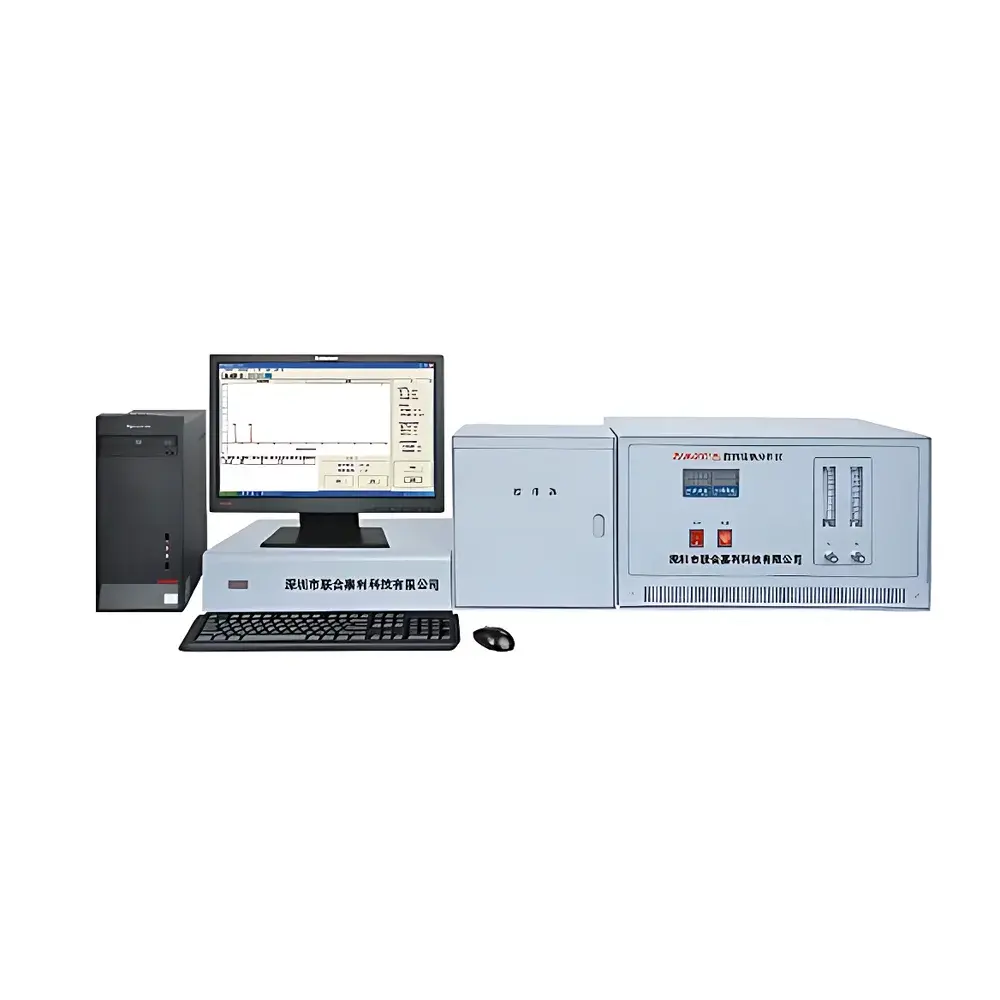
Karrie ZWK-2001 Microcomputer-Based Sulfur and Chlorine Analyzer
| Brand | Karrie |
|---|---|
| Model | ZWK-2001 |
| Measurement Principle | Dynamic Microcoulometric Titration |
| Analyte Range | S: 0.1 mg/L – 10,000 mg/L (up to % level) |
| Cl | 0.3 mg/L – 10,000 mg/L (up to % level) |
| Sample Forms | Liquid, Solid, Gas (with optional injectors) |
| Furnace Temp. Range | Ambient to 1000 °C |
| Temp. Control Accuracy | ±1% of setpoint |
| Repeatability | Cv ≤ 20% (X < 1.0 mg/L) |
| Compliance | SH/T 0253, GB/T 18612, SH/T 0254, SH/T 0222, ASTM D3120, ASTM D3246, ASTM D5808 |
| System Includes | Main analyzer unit (with amplifier), programmable furnace/cracking system, magnetic stirrer, sample injector (liquid/solid/gas variants), Windows-based control software, data acquisition PC, thermal printer |
Overview
The Karrie ZWK-2001 Microcomputer-Based Sulfur and Chlorine Analyzer is a dedicated elemental combustion analyzer engineered for quantitative determination of total sulfur and total chlorine in organic matrices using dynamic microcoulometric titration. The instrument operates on the fundamental principle of controlled high-temperature oxidative pyrolysis: samples are introduced into a quartz or ceramic cracking tube maintained at up to 1000 °C under inert or oxygen-enriched carrier gas flow. Organic sulfur and chlorine compounds undergo complete conversion to SO₂ and HCl, respectively. These gaseous species are swept into a dual-mode microcoulometric titration cell—configured either with iodine (I₃⁻) electrolyte for sulfur analysis or silver (Ag⁺) electrolyte for chlorine analysis. Electrolytic generation of titrant is precisely controlled by real-time current feedback; the integrated charge (Q, in coulombs) consumed during endpoint titration is directly proportional to analyte mass via Faraday’s law (m = Q × M / (n × F)), where M is molar mass, n is electrons transferred per molecule, and F is Faraday’s constant. This electrochemical detection architecture delivers high specificity, low detection limits, and inherent linearity across five orders of magnitude without external calibration curves.
Key Features
- Programmable high-temperature cracking furnace (ambient to 1000 °C) with ±1% temperature stability, ensuring complete and reproducible sample decomposition across diverse matrices.
- Dual-mode microcoulometric detection cell optimized for both sulfur (I₃⁻/SO₂) and chlorine (Ag⁺/HCl) analysis—switchable via software without hardware reconfiguration.
- Modular sample introduction system supporting liquid syringe injection, solid boat insertion, and optional gas loop injection—enabling trace-level analysis of fuels, pharmaceuticals, polymers, and environmental extracts.
- Integrated signal amplification and digital current integration circuitry using industrial-grade components to minimize electronic noise and maximize signal-to-noise ratio at sub-ppb equivalent levels.
- Real-time process monitoring: On-screen display of furnace temperature, cell potential, electrolysis current, titration progress, and endpoint confirmation—facilitating method development and troubleshooting.
Sample Compatibility & Compliance
The ZWK-2001 accommodates heterogeneous sample states—including volatile liquids (e.g., gasoline, jet fuel), viscous oils (e.g., lubricants, bitumen), powdered solids (e.g., coal, catalysts), and compressed gases (e.g., natural gas, refinery off-gas)—when paired with application-specific injectors. Its analytical performance meets the stringent requirements of multiple international standard methods: SH/T 0253 (petroleum products), GB/T 18612 (crude oil), ASTM D3120 (low-sulfur diesel), ASTM D3246 (organic chlorides in hydrocarbons), and ASTM D5808 (trace chlorine in aromatic hydrocarbons). The system supports audit-ready operation under GLP and GMP environments through timestamped raw data logging, user-access logs, and uneditable result archives—fully compatible with laboratory information management systems (LIMS) via ASCII export.
Software & Data Management
Control and data processing are executed via a dedicated Windows-based application that provides full instrument automation—from method setup and sequence definition to real-time chromatogram-like response visualization and final report generation. All acquisition parameters (furnace ramp profiles, gain settings, integration thresholds, endpoint criteria) are stored as reusable method files. Raw current vs. time traces, calculated mass values, relative standard deviations (Cv), and calibration verification records are saved in binary and CSV formats. The software includes built-in statistical tools for repeatability assessment per ISO 5725-2 and supports electronic signature functionality aligned with FDA 21 CFR Part 11 requirements when deployed on validated networked workstations.
Applications
This analyzer serves routine QC and R&D laboratories requiring regulatory-compliant sulfur and chlorine quantification in complex organic streams. Key use cases include: sulfur speciation screening in ultra-low-sulfur diesel (ULSD) per EPA Tier 3 specifications; chlorine residue testing in API intermediates and excipients per ICH Q3A/B guidelines; total halogen content verification in polymer feedstocks for RoHS/REACH compliance; and environmental monitoring of organochlorine pesticides or PCB congeners in soil and sediment extracts following EPA Method 8081B workflows. Its robustness and multi-matrix capability make it suitable for contract testing labs serving petrochemical, pharmaceutical, and environmental sectors.
FAQ
What detection principle does the ZWK-2001 employ?
It uses dynamic microcoulometric titration based on Faraday’s law, with electrogenerated I₃⁻ for sulfur and Ag⁺ for chlorine.
Can the same instrument analyze both sulfur and chlorine?
Yes—the titration cell and electrolyte are configurable for either analyte via software-selectable modes.
Is the system compliant with FDA 21 CFR Part 11 for electronic records?
When deployed with appropriate IT controls (audit trail, electronic signatures, access restrictions), the software architecture supports Part 11 compliance.
What sample introduction options are available out-of-the-box?
Standard configuration includes liquid syringe and solid boat injectors; gas loop injection requires optional hardware module.
How is instrument performance verified between calibrations?
Built-in system suitability checks include reference standard injections, blank subtraction routines, and CV calculation per replicate analyses.





