
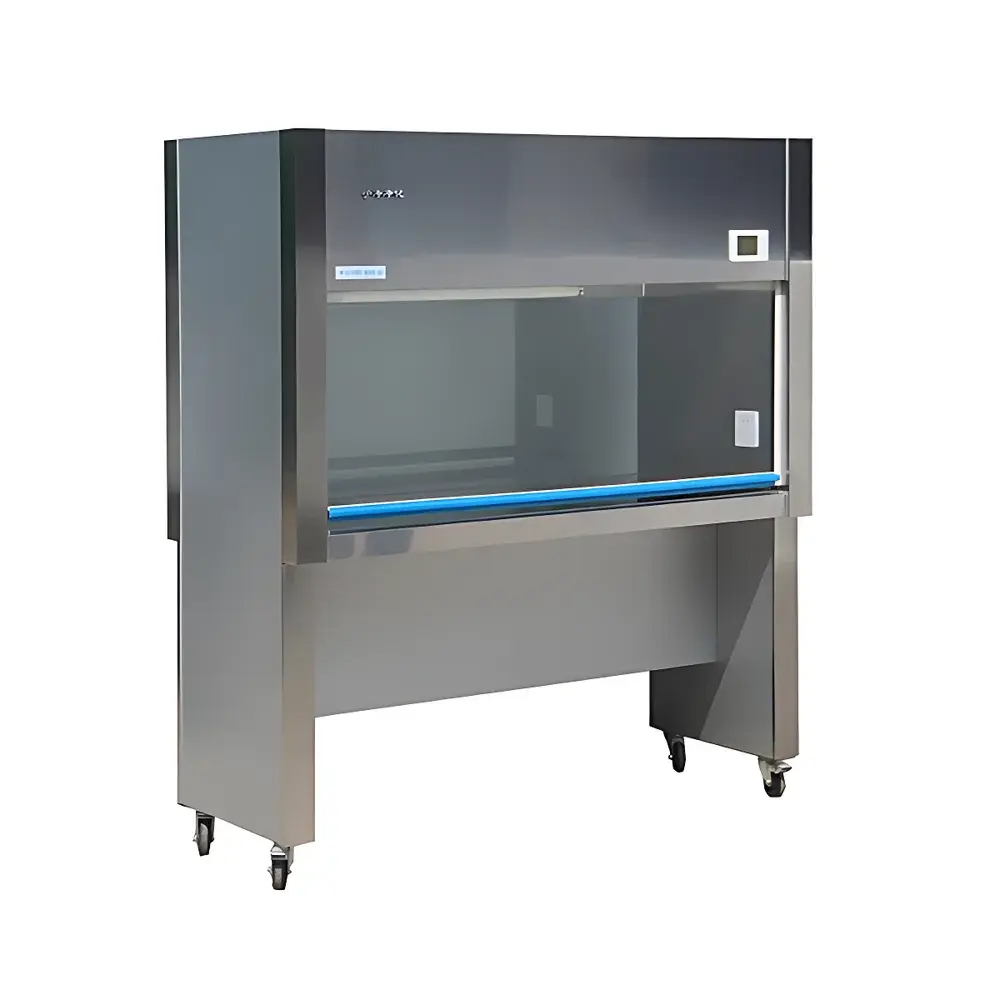
SW-CJ-3F Three-Person Dual-Sided Vertical Laminar Flow Clean Bench by Hujing Purification
| Brand | Hujing Purification (HJ) |
|---|---|
| Origin | Shanghai, China |
| Manufacturer Type | Direct Manufacturer |
| Instrument Category | Vertical Laminar Flow Clean Bench |
| Model | SW-CJ-3F |
| Cleanliness Class | ISO Class 5 (100 @ ≥0.5 µm, Fed. Std. 209E) |
| Noise Level | ≤62 dB(A) |
| User Capacity | Three operators, dual-sided access |
| Airflow Pattern | Vertical downward laminar flow |
| Average Air Velocity | 0.25–0.45 m/s (dual-speed control) |
| Microbial Contamination | ≤0.5 CFU/plate·hour (Φ90 mm settle plate) |
| Vibration | ≤5 µm peak-to-peak (X/Y/Z axes) |
| Illuminance | ≥300 lx |
| Power Supply | AC 220 V, 50 Hz |
| Max. Power Consumption | 1000 W |
| Net Weight | 280 kg |
| Work Area Dimensions (W×D×H) | 1800 × 580 × 515 mm |
| Overall Dimensions (W×D×H) | 1960 × 645 × 1625 mm |
| HEPA Filter Spec. | 1795 × 555 × 38 mm (1 unit) |
| Fluorescent Lamp | 50 W (1 unit) |
| UV Lamp | 50 W (1 unit) |
Overview
The SW-CJ-3F Three-Person Dual-Sided Vertical Laminar Flow Clean Bench is an ISO Class 5-certified (100 @ ≥0.5 µm per Fed. Std. 209E) laboratory containment system engineered for personnel protection and product integrity during non-hazardous microbiological, pharmaceutical, and cell culture procedures. Unlike horizontal flow hoods, this unit employs a vertically downward laminar airflow—generated by a high-efficiency centrifugal blower and conditioned through a single large-format HEPA filter (1795 × 555 × 38 mm, ≥99.995% @ 0.3 µm)—to sweep airborne particulates and microorganisms away from the work surface and toward the perforated stainless steel grille at the base. The quasi-enclosed tempered glass sash provides dual-sided operator access while minimizing cross-contamination risk and shielding users from volatile reagents or mild aerosols. Designed for continuous operation in GLP-compliant environments, the bench meets structural and performance benchmarks aligned with ISO 14644-1 for cleanroom equipment qualification and ASTM E2500 for verification of laboratory instrumentation.
Key Features
- Vertical laminar airflow architecture ensures uniform velocity distribution (0.25–0.45 m/s) across the full 1800 mm work surface, validated via ISO 14644-3 air velocity mapping protocols.
- Dual-speed electronic fan control with LCD interface enables real-time adjustment of airflow intensity to accommodate variable procedural demands—e.g., low-velocity mode for delicate tissue handling, high-velocity mode for rapid particle clearance.
- Quasi-enclosed front sash design (tempered glass, height-adjustable) reduces ambient air infiltration by >90% compared to open-front configurations, improving containment efficacy and user comfort.
- Integrated UV germicidal lamp (50 W, 253.7 nm) and fluorescent lighting (50 W, ≥300 lx at work surface) support both decontamination cycles and visual task clarity under IEC 60598-1 photometric standards.
- Robust 304 stainless steel work surface and epoxy-coated steel frame ensure corrosion resistance, ease of disinfection, and long-term dimensional stability under routine ethanol or quaternary ammonium wipe-downs.
- Vibration isolation compliant with ISO 20483:2017 — measured semi-peak displacement ≤5 µm across orthogonal axes — preserves integrity of micromanipulation and precision weighing tasks.
Sample Compatibility & Compliance
The SW-CJ-3F supports a broad range of non-volatile, non-toxic samples including bacterial and fungal cultures, plant protoplasts, primary mammalian cells, sterile media preparation, and aseptic packaging validation. It is not intended for use with volatile organic solvents, radioactive isotopes, or biohazardous agents requiring biosafety level 2 (BSL-2) containment. The unit conforms to key regulatory frameworks applicable to clean bench deployment in regulated laboratories: ISO 14644-1 (cleanroom classification), ISO 14644-3 (test methods), EN 12464-1 (lighting requirements), and GB/T 16292–16294 (Chinese national standards for clean bench performance testing). While not certified to NSF/ANSI 49 (which applies only to biosafety cabinets), its design aligns with Good Manufacturing Practice (GMP) Annex 1 expectations for grade A environments when installed and maintained per manufacturer-specified protocols.
Software & Data Management
This clean bench operates as a standalone mechanical system without embedded firmware or network connectivity. All operational parameters—including fan speed selection, UV timer activation (manual on/off), and illumination control—are managed via front-panel tactile switches and an integrated LCD display. No data logging, remote monitoring, or audit trail functionality is included, consistent with ISO/IEC 17025:2017 Clause 6.4.7 for equipment used in non-automated workflows. For laboratories requiring compliance with FDA 21 CFR Part 11 or EU Annex 11, third-party environmental monitoring systems (e.g., calibrated particle counters, temperature/humidity loggers) may be deployed adjacent to the unit to document operational conditions during critical processes.
Applications
- Aseptic transfer and subculturing of microbial strains in academic and industrial microbiology labs.
- Preparation of sterile culture media, buffers, and reagents for downstream molecular biology assays (e.g., PCR setup, ELISA plate coating).
- Handling of sensitive primary cells and stem cell lines prior to cryopreservation or differentiation induction.
- Quality control testing of pharmaceutical excipients and final dosage forms under ISO 13485-aligned environments.
- Electronics assembly pre-cleaning and optical component handling where particulate-free staging is required.
- Supporting ISO 11137 sterilization validation activities by providing classified staging areas for pre-irradiation sample arrangement.
FAQ
What cleanroom class does the SW-CJ-3F meet, and how is it verified?
It achieves ISO Class 5 (equivalent to Fed. Std. 209E Class 100) for particles ≥0.5 µm, confirmed via standardized particle counter testing per ISO 14644-1 Annex B using a calibrated 0.3–5.0 µm optical particle counter.
Can this unit be used for handling hazardous chemicals?
No. It lacks negative pressure containment and exhaust ducting; it is suitable only for non-toxic, non-volatile materials. Volatile solvents require a fume hood; biohazards require a certified biosafety cabinet.
Is HEPA filter replacement supported in-house, and what is the typical service interval?
Yes—filter replacement is tool-free and accessible from the rear panel. Interval depends on usage intensity and ambient air quality but typically ranges from 12 to 24 months; differential pressure monitoring is recommended to determine optimal change timing.
Does the unit comply with electrical safety standards for international export?
It meets GB 4706.1 (China’s implementation of IEC 60335-1) for household and similar electrical appliances. CE marking is not applied; customers requiring UL/cUL or UKCA certification must arrange third-party evaluation.
How is vibration performance validated during factory acceptance testing?
Vibration amplitude is measured at three orthogonal points on the work surface using a calibrated laser Doppler vibrometer per ISO 20483:2017, with results documented in the Certificate of Conformance shipped with each unit.



