
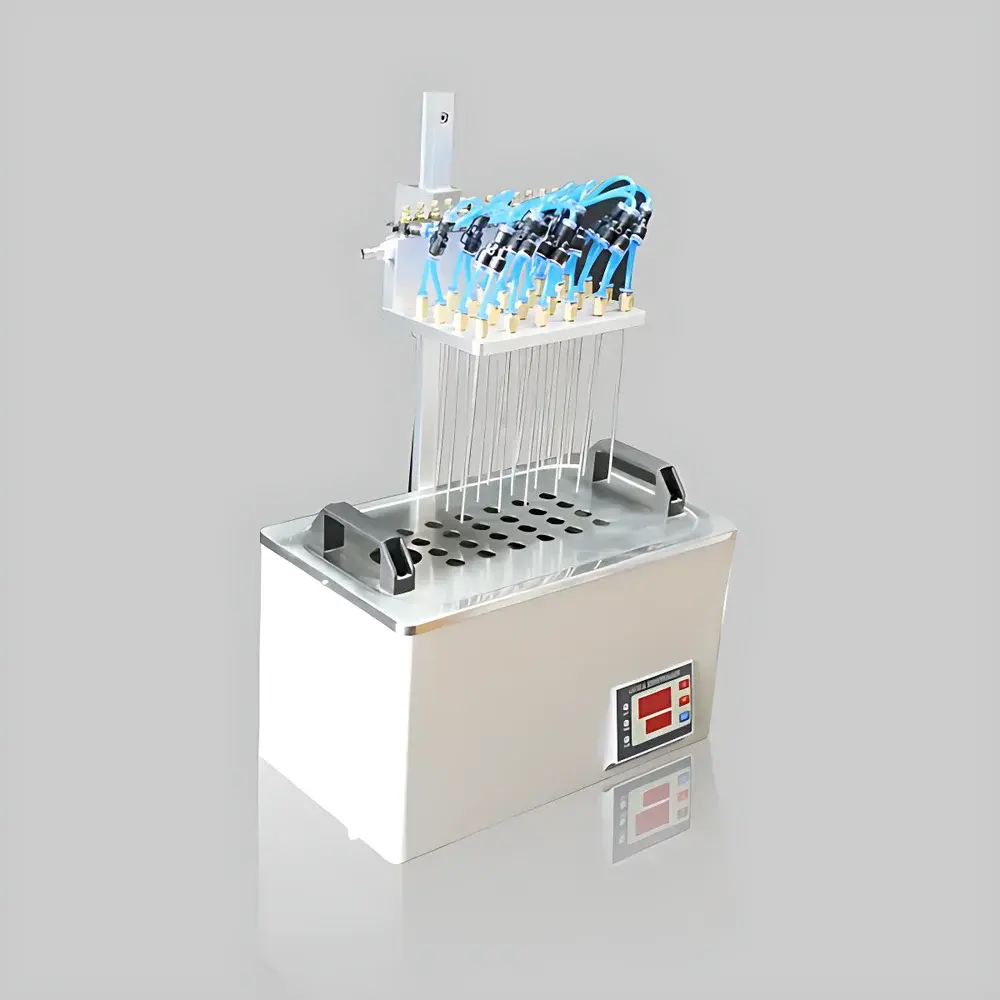
BenAng NBI-24W Water-Bath Nitrogen Evaporator
| Brand | BenAng |
|---|---|
| Origin | Shanghai, China |
| Model | NBI-24W |
| Heating Method | Water Bath |
| Temperature Range | 0–99.9 °C |
| Temperature Stability | ±0.1 °C |
| Sample Capacity | 24 positions |
| Tube Diameter Compatibility | 10–29 mm |
| Nitrogen Flow Rate | 0–10 L/min |
| Heating Power | 200 W |
| Timer Range | 0–999 min |
| Construction Materials | 316 Stainless Steel (gas channels), Anodized Aluminum (heating block), Epoxy-Coated Housing |
| Power Supply | 220 V, 50 Hz, 15 A |
| Operating Environment | −5 to 50 °C, 35–85% RH |
Overview
The BenAng NBI-24W Water-Bath Nitrogen Evaporator is an engineered solution for gentle, reproducible solvent removal and sample concentration under inert atmosphere conditions. It operates on the principle of controlled nitrogen gas sweeping across the surface of heated liquid samples—accelerating evaporation while minimizing thermal degradation, oxidation, or analyte loss. Unlike rotary evaporation—which subjects samples to vacuum-induced boiling and mechanical agitation—the NBI-24W employs low-pressure, laminar nitrogen flow over individual sample vessels immersed in a precisely regulated water bath. This method preserves thermally labile compounds (e.g., pesticides, pharmaceutical metabolites, fatty acid methyl esters) and supports applications requiring oxygen-sensitive handling, such as lipidomics, residual solvent analysis, and clinical toxicology workflows.
Key Features
- Stable water-bath heating system with PID-controlled digital temperature regulation (0–99.9 °C) and ±0.1 °C stability—ensuring uniform thermal distribution across all 24 sample positions.
- Adjustable-height gas distribution manifold with independently controllable 24-channel nitrogen outlets; each channel features precision flow control and compatibility with standard GC vials, culture tubes, and conical centrifuge tubes (10–29 mm outer diameter).
- Corrosion-resistant construction: gas pathways fabricated from ASTM A240 316 stainless steel; heating block made of anodized aluminum; housing coated with industrial-grade epoxy for chemical resistance and durability in routine QC/QA environments.
- Programmable timer (0–999 minutes) with audible end-of-run alert and automatic shut-off—supporting unattended operation during overnight or high-throughput batch processing.
- Over-temperature protection circuitry and real-time thermal monitoring prevent dry-run damage and ensure compliance with laboratory safety protocols (IEC 61010-1).
Sample Compatibility & Compliance
The NBI-24W accommodates a broad range of sample containers—including 1.5 mL microcentrifuge tubes, 4–15 mL glass test tubes, and 20 mL scintillation vials—via its adjustable aperture plate (standard opening: Ø15 mm, expandable up to Ø29 mm). Its design conforms to common method requirements in pharmacopeial standards (USP , EP 2.4.24) for residual solvent testing and supports GLP-compliant documentation when integrated with validated LIMS or ELN systems. While not inherently 21 CFR Part 11 compliant, its digital interface enables traceable parameter logging when paired with external audit-trail-capable software.
Software & Data Management
The NBI-24W operates via an embedded microcontroller with LED-based digital display and tactile membrane keypad—providing direct access to setpoint temperature, timer duration, and real-time status indicators. No proprietary software is required for basic operation; however, optional RS-232 or USB-to-serial adapters allow integration with custom LabVIEW, Python, or MATLAB scripts for centralized parameter logging and remote monitoring. All critical operational parameters (target temperature, actual bath temperature, elapsed time, flow status) are retained in non-volatile memory during power interruption, ensuring continuity in regulated environments.
Applications
- Residue analysis in food and environmental testing (e.g., pesticide multiresidue methods per AOAC 2007.01 and EN 15662).
- Pharmaceutical quality control: concentration of drug substance extracts prior to HPLC or GC-MS analysis per ICH Q2(R2) validation guidelines.
- Clinical research: preparation of plasma, urine, or tissue homogenates for LC-MS/MS quantification of biomarkers and therapeutic drugs.
- Forensic toxicology: nitrogen-assisted drying of immunoaffinity-purified fractions without compromising antibody integrity or antigen stability.
- Agricultural chemistry: parallel concentration of soil extract supernatants following QuEChERS sample preparation.
FAQ
What is the maximum recommended nitrogen pressure for safe operation?
The instrument is designed for inlet pressures between 0.1–0.3 MPa (1–3 bar); exceeding 0.4 MPa may compromise flow regulator longevity and tube seal integrity.
Can the NBI-24W be used with solvents other than aqueous or methanol-based solutions?
Yes—provided the solvent’s boiling point falls within the operational temperature range and its vapor pressure permits efficient removal at ≤10 L/min flow. Chlorinated solvents (e.g., DCM, chloroform) require fume hood use and compatible tubing (e.g., PTFE-lined).
Is calibration certificate included with shipment?
A factory-verified temperature calibration report (traceable to NIST-standard RTDs) is provided upon request; ISO/IEC 17025-accredited third-party calibration is available as an add-on service.
How often should the water bath be refilled or replaced?
Distilled or deionized water is recommended; bath fluid should be refreshed weekly in continuous-use settings or after visible turbidity, mineral buildup, or microbial growth is observed.
Does the unit support external temperature probe input for sample-specific monitoring?
No—the NBI-24W monitors only bath temperature; for direct sample temperature measurement, users may integrate a separate calibrated probe into the vessel or employ fiber-optic temperature sensors compatible with the bath geometry.



