
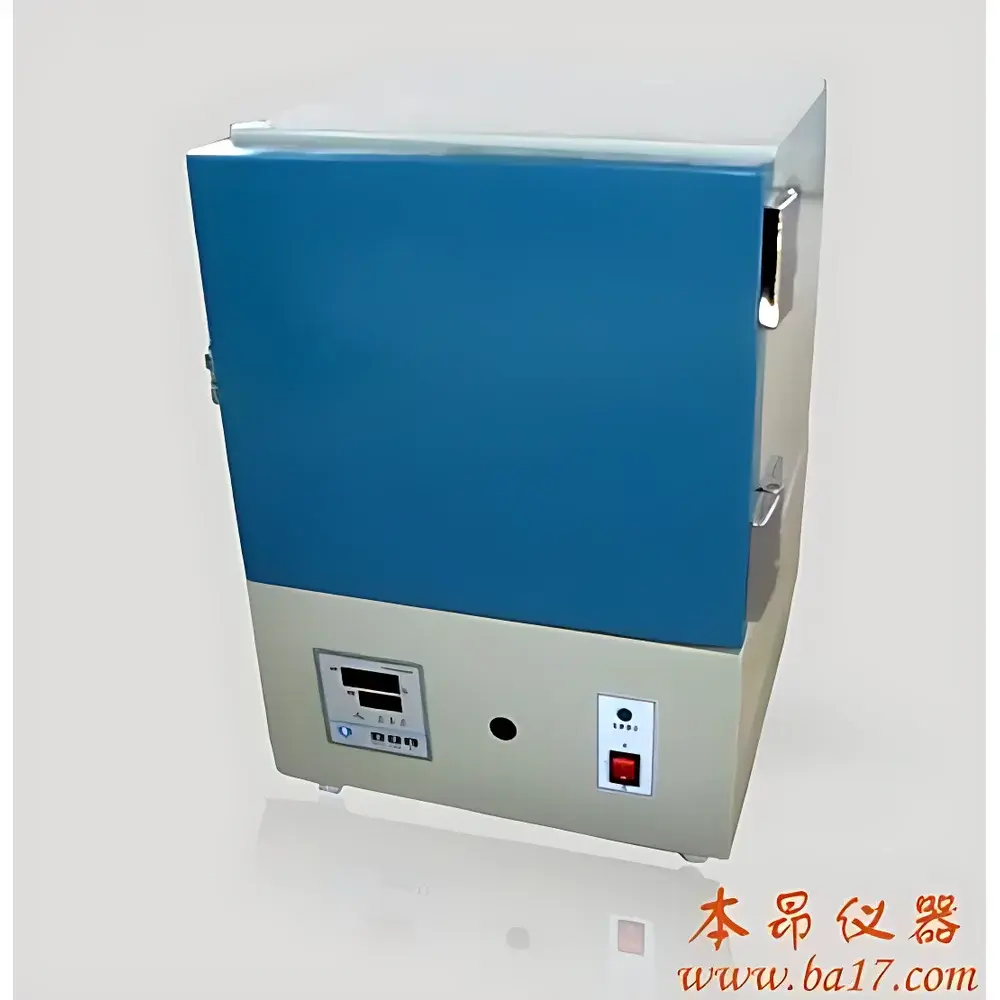
BenAng BA-4-16B Ceramic Fiber Muffle Furnace
| Brand | BenAng |
|---|---|
| Origin | Shanghai, China |
| Model | BA-4-16B |
| Instrument Type | Box-Type Muffle Furnace |
| Max Temperature | 1600 °C |
| Temperature Control Accuracy | ±1 °C |
| Rated Power | 4 kW |
| Heating Rate to 1000 °C | 12 min |
| Internal Chamber Dimensions | 200 × 150 × 150 mm |
| Heating Method | Resistance Wire (Kanthal® A1 Alloy) |
| Insulation Material | High-Purity Ceramic Fiber (50 mm thickness) |
| Temperature Sensor | K-Type Thermocouple (NiCr–NiSi) |
| Control System | PID Digital Controller |
| Voltage Supply | AC 220 V, 50/60 Hz |
Overview
The BenAng BA-4-16B Ceramic Fiber Muffle Furnace is a high-performance laboratory box furnace engineered for rapid, precise, and energy-efficient thermal processing up to 1600 °C. Designed for research laboratories, quality control facilities, and academic institutions, it employs a dual-engineered thermal architecture: ultra-low-conductivity high-purity ceramic fiber insulation (50 mm thick, sourced from U.S.-based manufacturers meeting ASTM C871 specifications) combined with Kanthal® A1 alloy heating elements—industrial-grade resistance wire manufactured in Sweden and certified to EN 60079-0 for use in controlled environments. Unlike conventional refractory brick furnaces, the BA-4-16B achieves 1000 °C in ≤12 minutes with surface temperatures remaining below 60 °C under full-load operation—well within ISO 13732-1 ergonomic safety thresholds for operator proximity. Its compact internal chamber (200 × 150 × 150 mm) supports reproducible heat treatment, ashing, calcination, sintering, and pre-treatment protocols across materials science, environmental analysis, pharmaceutical QA/QC, and coal characterization workflows.
Key Features
- High-efficiency thermal design: 50 mm monolithic ceramic fiber insulation reduces standby heat loss by >70% versus traditional brick-lined muffle furnaces; typical energy consumption is ~40% of comparable refractory units.
- Kanthal® A1 heating elements: Engineered for long-term stability at 1600 °C; resistive uniformity ensures axial and radial temperature homogeneity ≤±3 °C across the working zone (per ASTM E220 calibration protocol).
- PID digital temperature controller with K-type thermocouple input: Delivers ±1 °C setpoint accuracy over the full 100–1600 °C range; includes programmable ramp-soak profiles and auto-tuning functionality.
- Integrated safety architecture: Dual independent overtemperature cutoffs (mechanical and electronic), door-activated power interlock switch, automatic restart inhibition after power interruption, and surface temperature monitoring with cut-off at 85 °C.
- Low particulate emission profile: Non-shedding ceramic fiber construction eliminates fiber dust contamination—critical for trace-level elemental analysis (e.g., ICP-OES sample ashing per EPA Method 3050B) and pharmaceutical residual solvent testing (USP <467>).
Sample Compatibility & Compliance
The BA-4-16B accommodates crucibles (alumina, platinum, silica), porcelain boats, and quartz sample holders up to 120 mm in height. It complies with key regulatory and methodological frameworks including ASTM E1116 (standard practice for muffle furnace calibration), ISO/IEC 17025:2017 clause 6.4.3 (equipment suitability for testing), and GLP Annex 11 requirements for audit-trail-capable instrumentation when paired with optional data logging modules. Its stable thermal field meets USP <231> heavy metals test requirements and ASTM D3174 (ash content in coal) precision criteria. No volatile organic emissions are generated during operation—verified per ISO 16000-9 indoor air testing protocols.
Software & Data Management
While the standard configuration features a front-panel PID controller with local display and manual parameter entry, optional RS485 Modbus RTU interface enables integration into centralized Lab Information Management Systems (LIMS) or SCADA platforms. When connected to compliant third-party software (e.g., WinWedge Pro or LabVIEW-based acquisition suites), the furnace supports timestamped temperature logging, alarm event recording, and electronic signature-enabled report generation—fully aligned with FDA 21 CFR Part 11 requirements for electronic records and signatures where validated configurations are implemented.
Applications
- Materials science: Sintering of advanced ceramics (e.g., SiC, ZrO₂), heat treatment of metal alloys, and thermal gravimetric pre-conditioning.
- Environmental testing: Ashing of soil, sludge, and filter media per EPA Methods 9080A and 9081A; determination of loss on ignition (LOI) in sediment analysis.
- Pharmaceutical development: Residual solvent removal, excipient thermal stability screening, and sterilization validation support.
- Fuel & energy research: Proximate analysis of coal and biomass (moisture, volatile matter, fixed carbon, ash);灰熔点 determination per ISO 540.
- Academic instruction: Undergraduate and graduate labs in inorganic chemistry, metallurgy, and geochemistry requiring repeatable, safe, and instrumented high-temperature exposure.
FAQ
What is the maximum recommended continuous operating temperature?
The BA-4-16B is rated for continuous operation at 1550 °C; 1600 °C is specified as the absolute upper limit for short-duration (<30 min) calibration or process qualification runs.
Can this furnace be used for sulfuric acid digestion residue ashing?
Yes—when using high-purity alumina or platinum crucibles and following ASTM D5133 protocols, the inert atmosphere and low particulate emission ensure minimal blank interference.
Is NIST-traceable calibration documentation available?
Factory calibration certificates (including as-found/as-left data against NIST-traceable reference thermocouples) are provided upon request and may be supplemented with on-site IQ/OQ services.
Does the furnace meet CE or UKCA marking requirements?
The unit conforms to IEC 61000-6-3 (EMC emission) and IEC 61000-6-2 (immunity) standards; CE marking is available for EU-supplied configurations with appropriate conformity assessment.
What maintenance intervals are recommended for the heating elements and insulation?
Under normal usage (≤4 cycles/day), Kanthal® A1 elements typically exceed 3,000 hours of service life; ceramic fiber integrity should be visually inspected quarterly for compression or cracking—replacement is advised if surface emissivity increases beyond 0.85 (measured via portable infrared pyrometer).



