
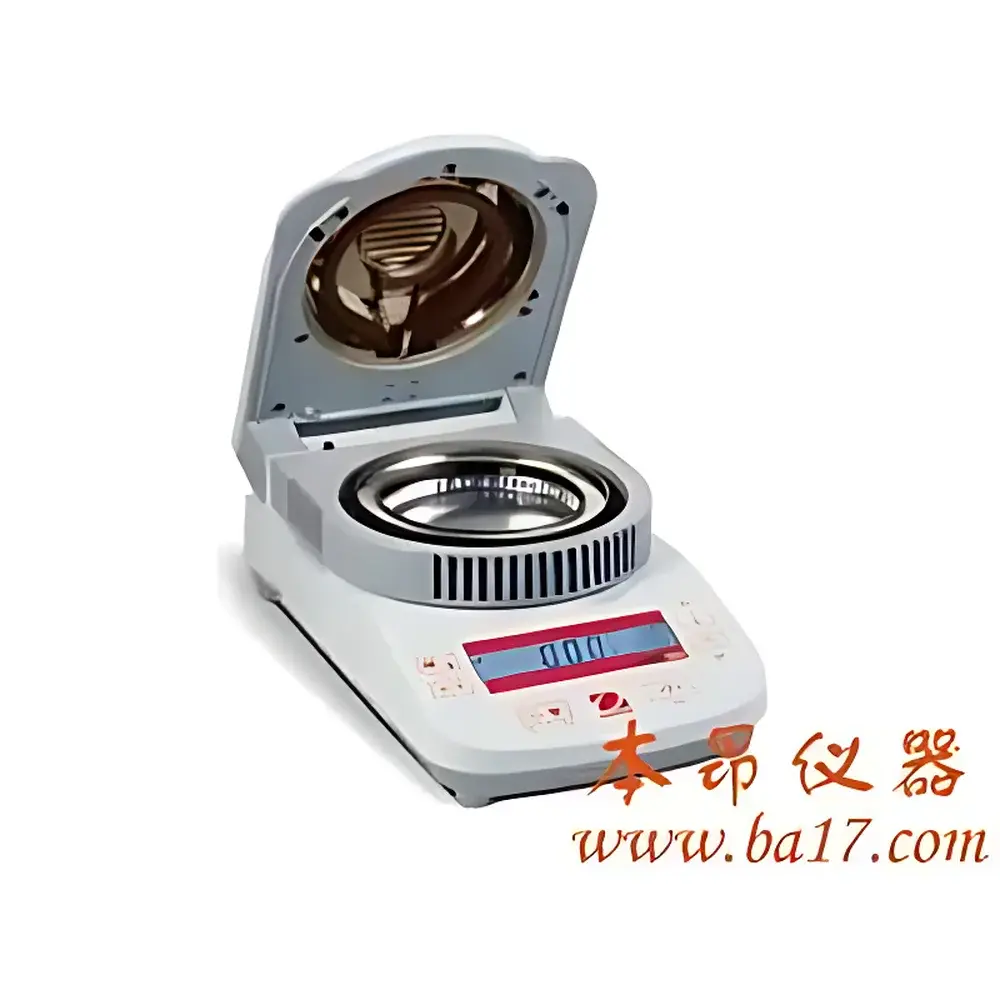
BenAng MB23 Basic Infrared Moisture Analyzer
| Brand | BenAng |
|---|---|
| Origin | Shanghai, China |
| Manufacturer Type | Authorized Distributor |
| Country of Origin | China |
| Model | MB23 |
| Measurement Principle | Infrared Thermogravimetric Analysis |
| Maximum Capacity | 110 g |
| Readability | 0.01 g |
| Moisture Readability (for >10 g sample) | ±0.1% |
| Repeatability (3 g sample) | ±0.3% |
| Repeatability (10 g sample) | ±0.2% |
| Minimum Sample Mass | 0.5 g |
| Recommended Sample Mass | 3–20 g |
| Heating Temperature Range | 50–160 °C (in 5 °C increments) |
| Heating Duration | 1–60 min (30 s step), 60–90 min (1 min step) |
| Endpoint Detection Modes | Timed & Automatic |
| Display | Backlit LCD showing moisture %, solids %, mass (g), time (min:s), temperature (°C) |
| Heating Source | Quartz Infrared Lamp |
| Weighing Pan Diameter | 90 mm |
| Dimensions (W×H×D) | 165 × 127 × 280 mm |
| Net Weight | 2.1 kg |
| Total Shipping Weight | 4.15 kg |
| Operating Ambient Temperature | 10–30 °C |
| Communication Interface | Bidirectional RS232 |
Overview
The BenAng MB23 Basic Infrared Moisture Analyzer is a compact, thermogravimetric instrument engineered for rapid and reliable moisture content determination in solid and semi-solid samples across quality control, R&D, and production environments. It operates on the principle of infrared heating coupled with high-precision analytical weighing: a calibrated quartz infrared lamp uniformly heats the sample, driving off volatile components—primarily water—while an integrated, thermally isolated load cell continuously monitors mass loss in real time. The instrument calculates moisture content (%) as the relative mass difference between initial and final dry weight, referenced to the original sample mass. Designed for routine analysis rather than ultra-trace quantification, the MB23 delivers consistent results under standardized test conditions compliant with ASTM D4442, ISO 712, and AOAC 952.03 methodologies for moisture by loss-on-drying (LOD).
Key Features
- Thermally Isolated Weighing System: Incorporates a proprietary隔热-style (heat-isolated) load cell architecture that minimizes thermal drift during heating cycles, ensuring stable mass readings throughout the drying process—even at elevated temperatures up to 160 °C.
- Intuitive Six-Button Interface: Eliminates layered menu navigation; all core functions—including method selection, start/stop, tare, and display toggle—are accessible via dedicated physical keys for glove-compatible, error-resistant operation in lab or factory settings.
- Backlit Monochrome LCD Display: Provides high-contrast visualization of real-time parameters: moisture %, residual solids %, current mass (g), elapsed time (mm:ss), and chamber temperature (°C), enabling immediate assessment without external software.
- Configurable Drying Protocols: Supports both timed and automatic endpoint detection. Users may define heating duration from 1 to 90 minutes (with 30-second resolution up to 60 minutes, then 1-minute increments), or enable auto-termination based on mass stabilization thresholds.
- Bidirectional RS232 Connectivity: Enables direct communication with serial printers for GLP-compliant hard-copy reporting or integration into LIMS or laboratory data management systems for traceable result export.
Sample Compatibility & Compliance
The MB23 accommodates a broad range of non-volatile or low-volatility matrices including pharmaceutical excipients, food powders (e.g., starches, milk powder), polymers, ceramics, minerals, and agricultural products. Sample mass must fall within the validated operating range (0.5–20 g); optimal precision is achieved at 3–10 g per test. The instrument complies with general requirements for LOD-based moisture analyzers under ISO/IEC 17025-accredited laboratories when operated within specified environmental limits (10–30 °C ambient, <80% RH non-condensing). While not certified for FDA 21 CFR Part 11 compliance out-of-the-box, audit trails and electronic records can be implemented via external software linked through RS232, supporting GMP/GLP documentation workflows.
Software & Data Management
The MB23 operates autonomously without embedded firmware-based data storage. All measurement data—including timestamp, method ID, initial/final mass, moisture %, and heating profile—is transmitted in ASCII format via RS232 upon completion. Compatible third-party applications (e.g., LabX Lite, custom Python/Excel VBA scripts) can parse and log outputs into structured databases. For regulated environments, users are advised to implement controlled document procedures for method validation, instrument calibration (using certified weights and reference standards), and periodic performance verification per USP <921> guidelines.
Applications
- Quality assurance of raw materials in food manufacturing (e.g., flour, sugar, spices)
- Moisture specification verification of tablet granules and API batches in pharmaceutical production
- Process monitoring of dried biomass, activated carbon, or catalyst supports
- Educational use in analytical chemistry laboratories for teaching gravimetric principles
- In-process control of polymer pellets prior to extrusion or injection molding
FAQ
What is the recommended calibration frequency for the MB23?
Calibration should be performed daily before first use using certified 10 g and 50 g test weights, with linearity verification across the full 0–110 g range conducted weekly.
Can the MB23 measure moisture in liquid or paste-like samples?
No—it is designed exclusively for free-flowing or compressible solids; liquids, gels, or highly volatile solvents risk splattering, uneven drying, or sensor contamination and are outside its validated scope.
Is the infrared heating source replaceable by the user?
Yes—the quartz infrared lamp is a field-replaceable component with standard M3 mounting; replacement requires basic mechanical tools and adherence to electrical safety protocols.
Does the MB23 support multiple user-defined methods?
No—method parameters (temperature, time, endpoint mode) must be manually re-entered for each test; it does not store or recall named methods internally.
How is repeatability verified during routine operation?
By analyzing three consecutive measurements of a homogeneous reference material (e.g., sodium tartrate dihydrate) at fixed temperature/time settings; observed %RSD must remain ≤0.3% for 3 g samples per ISO 8573-2 verification criteria.




