
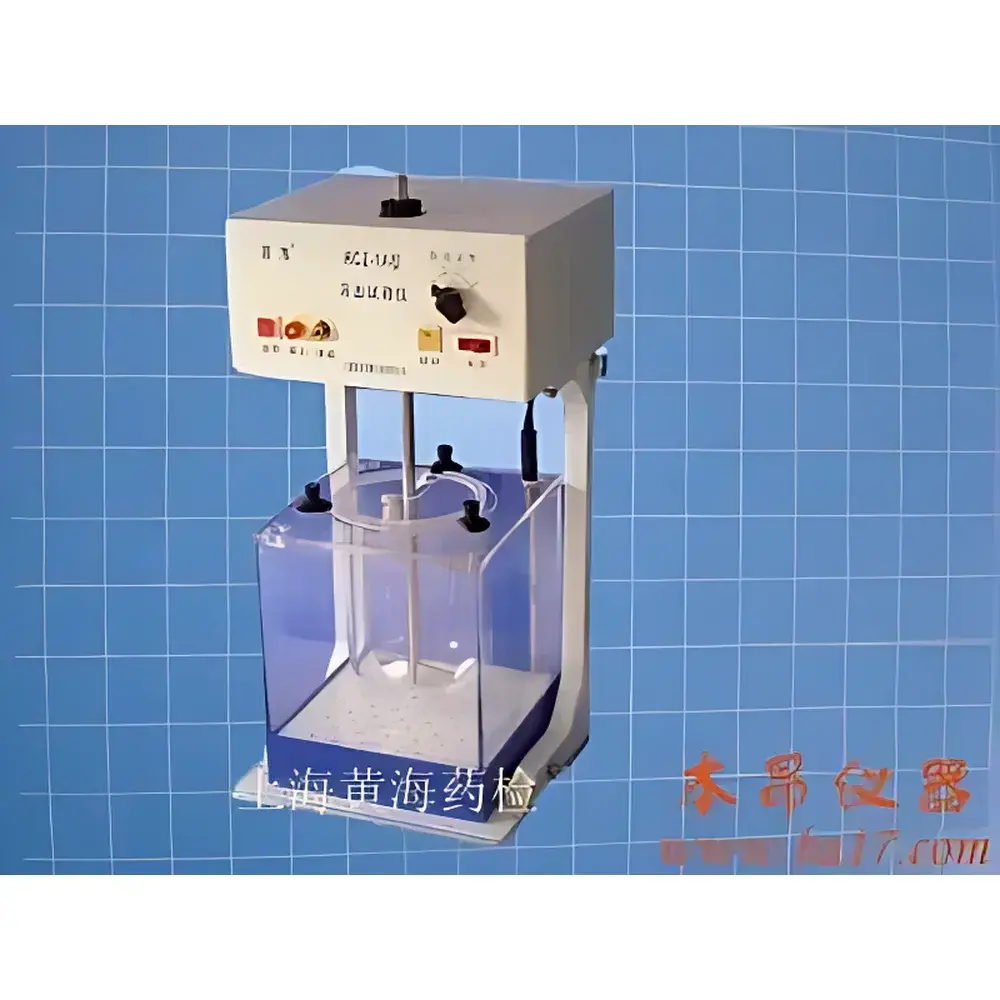
RCZ-1A Single-Vessel Pharmaceutical Dissolution Tester
| Origin | Shanghai, China |
|---|---|
| Manufacturer Type | Authorized Distributor |
| Origin Category | Domestic (China) |
| Model | RCZ-1A |
| Price | USD 600 (FOB Shanghai) |
| Temperature Control Accuracy | ±0.5 °C at 37 °C |
| Rotational Speed Options | 50, 100, 150, 200 rpm |
| Shaft Coaxiality Tolerance | <1 mm |
Overview
The RCZ-1A Single-Vessel Pharmaceutical Dissolution Tester is a precision-engineered benchtop instrument designed to perform standardized dissolution testing of solid oral dosage forms—including tablets, capsules, and controlled-release formulations—in compliance with pharmacopoeial requirements. It operates on the principle of paddle or basket method dissolution (USP Apparatus 2 or 1), where a rotating vessel containing dissolution medium maintains constant temperature and hydrodynamic conditions to simulate gastrointestinal fluid dynamics. Engineered for educational laboratories and early-stage pharmaceutical R&D environments, the RCZ-1A delivers reproducible, traceable dissolution profiles under tightly regulated thermal and mechanical conditions—enabling robust method development, formulation screening, and quality control validation in non-GMP settings.
Key Features
- Microprocessor-controlled temperature regulation with high-stability heating bath, maintaining 37 °C ±0.5 °C across the entire test duration—meeting USP , EP 2.9.3, and ChP 2005 dissolution temperature tolerance criteria.
- Four-step fixed-speed electronic motor drive (50, 100, 150, and 200 rpm), calibrated per USP mechanical verification protocols; speed stability maintained within ±2% of setpoint under load.
- Single-vessel configuration optimized for teaching labs and small-batch comparative studies—reducing reagent consumption, simplifying setup, and minimizing operator training time.
- Stainless-steel dissolution vessel holder and vertical shaft assembly ensure structural rigidity; coaxial alignment tolerance <1 mm meets USP’s requirement for rotational axis deviation, minimizing flow asymmetry and wall effects.
- Compact footprint (W × D × H: 320 × 300 × 480 mm) and low power consumption (≤200 W) support integration into shared instrumentation rooms or undergraduate teaching suites.
Sample Compatibility & Compliance
The RCZ-1A accommodates standard USP/ChP-compliant 1-L cylindrical glass dissolution vessels (Type I or II) and supports common dissolution media including deionized water, 0.1 N HCl, phosphate buffers (pH 4.5–6.8), and surfactant-containing solutions (e.g., SDS 1%). Its design conforms to the dimensional and operational specifications outlined in the Chinese Pharmacopoeia (ChP) 2005 Edition, and its mechanical performance aligns with foundational verification criteria in USP and EP 2.9.3. While not certified for full GMP production-line use, it satisfies GLP-aligned documentation needs for academic research, pre-formulation studies, and internal QC protocol development. All mechanical parameters—including vessel immersion depth, paddle/basket centering, and vibration amplitude—are manually verifiable using standard metrology tools (e.g., dial indicators, laser alignment kits).
Software & Data Management
The RCZ-1A operates as a standalone hardware platform without embedded software or digital data logging. Temperature and rotation settings are configured via front-panel tactile controls with LED status indicators. For regulatory traceability, users are advised to integrate external recording systems—such as calibrated thermistors connected to data loggers (e.g., Omega OM-DAQPRO-5300) or UV-Vis spectrophotometers with time-stamped absorbance output. When deployed in GLP environments, manual entry of test parameters (vessel ID, medium volume, sampling timepoints, temperature readings) into validated electronic lab notebooks (ELN) or LIMS platforms ensures audit-ready documentation. The instrument’s deterministic mechanical behavior supports retrospective validation against reference standards (e.g., predissolved caffeine or salicylic acid tablets) per ICH Q5C stability guidelines.
Applications
- Pharmaceutical education: Hands-on demonstration of dissolution kinetics, sink condition principles, and hydrodynamics in undergraduate pharmaceutics courses.
- Formulation optimization: Rapid screening of excipient effects (e.g., disintegrants, surfactants) on release rate across multiple pH media.
- Bioequivalence support: Generation of comparative dissolution profiles for generic product development prior to full-scale USP four-vessel testing.
- Stability-indicating method development: Correlation of dissolution behavior with accelerated aging conditions (e.g., 40 °C/75% RH) per ICH Q1A(R2).
- Reference standard qualification: Verification of dissolution apparatus performance during periodic mechanical calibration per USP .
FAQ
Does the RCZ-1A comply with current USP mechanical verification requirements?
Yes—its temperature accuracy (±0.5 °C), speed stability, and shaft coaxiality (<1 mm) meet baseline verification thresholds specified in USP for apparatus qualification.
Can it be used for FDA-submitted dissolution data?
No—this single-vessel system is intended for teaching and exploratory R&D only; regulatory submissions require multi-vessel apparatus (e.g., USP Apparatus 1–4) operated under full 21 CFR Part 11-compliant software environments.
Is vessel temperature uniformity verified across the entire 1-L volume?
Per ChP 2005 and USP guidance, users must conduct manual temperature mapping (at 5 radial × 3 axial points) during initial qualification; the RCZ-1A’s bath geometry supports acceptable uniformity when operated at nominal 37 °C with proper medium circulation.
What maintenance is required to sustain mechanical accuracy?
Quarterly verification of paddle centering, shaft runout, and temperature sensor calibration using NIST-traceable references is recommended; no consumable parts require replacement under normal academic-use conditions.
Is technical support available in English for international academic institutions?
Yes—authorized distributors provide English-language operation manuals, mechanical verification checklists, and remote troubleshooting assistance for installation and routine qualification.






