
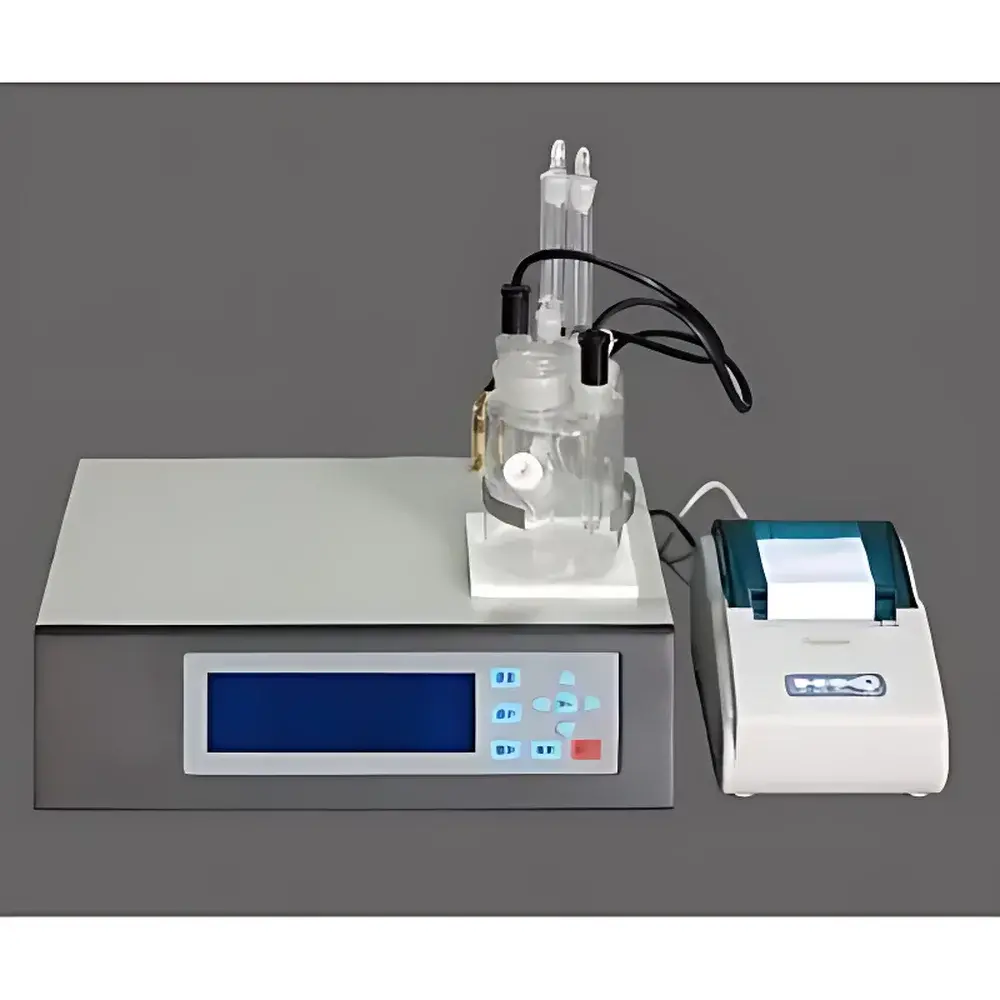
BenAng MA-2A Coulometric Karl Fischer Moisture Titrator
| Brand | BenAng |
|---|---|
| Origin | Shanghai, China |
| Model | MA-2A |
| Instrument Type | Coulometric Karl Fischer Moisture Titrator |
| Moisture Range | 1 ppm to 100% (3 µg – 1000 mg H₂O) |
| Sensitivity Threshold | 0.1 µg H₂O |
| Accuracy | ±2 µg for 3–1000 µg H₂O |
| Electrolysis Current Output | 0–400 mA (auto-controlled) |
| Display | 240 × 64 dot-matrix LCD (blue backlight) |
| Readout Units | % w/w, µg H₂O |
| Minimum Sample Injection Volume | 0.001 mL |
| Power Supply | AC 220 V ±10%, 50 Hz |
| Power Consumption | 30 W |
| Operating Temperature | 5–40 °C |
| Operating Humidity | ≤85% RH |
| Dimensions | 300 × 250 × 100 mm (W × D × H) |
| Interface | RS-232 printer port |
Overview
The BenAng MA-2A Coulometric Karl Fischer Moisture Titrator is a benchtop analytical instrument engineered for high-precision, trace-level moisture quantification in non-aqueous and low-water-content samples. It operates on the fundamental electrochemical principle of coulometric Karl Fischer titration—where iodine is generated *in situ* via controlled electrolysis of an iodide-containing reagent, and stoichiometrically reacts with water according to the classic Karl Fischer reaction: I₂ + SO₂ + H₂O + 3RN + CH₃OH → 2RN·HI + RN·HSO₄CH₃. Unlike volumetric KF systems, the MA-2A eliminates manual burette handling, reagent standardization, and associated environmental exposure risks by generating titrant electrochemically in real time. This architecture ensures exceptional reproducibility for measurements spanning 1 ppm to 100% water content (equivalent to 3 µg to 1000 mg absolute water mass), making it suitable for stringent QC/QA workflows across pharmaceutical excipients, lithium battery electrolytes, polymer resins, and petrochemical solvents.
Key Features
- Coulometric generation of iodine with auto-controlled current output (0–400 mA), enabling dynamic response to sample water load and minimizing over-titration artifacts
- Digital signal processing circuitry with temperature-compensated analog front-end, mitigating drift from ambient thermal fluctuations and line voltage variation (±10% tolerance)
- Integrated moisture calculation engine compliant with ASTM E203 and ISO 760 standards; direct display of results in % w/w and µg H₂O without manual conversion
- High-resolution 240 × 64 dot-matrix blue-backlit LCD with intuitive Chinese-language menu navigation—optimized for laboratory technicians in multilingual operational environments
- RS-232 serial interface supporting optional thermal or impact mini-printer for GLP-compliant hard-copy record generation
- Compact footprint (300 × 250 × 100 mm) and low power draw (30 W) for integration into regulated lab spaces with limited benchtop real estate
Sample Compatibility & Compliance
The MA-2A accommodates liquid, solid, and viscous samples—including hygroscopic powders, oils, monomers, and organic solvents—via standardized injection protocols using gas-tight syringes or automated samplers (external). Its coulometric design inherently avoids contamination from atmospheric moisture ingress during titration, addressing a critical limitation of open-burette volumetric KF systems. The instrument meets essential functional requirements outlined in USP , EP 2.5.12, and JP 2.05 for moisture determination. While not pre-certified for 21 CFR Part 11 compliance out-of-the-box, its data logging architecture supports audit-trail implementation when paired with validated third-party LIMS or ELN platforms. All electrical components conform to IEC 61010-1 safety standards for laboratory equipment.
Software & Data Management
The MA-2A embeds firmware with built-in arithmetic logic for automatic blank subtraction, endpoint detection via dual-current threshold algorithm, and real-time current-integration for coulombic charge calculation (Q = ∫I·dt). Results are stored internally with timestamp and operator ID fields (user-assigned). Raw current vs. time profiles and integrated charge values are exportable via RS-232 to CSV-compatible spreadsheets for secondary statistical analysis (e.g., ANOVA, control charting per ISO 80000-1). No proprietary software installation is required; basic data retrieval uses standard terminal emulation (e.g., PuTTY). For GMP environments, laboratories may configure external validation documentation packages covering IQ/OQ/PQ protocols aligned with Annex 11 principles.
Applications
- Pharmaceutical manufacturing: Residual solvent analysis in APIs, moisture testing of lyophilized products, and excipient qualification per ICH Q5C guidelines
- Energy sector: Water content verification in lithium hexafluorophosphate (LiPF₆) electrolytes and NMP solvent recovery streams
- Petrochemical QA: Trace moisture assessment in transformer oils (IEC 60814), jet fuels (ASTM D6304), and synthetic lubricants
- Chemical R&D: Kinetic studies of hydrolysis-sensitive intermediates and catalyst hydration state monitoring
- Food & feed: Quantification of bound water in starch derivatives and protein isolates where oven-drying yields inaccurate results
FAQ
What distinguishes coulometric from volumetric Karl Fischer titration?
Coulometric KF generates iodine electrochemically within the titration cell, offering superior precision below 100 ppm and eliminating reagent standardization. Volumetric KF relies on pre-standardized iodine solutions delivered via burette—more suitable for higher water concentrations (>1000 ppm) but vulnerable to atmospheric moisture uptake.
Can the MA-2A analyze solid samples directly?
Yes—when used with a dedicated oven attachment (sold separately) or via solvent extraction (e.g., methanol/chloroform), enabling dissolution and transfer of bound water into the KF cell.
Is method validation support available for regulatory submissions?
BenAng provides instrument specification sheets, calibration certificates traceable to NIM (National Institute of Metrology, China), and application notes aligned with ASTM/ISO test protocols—serving as foundational documentation for user-led validation activities.
What maintenance intervals are recommended for optimal performance?
Daily: Cell cleaning with dry methanol; weekly: reference electrode inspection and catholyte replacement; annually: full system verification using certified water standards (e.g., 1.00 ± 0.02 mg H₂O/ampoule).
Related Products





