
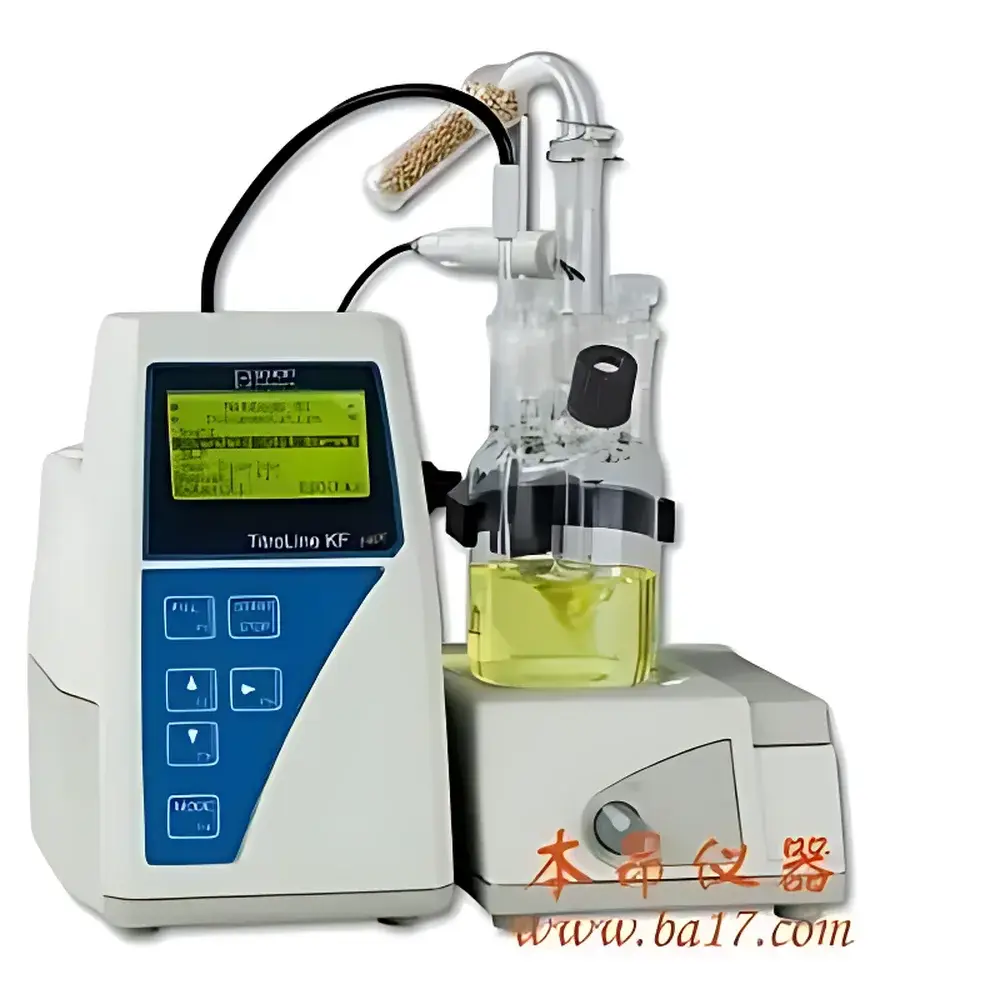
Schott Titroline KF M3 Aldehyde- and Ketone-Specific Karl Fischer Moisture Analyzer
| Origin | Shanghai, China |
|---|---|
| Manufacturer Type | Authorized Distributor |
| Origin Category | Domestic (China) |
| Model | Titroline KF M3 |
| Price | ¥88,200 |
| Moisture Range | 10 µg – 100 mg H₂O (1 ppm – 100%) |
| Accuracy | 0.1 µg |
| Precision | ±3 µg (10–1000 µg), ±0.3% (>1 mg) |
| Max. Titration Rate | ~2 mg/min |
| Electrode | Membrane-Type Generator Electrode TZ1753 |
| Display | 64×128-pixel backlit LCD (8 lines), real-time titration curve |
| Compliance | DIN 12650 Part 5, EN ISO 8655-3 |
| Data Output Units | %, ppm, mg, mg/L, mg/pc, µg |
| Integrated Titration Stand | TMKF with integrated aspiration/dispensing pump |
| GLP Features | Audit-trail-capable blank titration, auto-start on sample addition, method recall, statistical reprocessing (mean, SD, RSD), real-time curve export |
Overview
The Schott Titroline KF M3 is a dedicated coulometric Karl Fischer moisture analyzer engineered for high-precision quantification of water content in chemically challenging samples—particularly aldehydes and ketones. Unlike conventional volumetric KF systems, the Titroline KF M3 employs a membrane-separated coulometric generator electrode (TZ1753) to eliminate side reactions caused by carbonyl compounds reacting with iodine or sulfur dioxide in standard KF reagents. This design ensures stoichiometric accuracy and long-term reagent stability, critical for laboratories performing QC/QA in pharmaceutical excipient manufacturing, fine chemical synthesis, polymer resin production, and solvent purification. The instrument operates on the fundamental electrochemical principle defined in ASTM E203 and ISO 760: water is consumed in a coulometrically generated iodine reaction at the anode, with current integration yielding absolute mass determination (µg H₂O) independent of reagent concentration drift. Its measurement range spans 10 µg to 100 mg H₂O—covering trace-level analysis (1 ppm in 1 g sample) through to high-moisture formulations—with inherent accuracy of 0.1 µg and precision validated per EN ISO 8655-3 for piston burette performance.
Key Features
- Membrane-type coulometric generator electrode TZ1753—specifically optimized to suppress aldol condensation and enolization side reactions during water determination in aldehydes (e.g., formaldehyde, acetaldehyde) and ketones (e.g., acetone, cyclohexanone, methyl ethyl ketone).
- Integrated TMKF titration stand with dual-function peristaltic pump: fully automated reagent dispensing, waste aspiration, and cell rinsing—minimizing operator intervention and cross-contamination risk.
- Real-time 8-line backlit LCD display (64 × 128 pixels) showing dynamic titration curves, current/voltage profiles, endpoint detection status, and live moisture accumulation—enabling immediate method optimization and outlier identification.
- Preloaded library of 10 GLP-compliant methods: including blank titration, sample titration, drift correction, and multi-point calibration—each editable for solvent type, cell volume, electrode polarity, and endpoint threshold.
- Auto-start functionality triggered upon sample injection—eliminating manual timing errors; supports post-run reprocessing via weight/volume re-entry for statistical validation without re-titration.
- Full compliance with DIN 12650 Part 5 (Karl Fischer apparatus specifications) and EN ISO 8655-3 (piston burettes)—ensuring metrological traceability and audit readiness for regulated environments.
Sample Compatibility & Compliance
The Titroline KF M3 is validated for direct analysis of low-molecular-weight and high-reactivity carbonyl compounds—including but not limited to benzaldehyde, diacetyl, levulinic acid, and diketones—without derivatization or solvent masking. It accommodates liquid samples (neat or diluted in KF-compatible solvents such as chloroform/methanol mixtures), viscous oils, and solid matrices when coupled with the optional KF oven (e.g., Schott KF Oven 2000). All system operations adhere to Good Laboratory Practice (GLP) requirements: full electronic audit trail (timestamped method parameters, operator ID, raw current integrals, blank corrections), secure user access levels, and non-modifiable result archives. For regulated pharmaceutical applications, the instrument supports 21 CFR Part 11–compliant data integrity workflows when paired with Schott’s Titroline Data Manager software (sold separately).
Software & Data Management
While the Titroline KF M3 operates autonomously via its embedded firmware, it provides RS232 and USB interfaces for bidirectional communication with external PCs. Raw titration data—including time-stamped current values, calculated water mass, drift-corrected endpoints, and statistical summaries (mean, SD, RSD)—can be exported in CSV format for LIMS integration or Excel-based trending. Optional PS/2 keyboard connectivity simplifies method naming, sample ID entry, and parameter adjustment during routine operation. When used with Titroline Data Manager v3.x, the system enables centralized method deployment, electronic signature capture, electronic batch records (EBR), and automated report generation compliant with ISO/IEC 17025 and ICH Q2(R2) analytical procedure validation guidelines.
Applications
- Pharmaceutical: Water content verification in APIs containing reactive carbonyl groups (e.g., corticosteroids, prostaglandins, cephalosporin intermediates) per USP and Ph. Eur. 2.5.12.
- Chemical Manufacturing: QC of solvent batches (acetone, MEK, THF) where residual water affects downstream Grignard or hydride reductions.
- Polymers & Resins: Moisture assessment in polyurethane prepolymers and epoxy hardeners—critical for gel time control and final cure integrity.
- Food & Flavorings: Quantification of bound water in aldehyde-rich natural extracts (e.g., vanillin, cinnamaldehyde) without overestimation from side reactions.
- Electrolyte Formulations: Trace moisture screening in lithium-ion battery electrolyte solvents (e.g., EC/DMC blends) prior to cell filling.
FAQ
Why is the TZ1753 membrane electrode essential for aldehyde/ketone analysis?
The TZ1753 physically isolates the iodine-generation compartment from the sample chamber, preventing direct contact between reactive carbonyls and iodine/sulfur dioxide—thereby eliminating erroneous water readings from competing redox pathways.
Can the Titroline KF M3 be used for non-carbonyl samples?
Yes—it functions as a general-purpose coulometric KF analyzer for all standard applications (e.g., hydrocarbons, alcohols, esters); however, its optimized electrode geometry and firmware tuning deliver superior reproducibility specifically for carbonyl-rich matrices.
Is method validation support included?
The instrument includes built-in tools for repeatability testing, intermediate precision checks, and limit-of-quantitation (LOQ) verification per ICH Q2(R2); application notes and validation templates are available from Schott Technical Support.
What maintenance is required for long-term stability?
Daily: Electrode cleaning with dry methanol; weekly: membrane inspection and catholyte replacement; annually: pump tubing replacement and amperometric calibration using certified water standards (e.g., Hydranal CertiPUR).
Does the system meet FDA 21 CFR Part 11 requirements out-of-the-box?
The hardware and firmware provide foundational controls (audit trail, electronic signatures, data immutability); full Part 11 compliance requires configuration of Titroline Data Manager with validated IT infrastructure and documented SOPs.





