
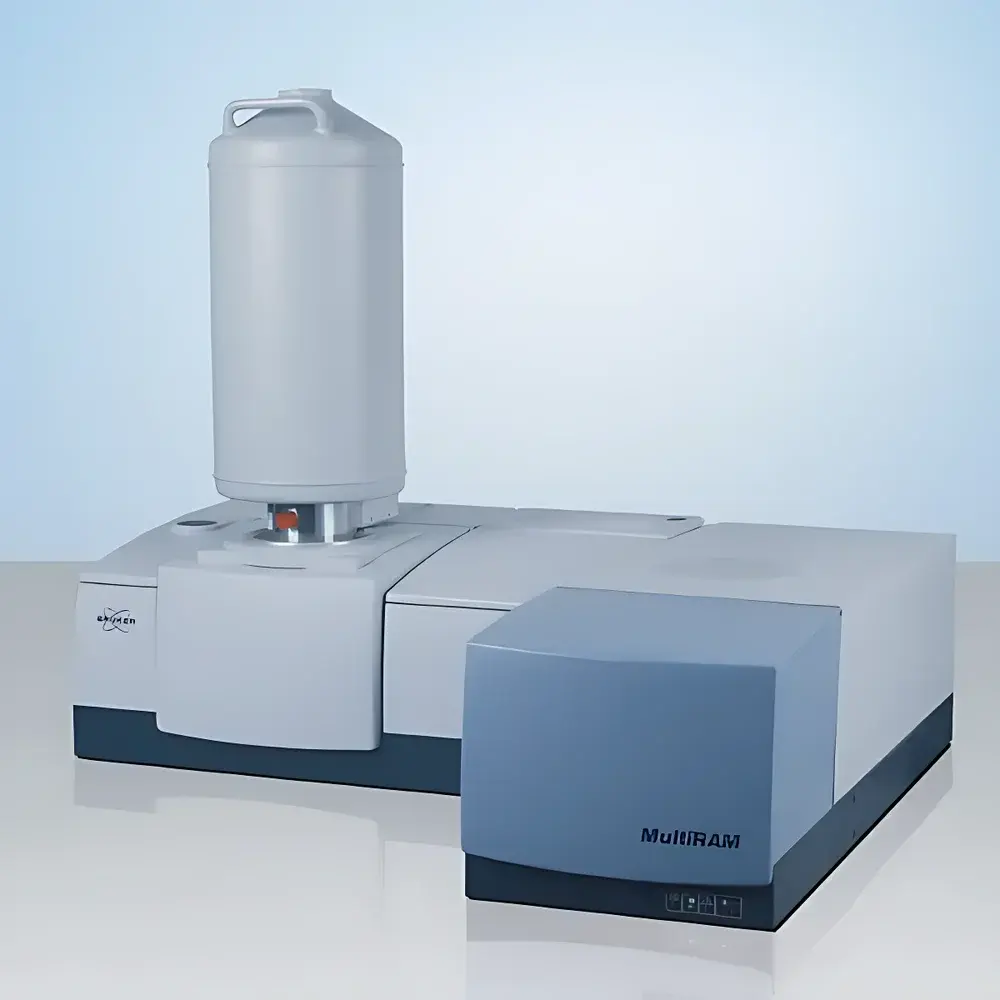
Bruker MultiRAM Fourier Transform Raman Spectrometer
| Brand | Bruker |
|---|---|
| Origin | Germany |
| Model | MultiRAM |
| Instrument Type | Fourier Transform Raman Spectrometer |
| Spectral Range | 3600 – 50 cm⁻¹ (Stokes shift) |
| Spectral Resolution | < 0.5 cm⁻¹ |
| Interferometer | RockSolid™ permanent alignment, gold-coated optics |
| Laser Source | Software-controlled Nd:YAG, 1064 nm |
| Detectors | Optional RT InGaAs (1 or 2), proprietary liquid-nitrogen-cooled Ge detector |
| Sample Chamber | Triple-side access, motorized stage, 90° scattering geometry, defocusing optics, integrated white-light source for response calibration |
| Accessories | Polarization module, dual fiber coupling ports, automated sample changer (cryo- and thermo-capable), RamanScope III FT-Raman microscope integration, SENTERRA II compact Raman microscope compatibility |
Overview
The Bruker MultiRAM is a high-performance Fourier Transform Raman (FT-Raman) spectrometer engineered for quantitative molecular characterization across demanding research and industrial quality control environments. Unlike dispersive Raman systems, the MultiRAM employs interferometric detection based on the Michelson principle, delivering inherent wavelength accuracy, exceptional signal-to-noise ratio (SNR), and high spectral reproducibility—critical for long-term stability in regulated laboratories. Its core optical architecture centers on the RockSolid™ interferometer: a monolithic, permanently aligned design with gold-coated mirrors and broadband quartz beam splitter, eliminating mechanical drift and enabling robust operation under variable thermal and vibrational conditions. The system operates exclusively with a 1064 nm Nd:YAG laser excitation source, minimizing fluorescence interference commonly encountered in visible-range Raman analysis—making it particularly suitable for polymers, pharmaceuticals, carbon-based materials, and thermally labile biological samples.
Key Features
- RockSolid™ interferometer with gold-coated optics ensures long-term alignment stability and minimal maintenance over extended operational cycles.
- Full spectral coverage from 3600 to 50 cm⁻¹ (Stokes shift) at resolution better than 0.5 cm⁻¹, compliant with ASTM E1840 and ISO 8601 standards for spectral data acquisition.
- Dual-detector capability: configurable with one or two room-temperature InGaAs detectors for routine throughput, or paired with Bruker’s proprietary liquid-nitrogen-cooled germanium (Ge) detector for ultra-low-signal applications requiring maximum sensitivity.
- Extended cryogenic hold time: up to 7 days of continuous operation without refilling, supporting unattended overnight and multi-shift analyses.
- Triple-access sample chamber with motorized XYZ stage, 90° scattering geometry, and defocusing optics—enabling safe analysis of heat-sensitive or photoactive samples without thermal degradation.
- Integrated white-light source for real-time instrument response function calibration, ensuring traceable spectral intensity correction per ISO/IEC 17025 requirements.
Sample Compatibility & Compliance
The MultiRAM accommodates diverse sample forms—including solids, powders, gels, liquids, and thin films—via interchangeable sampling interfaces. Its large-volume chamber supports macro- and micro-sampling configurations, including direct coupling to Bruker’s RamanScope III FT-Raman microscope and SENTERRA II compact Raman microscope for diffraction-limited spatial resolution down to ~1 µm. Optional accessories include temperature-controlled stages (–196 °C to +600 °C), automated sample changers with barcode recognition, polarization modulation modules, and dual-fiber input/output for remote or hazardous environment deployment. The system meets key regulatory expectations for analytical instrumentation: full audit trail support, electronic signature readiness, and compatibility with 21 CFR Part 11-compliant LIMS and ELN platforms when operated with OPUS software in GLP/GMP mode.
Software & Data Management
Controlled exclusively by Bruker’s OPUS spectroscopy software suite, the MultiRAM provides a validated, modular environment for acquisition, processing, and reporting. OPUS includes advanced baseline correction algorithms (e.g., asymmetric least squares), peak fitting with Voigt or pseudo-Voigt line shapes, multivariate analysis (PCA, PLS), and spectral library search against >15,000 reference spectra. All raw interferograms and processed spectra are stored in Bruker’s proprietary .OPUS binary format, preserving metadata such as instrument configuration, environmental conditions, and user credentials. Data export complies with ASTM E1421 and ICH Q5C guidelines, supporting CSV, JCAMP-DX, and ASCII formats for third-party chemometric tools. Automated report generation adheres to ISO 17025 documentation requirements, including uncertainty estimation per GUM principles.
Applications
The MultiRAM is routinely deployed in polymer crystallinity assessment, pharmaceutical polymorph identification, carbon nanomaterial characterization (e.g., graphene defect density, SWCNT chirality), battery electrode composition mapping, forensic trace evidence analysis, and geological mineral phase quantification. Its low-fluorescence 1064 nm excitation enables reliable measurement of highly fluorescent dyes, biological tissues, and aged organic artifacts where conventional 532 nm or 785 nm systems fail. In QC settings, it supports raw material verification, blend uniformity testing, and stability-indicating assay development—fully traceable to NIST-traceable Raman standards.
FAQ
What is the primary advantage of FT-Raman over dispersive Raman in the MultiRAM?
FT-Raman provides superior wavenumber accuracy, higher throughput (Jacquinot advantage), and enhanced rejection of stray light and Rayleigh scatter—critical for weak Raman signals in complex matrices.
Can the MultiRAM be used for in situ or process monitoring?
Yes—via optional fiber-optic probes and ruggedized external sampling heads compatible with reactor vessels, gloveboxes, or cleanroom environments.
Is the liquid-nitrogen-cooled Ge detector required for all applications?
No—it is recommended for low-concentration analytes, weak-scattering samples, or high-resolution studies; RT InGaAs detectors suffice for routine polymer or pharmaceutical QC.
How does the MultiRAM ensure compliance with FDA or EU GMP requirements?
Through OPUS software’s 21 CFR Part 11 mode, including role-based access control, electronic signatures, immutable audit trails, and IQ/OQ/PQ documentation templates.
What calibration standards are supported for instrument qualification?
NIST-traceable polystyrene film (for wavenumber accuracy), cyclohexane (for resolution verification), and SRM 2241 (for intensity linearity).





