
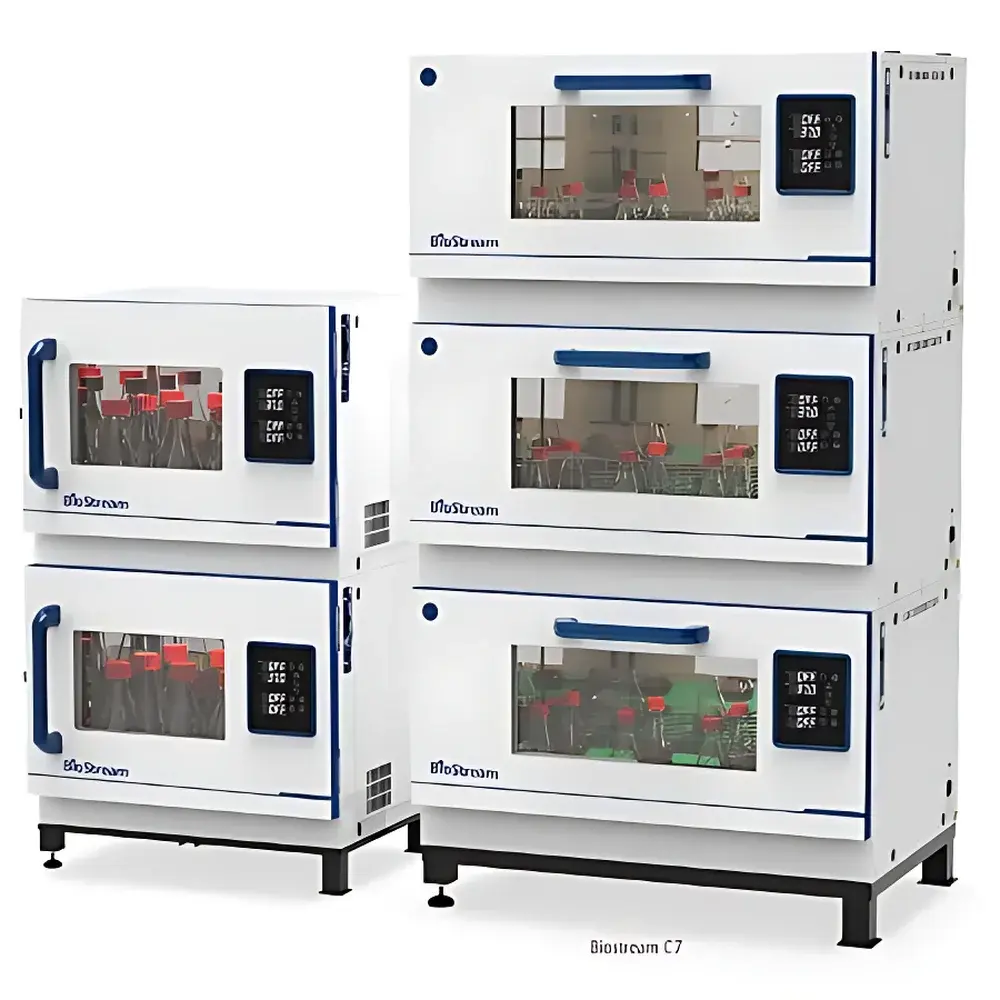
Biostream C7/C5/C3 Modular Shaking Incubator
| Brand | Biostream |
|---|---|
| Origin | Netherlands |
| Model | C7 / C5 / C3 |
| Category | Modular, Under-Counter & Stackable Shaking Incubator |
| Drive System | Fully Enclosed Magnetic Drive |
| Construction | Stainless Steel (AISI 304), Sanitary Radius Corners |
| Door Type | Counterweight-Assisted Downward-Pull Door with Integrated Work Platform |
| Temperature Range | Ambient +5°C to 65°C (±0.1°C uniformity) |
| Shaking Mode | Orbital (25–300 rpm), Adjustable Amplitude (12.5–50 mm) |
| Compliance | Designed for GLP/GMP environments, IP54-rated electronics enclosure, FDA 21 CFR Part 11–ready software architecture |
Overview
The Biostream C7/C5/C3 Modular Shaking Incubator is an engineered solution for laboratories requiring high-integrity, space-constrained cell culture and bioprocessing workflows. Based on the principle of orbital shaking combined with precise thermoregulation in a fully sealed incubation chamber, this system delivers reproducible physiological conditions for mammalian, insect, and microbial cultures. Unlike conventional top-hinged or side-opening shakers, the C7 series employs a downward-pull door mechanism that doubles as a stable sample access platform—enabling full 100% tray extension without auxiliary fixtures or lever-based mechanisms. Its modular architecture supports single-unit benchtop placement, under-bench integration, or vertical stacking up to three tiers (C7-C5-C3 configuration), with the topmost tray accessible at ≤1.4 m from floor level—addressing ergonomic constraints in modern core facilities and GMP-compliant cleanrooms.
Key Features
- Modular Spatial Integration: Configurable as standalone units (C7), mid-tier (C5), or base-layer (C3); compatible with standard lab furniture depth (≤600 mm) and height clearance (≤1.8 m for triple stack).
- Sanitary Mechanical Architecture: All wetted surfaces—including inner chamber walls, door liner, and tray support rails—are constructed from electropolished AISI 304 stainless steel with ≥R3 radius corners, enabling validated cleaning-in-place (CIP) and steam sterilization (SIP) protocols.
- Magnetic Drive System: Brushless, low-voltage magnetic coupling eliminates mechanical shafts and seals—reducing heat generation (<0.5 W internal thermal load), eliminating lubricant contamination risk, and ensuring long-term drive stability across humidity ranges up to 95% RH non-condensing.
- Downward-Pull Door with Load-Bearing Platform: Counterbalanced door opens vertically downward and locks at 90°, forming a rigid, 15 kg-rated work surface; tray slides forward via self-aligning magnetic rail system without screws, cams, or manual repositioning.
- Environmental Resilience: Electronics, motor driver, and power supply are housed externally in an IP54-rated enclosure; incubation chamber is fully waterproof—allowing direct aqueous decontamination, including 70% ethanol, hydrogen peroxide vapor, or sporicidal agents.
Sample Compatibility & Compliance
The C7/C5/C3 accommodates standard culture vessels including Erlenmeyer flasks (50–5000 mL), roller bottles, multi-well plates (up to 384-well), and custom bioreactor bags (via optional clamping adapters). Its temperature uniformity (±0.1°C at setpoint) and orbital motion profile (25–300 rpm, amplitude 12.5–50 mm) meet ASTM E1358-22 requirements for shaker validation. The system’s construction and documentation support qualification under ISO 13485 (for medical device manufacturing), USP (cell therapy process equipment), and EU Annex 1 (sterile processing). Full traceability logs—including door open/close events, temperature excursions, and shake parameter changes—are timestamped and digitally signed in accordance with FDA 21 CFR Part 11 requirements when paired with Biostream ControlSuite v3.2+.
Software & Data Management
Biostream ControlSuite provides role-based access control (RBAC), audit-trail-enabled parameter logging, and real-time remote monitoring via Ethernet or Wi-Fi (TLS 1.2 encrypted). Users define multi-step protocols with independent ramp/soak profiles for temperature and shaking parameters; all changes trigger automatic electronic signature capture. Data export complies with ASTM E2500-20 (validation data format) and is compatible with LIMS integration through OPC UA or CSV/JSON APIs. Optional IQ/OQ documentation packages include factory-calibrated temperature mapping reports (per ISO 14644-3), vibration spectrum analysis, and electromagnetic compatibility (EMC) test summaries.
Applications
- Mammalian suspension culture (CHO, HEK293) under controlled DO and shear stress regimes
- Insect cell expansion (Sf9, Sf21) requiring gentle agitation (≤100 rpm, 12.5 mm amplitude)
- Protein expression in E. coli and yeast systems with inducible promoters
- Stem cell differentiation assays requiring synchronized mechanical stimulation
- Microbial fermentation optimization under variable pH/temperature/shake combinations
- Bioburden reduction studies using validated thermal-hygrometric cycles
FAQ
Can the C7 be installed under a standard laboratory bench?
Yes—the C7 unit has a total height of 595 mm and requires only 100 mm rear clearance for ventilation; it fits beneath most 850 mm-high lab benches with integrated cable management grommets.
Is autoclaving of internal components supported?
No internal parts are designed for autoclaving; however, the entire chamber may be sterilized using vaporized hydrogen peroxide (VHP) at concentrations up to 1200 ppm for 60 minutes, validated per ISO 14644-3 Annex B.
How is vibration isolation achieved during stacking?
Each tier incorporates elastomeric interface pads with 5–10 Hz natural frequency decoupling; structural resonance is suppressed via tuned mass dampers embedded in the C3 base module.
Does the system support CO₂ control?
CO₂ regulation is not natively integrated but can be added via third-party gas mixing modules connected to the chamber’s external gas inlet port (¼” NPT), with feedback control managed through ControlSuite’s analog I/O expansion slot.
What maintenance intervals are recommended?
Magnetic drive calibration and temperature sensor verification are recommended annually; stainless steel surface passivation should be performed quarterly in GMP environments per ASTM A967-22.





