
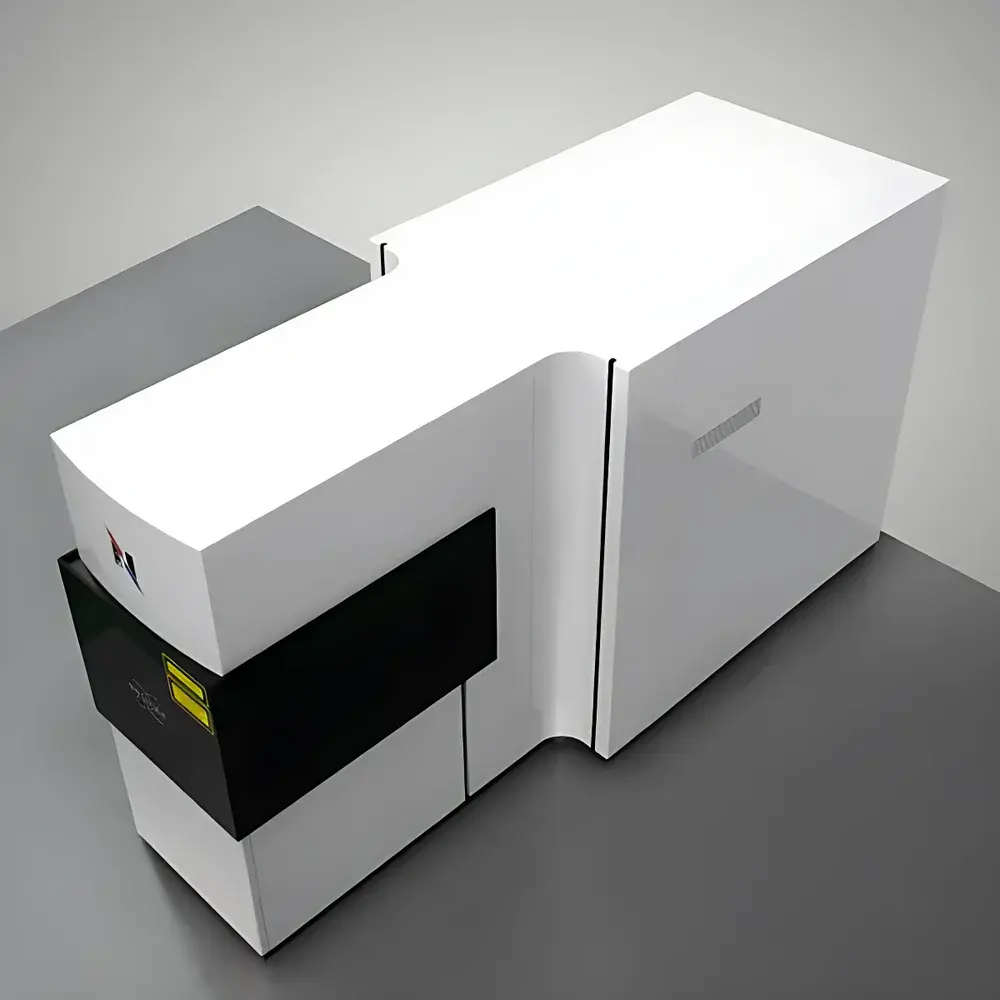
Bruker RAMANwalk Raman Microscope
| Brand | Bruker |
|---|---|
| Origin | Germany |
| Manufacturer Type | Authorized Distributor |
| Origin Category | Imported |
| Model | RAMANwalk |
| Instrument Type | Fourier Transform Raman Spectrometer |
| Spatial Resolution | 350 nm in X and Y |
Overview
The Bruker RAMANwalk Raman Microscope is a high-performance, fully automated confocal Raman imaging system engineered for rapid, high-fidelity chemical mapping of heterogeneous samples. Unlike conventional point-scanning or raster-based Raman microscopes, RAMANwalk implements a stochastic path optimization algorithm—termed “random walk”—to dynamically determine the most information-rich acquisition sequence without prior knowledge of sample composition or morphology. This approach leverages real-time spectral variance detection: when the system identifies statistically distinct Raman scattering signatures (e.g., characteristic peaks indicating polymorphs, contaminants, or phase boundaries), it triggers localized adaptive sampling, thereby concentrating measurement time where chemical heterogeneity is highest. The instrument operates on a confocal epi-illumination architecture with a high-numerical-aperture objective, integrated galvanometric scanning mirrors, and a high-throughput spectrograph coupled to a thermoelectrically cooled CCD detector. Its core measurement principle is spontaneous Raman scattering excited by a single-frequency near-infrared (NIR) laser (typically 785 nm), with spectral data acquired in the range of ~100–3500 cm⁻¹ at resolution <2 cm⁻¹ (FWHM). Designed for routine laboratory use, RAMANwalk delivers sub-micron spatial resolution and reproducible spectral fidelity compliant with ISO/IEC 17025 requirements for analytical instrumentation validation.
Key Features
- Stochastic path optimization engine enabling up to 5× faster Raman image acquisition versus conventional raster scanning
- Confocal optical design with diffraction-limited lateral resolution of 350 nm (X/Y) and axial resolution of 1 µm (Z) using standard 100× objective
- Galvo-controlled laser beam steering for high-speed, non-mechanical scanning without stage movement artifacts
- Fully automated hardware alignment and spectral calibration—including daily drift compensation via internal neon reference line
- Integrated motorized XYZ stage with piezo-driven Z-focus for precise 3D volumetric imaging
- Real-time spectral clustering and on-the-fly region-of-interest (ROI) definition during acquisition
Sample Compatibility & Compliance
RAMANwalk accommodates solid, powder, thin-film, and encapsulated samples on standard microscope slides or wafer substrates (up to 150 mm diameter). It supports ambient, inert-gas, and temperature-controlled environments (−180 °C to +600 °C with optional stages). All optical and electronic subsystems comply with CE, IEC 61010-1 (safety), and IEC 60825-1 (laser safety Class 1 enclosure). Data integrity workflows meet GLP/GMP documentation requirements, with optional FDA 21 CFR Part 11–compliant audit trail and electronic signature modules available through OPUS software. Instrument performance verification follows ASTM E1840 and ISO 8573-9 protocols for spectral accuracy and spatial registration.
Software & Data Management
Controlled exclusively via Bruker’s OPUS 8.x platform, RAMANwalk provides unified access to acquisition, processing, and reporting. The software includes embedded multivariate analysis tools (PCA, cluster analysis, MCR-ALS), quantitative spectral deconvolution, and automated phase identification against the integrated BRUKER Raman Database (containing >12,000 reference spectra). All raw hyperspectral cubes (.raw/.spd) are stored in HDF5 format with embedded metadata (excitation wavelength, grating position, integration time, objective ID, environmental conditions). Batch processing pipelines support automated report generation in PDF/XLSX formats with customizable templates aligned to ISO/IEC 17025 clause 7.8 reporting requirements.
Applications
- Pharmaceutical solid-state characterization: polymorph distribution, API-excipient interactions, coating uniformity
- Materials science: carbon allotrope mapping (graphene, nanotubes), stress/strain analysis in semiconductors, corrosion product identification
- Geosciences: mineral phase assemblage quantification in thin sections, fluid inclusion analysis
- Forensics: trace evidence differentiation (paint chips, fibers, explosives residues) without destructive preparation
- Life sciences: label-free cellular component mapping (lipids, proteins, nucleic acids) in fixed tissue sections
FAQ
Does RAMANwalk require user-defined regions of interest before acquisition?
No. The random walk algorithm initiates acquisition without pre-defined ROIs and autonomously identifies chemically distinct domains during live spectral monitoring.
Is spectral calibration traceable to NIST standards?
Yes. Internal neon lamp reference lines provide wavelength calibration traceable to NIST SRM 2035, with certificate of calibration included with each instrument shipment.
Can RAMANwalk perform depth profiling?
Yes. Confocal Z-stepping combined with automatic focus stabilization enables reproducible 3D Raman tomography with 1 µm axial step resolution.
What laser safety class does the system operate under?
The fully enclosed optical path meets IEC 60825-1 Class 1 requirements; no operator laser safety training is required for routine operation.
Is remote operation supported?
Yes. OPUS supports secure remote desktop access and scheduled unattended acquisitions via Windows Remote Desktop Protocol (RDP) with enterprise-grade authentication.





