
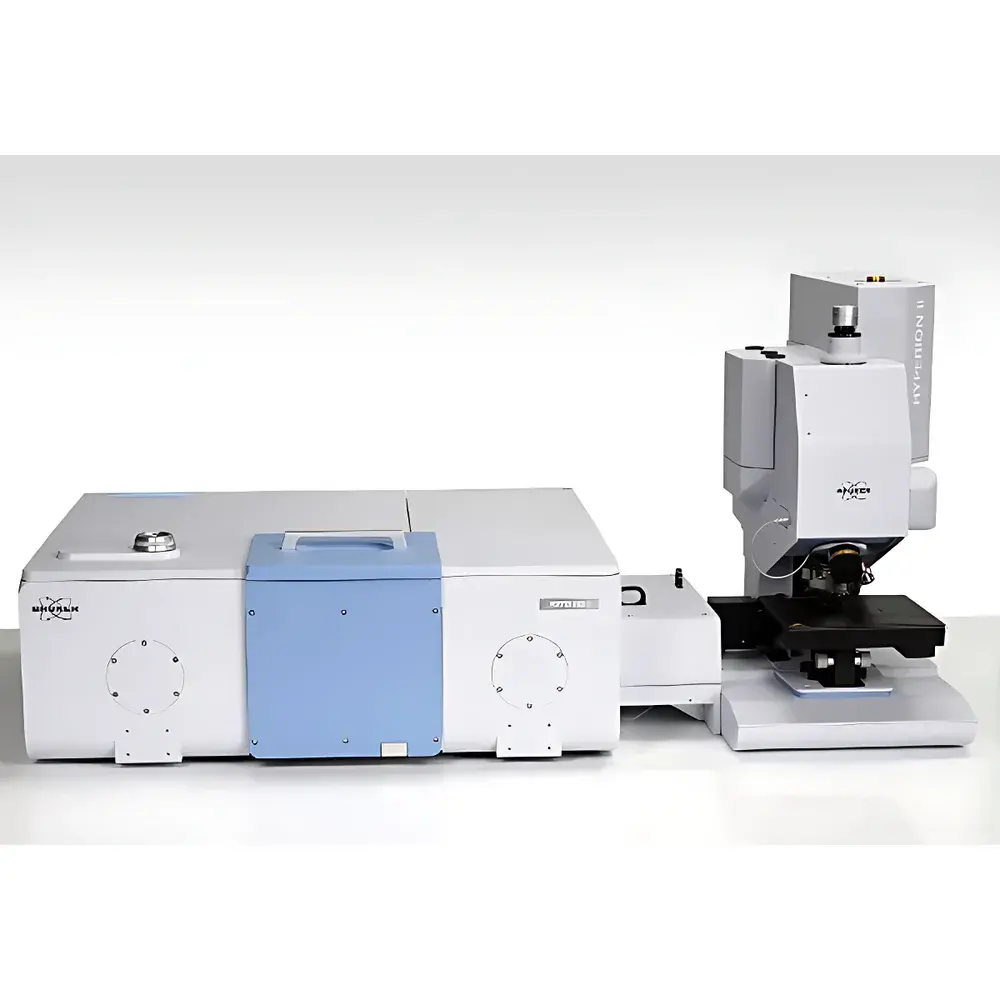
Brookfield HYPERION II Research-Grade FT-IR and QCL Laser Imaging Microscope
| Brand | Bruker |
|---|---|
| Origin | Germany |
| Manufacturer Type | Authorized Distributor |
| Origin Category | Imported |
| Model | HYPERION II |
| Pricing | Upon Request |
Overview
The Brookfield HYPERION II is a research-grade integrated Fourier Transform Infrared (FT-IR) and Quantum Cascade Laser (QCL)-based infrared imaging microscope engineered for high-spatial-resolution chemical mapping and molecular fingerprinting at the microscale. Unlike conventional IR microscopes relying solely on thermal broadband sources, the HYPERION II uniquely unifies two complementary infrared modalities: interferometric FT-IR spectroscopy—providing full spectral information across wide wavenumber ranges (typically 7500–350 cm⁻¹, extendable to NIR and FIR)—and tunable single-frequency QCL illumination via the optional Integrated Laser Imaging Module (ILIM, Class 1 laser). This dual-source architecture enables simultaneous acquisition of hyperspectral data cubes (wavenumber × x × y) and high-speed monochromatic laser images, all within a single optical platform. Its optical design adheres to Köhler illumination principles and maintains diffraction-limited performance across both visible and mid-infrared domains, ensuring precise co-registration between optical microscopy and spectral data—critical for correlative analysis in regulated and academic environments.
Key Features
- Modular detector configuration: LN₂-cooled MCT detectors (broadband, mid-band, or narrow-band), thermoelectrically cooled (TE) MCT for cryogen-free operation, and FPA detectors (64 × 64 or 128 × 128 pixels) for rapid wide-field IR imaging.
- Integrated ILIM (Class 1) enabling real-time, high-SNR QCL-based imaging in transmission, reflection, and ATR modes—without compromising spectral fidelity or acquisition speed.
- Patented coherence reduction technology eliminates speckle artifacts in laser imaging while preserving full signal-to-noise ratio and frame rate—no post-processing required.
- Motorized, software-controlled aperture selection: manual knife-edge, automated aperture wheel, and specialized metal apertures for NIR applications.
- Multi-objective turret supporting IR-optimized objectives: 3.5×/15×/36× reflective IR, 20× ATR, 15× GIR (Grating Image Relay), and 4×/40× visible-light objectives—all parfocal and aligned to a common optical axis.
- Full compatibility with environmental stages: cryogenic cooling, heating (up to 600 °C), vacuum-compatible sample chambers, and macro-IR imaging accessories for large-area screening.
Sample Compatibility & Compliance
The HYPERION II accommodates diverse solid, liquid, and thin-film specimens—including biological tissues, polymer laminates, semiconductor wafers, forensic trace evidence, and microplastic particles—without requiring conductive coating or vacuum conditions. Its ATR imaging mode supports direct surface interrogation of opaque or highly scattering samples. The system complies with ISO 17025 requirements for analytical instrument qualification and supports GLP/GMP workflows through audit-trail-enabled software logging. Optional FDA 21 CFR Part 11 compliance packages are available for pharmaceutical and clinical research applications. All optical components meet RoHS and REACH directives; laser subsystems conform to IEC 60825-1:2014 (Class 1).
Software & Data Management
Operated via OPUS™ software (v8.5+), the HYPERION II provides unified control of FT-IR, QCL, and visible-light imaging subsystems. The software includes spectral preprocessing tools (ATR correction, atmospheric compensation, Mie scattering correction), multivariate analysis modules (PCA, CLS, MCR-ALS), and pixel-wise chemometric mapping. Data export formats include HDF5, JCAMP-DX, and TIFF stacks—ensuring interoperability with third-party platforms such as MATLAB, Python (SciPy/NumPy), and commercial image analysis suites. Raw interferograms and laser intensity logs are stored with full metadata (date/time, instrument state, aperture size, objective ID, stage coordinates), facilitating traceability and reprocessing.
Applications
- Life Sciences: Label-free subcellular chemical mapping of fixed/frozen tissue sections; lipid/protein distribution in neurons; drug uptake kinetics in 3D spheroids.
- Pharmaceuticals: Polymorph identification in tablets; API-excipient interaction analysis; counterfeit detection via spectral library matching.
- Materials Science: Depth-resolved oxidation profiling in coatings; filler dispersion homogeneity in composites; interfacial degradation in battery electrodes.
- Forensics & Microplastics: Identification of synthetic fibers and polymer fragments down to 5 µm; discrimination of weathered vs. pristine microbeads using spectral deconvolution.
- Semiconductor Industry: Contamination analysis on Si/SiC wafers; residual photoresist characterization; gate oxide thickness estimation via interference fringe modeling.
FAQ
Does the HYPERION II require liquid nitrogen for routine operation?
No—optional TE-cooled MCT detectors enable high-sensitivity measurements without cryogens, though LN₂-cooled variants remain available for ultimate SNR in low-light applications.
Can FT-IR and QCL imaging be performed simultaneously?
Not in real time, but sequential acquisition is fully synchronized via shared stage control and coordinate referencing—enabling pixel-accurate overlay of FT-IR spectral maps and QCL-derived contrast images.
Is ATR imaging supported with all objective options?
Yes—20× ATR objective is standard; additional ATR accessories (e.g., Ge, diamond, or Si ATR crystals) are compatible and auto-recognized by OPUS software.
What is the smallest resolvable feature size under standard mid-IR illumination?
Approximately 3–5 µm (λ/2 at 3000 cm⁻¹), limited by diffraction; resolution improves at longer wavelengths and with QCL illumination due to higher source brightness and coherence management.
Are custom spectral libraries supported for automated classification?
Yes—users may build, validate, and deploy proprietary spectral libraries with configurable match thresholds, confidence metrics, and hierarchical classification trees.





