
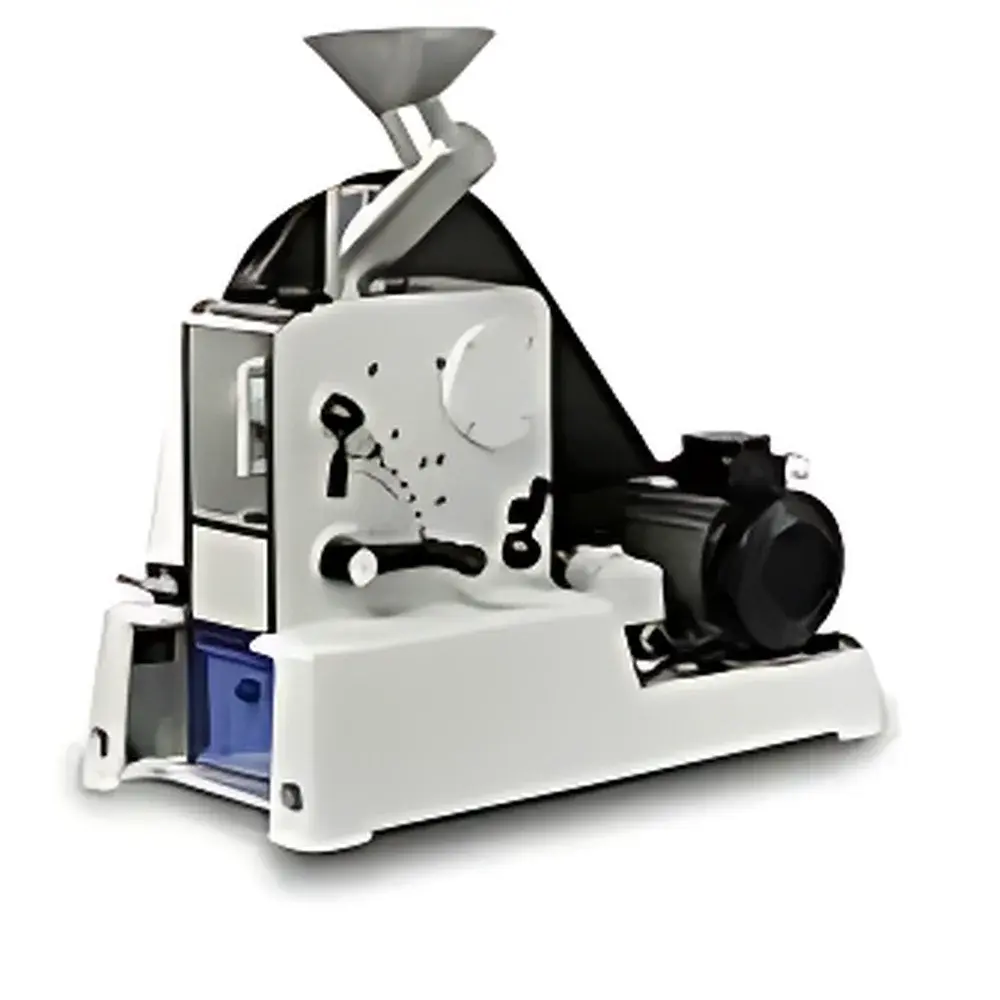
Fritsch PULVERISETTE 1 Jaw Crusher
| Brand | Fritsch |
|---|---|
| Origin | Germany |
| Model | PULVERISETTE 1 |
| Maximum Feed Size (Type I) | 60 mm × 60 mm |
| Maximum Feed Size (Type II) | 95 mm × 95 mm |
| Throughput Capacity (Type I) | 140 kg/h |
| Throughput Capacity (Type II) | 200 kg/h |
| Final Particle Size Range | 1–15 mm |
| Motor Power (Type I) | 1.1 kW |
| Motor Power (Type II) | 2.2 kW |
| Net Weight (Type I) | 177 kg |
| Net Weight (Type II) | 205 kg |
| Dimensions (W×D×H) | 40 × 80 × 80 cm |
| Adjustable Jaw Gap | 1–15 mm (10 preset positions) |
| Grinding Chamber Materials | Stainless steel, zirconium oxide, tempered steel, chromium-free steel, manganese steel, tungsten carbide |
Overview
The Fritsch PULVERISETTE 1 Jaw Crusher is a robust, precision-engineered primary crushing instrument designed for laboratory-scale comminution of heterogeneous solid materials. Operating on the principle of compressive crushing—where material is fed between two opposing jaw plates (one fixed, one reciprocating)—it delivers controlled, reproducible size reduction through mechanical stress rather than impact or shear. This makes it particularly suitable for brittle, medium-hard to hard materials such as ores, coal, slag, ceramics, glass, geological core samples, and construction aggregates. Unlike high-speed impact mills, the jaw mechanism minimizes heat generation and particle amorphization, preserving sample integrity for downstream analytical workflows including X-ray fluorescence (XRF), X-ray diffraction (XRD), and geochemical assay preparation. The device complies with DIN EN 61000-6-2 (EMC immunity) and DIN EN 61000-6-4 (EMC emission) standards, and its mechanical design conforms to ISO 12100:2012 for machinery safety.
Key Features
- Two interchangeable jaw plate configurations (Type I and Type II) enabling flexible throughput and feed size adaptation—up to 95 mm maximum feed dimension for coarse bulk samples.
- Precision-adjustable jaw gap with 10 discrete settings (1–15 mm), allowing systematic control over final particle size distribution without tooling changes.
- Low-contamination grinding chamber architecture: all wear components are fully removable and accessible via front-panel access; no internal fasteners require disassembly for routine cleaning.
- Modular integration capability: direct mechanical coupling with the Fritsch PULVERISETTE 13 Disc Mill enables seamless two-stage comminution—reducing output from the jaw crusher directly to ≤0.1 mm for homogenized analytical sub-sampling.
- Dust suppression compatibility: integrated 50 mm vacuum port conforms to ISO 16000-7 for particulate containment, supporting connection to standard lab-grade vacuum systems (e.g., HEPA-filtered industrial vacuums).
- Six certified grinding material options—including tungsten carbide and zirconium oxide—ensuring chemical inertness and abrasion resistance for trace-metal analysis, halogen-free processing, or highly abrasive mineral matrices.
Sample Compatibility & Compliance
The PULVERISETTE 1 accepts dry, non-fibrous, non-sticky solids with Mohs hardness up to 8. It is routinely deployed in ISO/IEC 17025-accredited laboratories for sample preparation prior to elemental analysis (ASTM D5630, ISO 12902-2), petrographic thin-section production (ASTM D3401), and ASTM D2974 ash content determination. Its mechanical design meets CE marking requirements under the Machinery Directive 2006/42/EC and the Low Voltage Directive 2014/35/EU. For regulated environments, optional documentation packages include Factory Acceptance Test (FAT) reports, material certificates (EN 10204 3.1), and calibration records traceable to PTB (Physikalisch-Technische Bundesanstalt).
Software & Data Management
While the PULVERISETTE 1 operates as a standalone electromechanical unit without embedded microprocessor control, it supports full GLP/GMP traceability when integrated into digital lab workflows. Optional accessories include a calibrated digital gap gauge (certified to ±0.05 mm) and an electronic batch log template compatible with LIMS platforms (e.g., LabWare, Thermo Fisher SampleManager). All mechanical adjustments are manually recorded per SOP; the absence of firmware eliminates cybersecurity vulnerabilities associated with networked instrumentation, aligning with FDA 21 CFR Part 11 Annex 11 principles for “simple devices” requiring audit-trail–capable procedural documentation only.
Applications
- Geochemical exploration labs preparing rock and soil samples for multi-element ICP-MS analysis.
- Cement and refractory manufacturers performing raw material homogenization prior to loss-on-ignition (LOI) and lime saturation factor (LSF) testing.
- Recycling R&D facilities characterizing mixed metal scrap composition via XRF after size-reduction and magnetic separation.
- Academic mineralogy departments conducting comparative hardness and fracture-toughness studies across silicate and sulfide mineral families.
- Environmental testing labs reducing heterogeneous landfill leachate solids to <10 mm for TCLP extraction (EPA Method 1311).
FAQ
What types of materials are unsuitable for the PULVERISETTE 1?
Materials with high elasticity (e.g., rubber, polymers), fibrous structure (wood chips, plant stems), or excessive moisture content (>5% w/w) may cause clogging or inconsistent crushing and are not recommended.
Can the jaw plates be replaced in the field without specialized tools?
Yes—the jaw assembly is secured with four hex bolts accessible from the front panel; replacement requires only a 13 mm wrench and takes under 12 minutes with operator training.
Is the PULVERISETTE 1 compliant with ATEX directives for explosive atmospheres?
No—this model is not rated for Zone 21/22 dust-explosion environments. For hazardous area use, consult Fritsch’s ATEX-certified PULVERISETTE 25 variant.
How is particle size distribution verified post-crushing?
Users typically perform sieve analysis per ISO 2591-1 using standardized test sieves (ISO 3310-1); Fritsch provides optional sieve shaker integration kits with amplitude and time programmability.
Does Fritsch offer validation protocols for pharmaceutical GMP applications?
While primarily used in industrial and geological labs, IQ/OQ documentation templates are available upon request and can be adapted for GMP-compliant raw material prep in excipient manufacturing, subject to client-specific risk assessment.



