
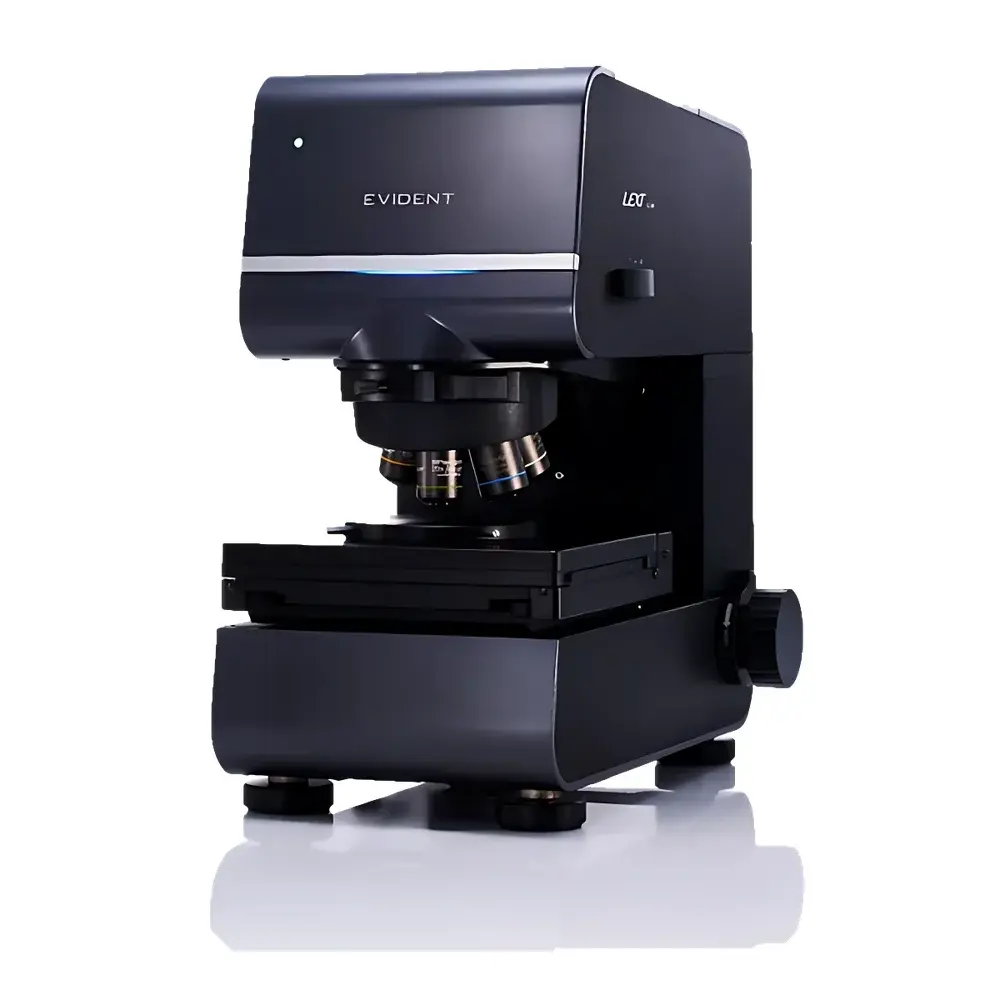
Olympus OLS5500 LEXT Laser Scanning Confocal Microscope
| Brand | Olympus |
|---|---|
| Origin | Japan |
| Model | OLS5500 |
| Measurement Modes | White Light Interferometry (WLI), Laser Scanning Microscopy (LSM), Focus Variation Microscopy (FVM) |
| Vertical Resolution | Sub-nanometer (WLI mode) |
| Horizontal Resolution | ≤120 nm (LSM mode, 405 nm laser) |
| Maximum Field of View | 10 mm × 7.5 mm (FVM macro mode) |
| Objective NA Range | 0.1–0.8 (LEXT-specific high-NA WLI objectives) |
| Sample Height Range | Up to 30 mm (standard stage) |
| Compliance | ISO 25178-601 (areal surface texture), JIS B 0601, ASTM E2927-22 |
Overview
The Olympus OLS5500 LEXT Laser Scanning Confocal Microscope is an integrated 3D surface metrology platform engineered for quantitative topographic characterization across length scales—from sub-nanometer vertical resolution to millimeter-scale fields of view. Unlike conventional optical microscopes, the OLS5500 employs three complementary optical measurement principles within a single instrument: white light interferometry (WLI) for ultra-precise height mapping of smooth and moderately textured surfaces; laser scanning microscopy (LSM) using a 405 nm diode laser for high-lateral-resolution imaging of reflective or low-contrast features; and focus variation microscopy (FVM) for robust profiling of steep slopes, deep trenches, and macro-to-micro transitional geometries. This tri-modal architecture enables traceable, NIST-compatible surface texture analysis without sample relocation or system reconfiguration—critical for R&D labs and quality control environments requiring ISO 25178-compliant areal surface parameters (Sa, Sq, Sz, etc.) and geometric feature extraction.
Key Features
- Tri-modal optical engine: Simultaneous hardware-level integration of WLI, LSM, and FVM ensures measurement continuity across roughness, waviness, and form domains.
- Proprietary LEXT objective series: Engineered with aspheric correction and optimized chromatic dispersion control for WLI, enabling stable interference fringe contrast on surfaces with slope angles up to 85° and reflectivity variations from 1% to 95%.
- High-NA WLI optics: Objectives with numerical apertures up to 0.8 deliver sub-nanometer vertical repeatability (σ < 0.15 nm, 1σ, 10× averaging) and phase stability under ambient temperature fluctuations ±1°C.
- Automated workflow guidance: Context-aware software interface sequences measurement setup, focus search, scan parameter optimization, and data validation—reducing operator dependency and minimizing protocol deviation.
- Multi-scale stitching capability: Seamless tiling of up to 1,000 individual fields-of-view with sub-pixel registration accuracy (<0.5 µm lateral drift compensation).
Sample Compatibility & Compliance
The OLS5500 accommodates diverse industrial specimens without conductive coating or vacuum requirements: metallic alloys, silicon wafers, polymer films, ceramic coatings, medical implants, and precision-machined molds. Its non-contact, non-destructive operation meets ISO/IEC 17025 laboratory accreditation requirements for dimensional metrology. Surface texture reports comply with ISO 25178-2 (areal parameters), ISO 25178-601 (instrument calibration), and ASTM E2927-22 (laser scanning confocal microscope performance verification). For regulated industries, raw data files include embedded audit trails compliant with FDA 21 CFR Part 11 requirements when deployed with Olympus’s validated LEXT software suite (v5.1+).
Software & Data Management
The bundled LEXT OLS5500 Analysis Software provides full traceability through hierarchical project folders, version-controlled measurement protocols, and encrypted metadata logging (operator ID, timestamp, environmental conditions, calibration status). All 3D point clouds are stored in vendor-neutral .STL and .OBJ formats alongside proprietary .OLS binary archives containing full interferogram and Z-stack raw data. Batch processing supports automated parameter extraction across hundreds of regions-of-interest (ROIs), with customizable pass/fail thresholds aligned to internal SPC limits or customer-specific GD&T specifications. Export modules integrate directly with JMP, MATLAB, and Minitab for statistical process modeling.
Applications
- Semiconductor packaging: Quantifying die attach voids, solder bump coplanarity, and TSV (through-silicon via) step heights with <1 nm vertical uncertainty.
- Biomedical device manufacturing: Measuring surface roughness (Sa) of orthopedic implant coatings per ISO 14644-1 and verifying micro-texture fidelity post-PVD deposition.
- Optical component inspection: Characterizing scratch/dig defects, lens surface irregularity (PV, RMS), and anti-reflective coating uniformity on curved substrates.
- Advanced materials R&D: Correlating nanoscale grain boundary topography (via LSM) with macro-scale wear scar morphology (via FVM) in tribological testing.
- Failure analysis labs: Cross-sectional profiling of delamination interfaces in multilayer thin-film stacks without destructive sectioning.
FAQ
Does the OLS5500 require vibration isolation or climate-controlled rooms for routine operation?
No—its active fringe stabilization algorithm and dual-reference beam path compensate for low-frequency mechanical drift (≤5 Hz) and thermal gradients typical of standard ISO Class 7 cleanrooms or QC laboratories.
Can third-party software import raw interferograms or Z-stacks from the OLS5500?
Yes—raw WLI interferograms (.BMP sequence), LSM intensity stacks (.TIFF), and FVM depth maps (.CSV) are accessible via the SDK; full documentation is provided under NDA for OEM integration.
What calibration standards are supplied with the system?
A NIST-traceable step-height standard (100 nm, 500 nm, 1 µm steps), roughness standard (Ra = 0.1 µm and 2.0 µm), and pitch standard (10 µm line/space) are included, each with certificate of calibration valid for 12 months.
Is remote diagnostics and firmware updates supported?
Yes—the system supports secure TLS 1.2–encrypted remote access via Olympus’s authorized service portal, enabling predictive maintenance alerts and over-the-air firmware patches validated per IEC 62304 Class B software lifecycle requirements.





