
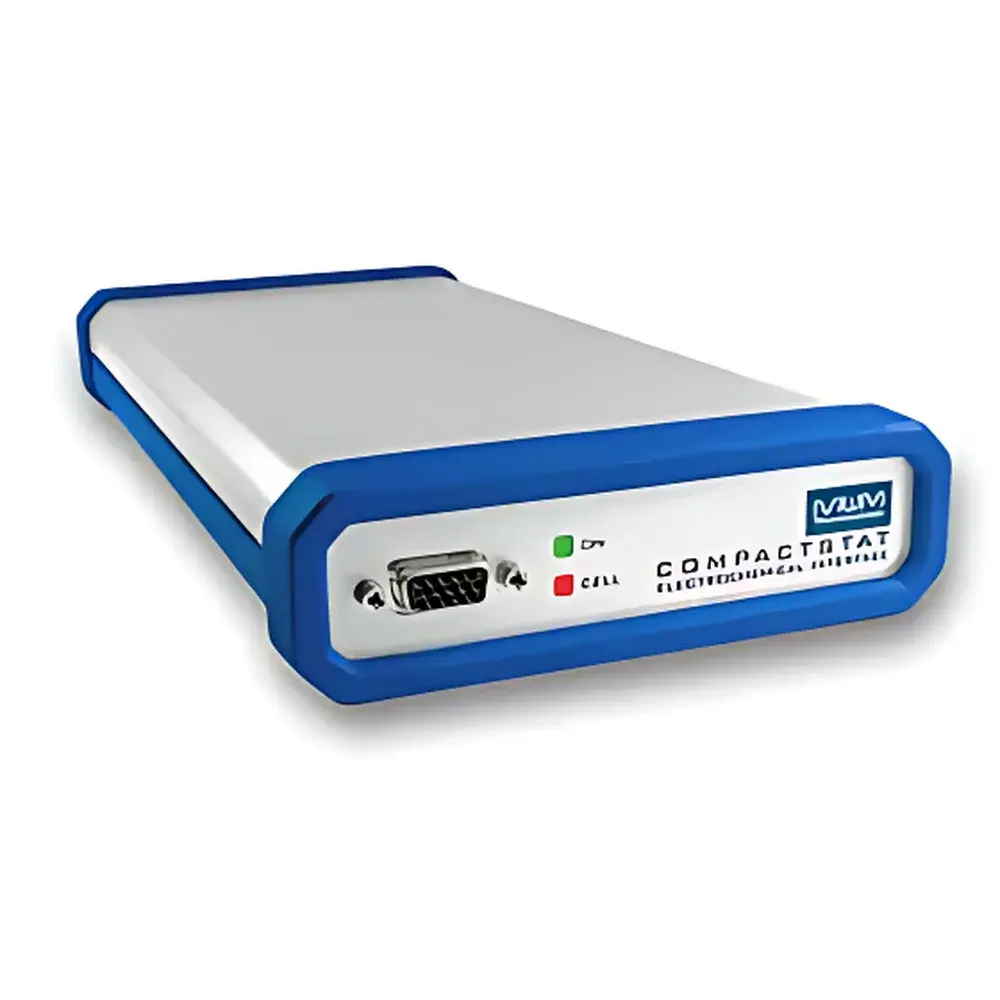
Ivium CompactStat.h Portable Electrochemical Workstation
| Brand | Ivium |
|---|---|
| Origin | Netherlands |
| Model | CompactStat.h |
| Instrument Type | Portable Electrochemical Workstation |
| Channel Count | Single-Channel |
| Dimensions | 12 × 26 × 2.5 cm |
| Weight | 0.6 kg |
| Power Supply | 100–240 V, 45–65 Hz, 4 VA via 12 V DC adapter |
| Interface | USB |
| PC Requirements | Windows 8/10 |
| Electrode Connections | 4-terminal (WE, CE, RE, SE) |
| Potentiostat Bandwidth | >3 MHz |
| EIS Frequency Range | 10 µHz – 3 MHz |
| Current Range | ±1 pA – ±1 A (14 decades) |
| Potential Range | ±10 V |
| Potential Resolution | 0.02 mV (20-bit @ ±10 V) |
| Current Resolution | 0.6 aA (attoampere) minimum |
| ADC | Dual-channel, 24-bit, 100,000 pts/s |
| Ohmic Drop Compensation | Up to 2 V per current range |
| Input Impedance (Electrometer) | >1000 GΩ |
| Bias Current | <10 pA |
| Analog I/O | 8 in / 2 out (±4 V, 16-bit) |
| Digital I/O | 2 in / 3 out (0–+5 V) |
Overview
The Ivium CompactStat.h is a high-performance, single-channel portable electrochemical workstation engineered for precision electrochemical characterization in field-deployable and space-constrained laboratory environments. Built on Ivium’s proprietary low-noise, galvanically isolated architecture, the CompactStat.h employs a true four-terminal potentiostat/galvanostat design with integrated frequency response analysis (FRA) and advanced electrometer capabilities. Its core measurement principle relies on real-time digital control of applied potential or current waveforms—enabling potentiodynamic, potentiostatic, galvanostatic, and impedance-based techniques—including cyclic voltammetry (CV), linear sweep voltammetry (LSV), chronoamperometry (CA), chronopotentiometry (CP), electrochemical impedance spectroscopy (EIS), and pulse techniques such as differential pulse voltammetry (DPV) and square-wave voltammetry (SWV). The instrument’s galvanic isolation from mains power and host PC eliminates ground-loop interference, making it uniquely suited for measurements on floating systems—e.g., coated pipelines, reinforced concrete structures, or battery cells under thermal or mechanical stress—where electrical grounding is prohibited or impractical.
Key Features
- Galvanic Isolation & Ultra-Low Noise Design: Fully isolated from AC mains and PC ground; enables reliable sub-picoampere current detection (1000 GΩ input impedance) essential for nanomaterials, corrosion monitoring, and bioelectrochemical sensing.
- Wide Dynamic Range & High Resolution: 14-decade current range (±1 pA to ±1 A), 24-bit dual-channel ADC sampling at 100 kS/s, and 20-bit potential resolution (0.01 mV at ±4 V, 0.02 mV at ±10 V) ensure fidelity across micro- and macro-electrochemical regimes.
- Integrated Impedance Analyzer: Full-frequency EIS from 10 µHz to 3 MHz with programmable sine amplitude (0.015 mV–1 V), 16-bit DC offset subtraction, and dual DC decoupling filters—compliant with ASTM E1462 and ISO 16773-2 for corrosion resistance evaluation.
- Modular Expandability: Compatible with optional modules including bipotentiostat expansion, multi-working electrode switchers, photoelectrochemical (PEC) accessories, and linear signal generators—supporting complex experimental protocols without hardware replacement.
- Real-Time External Control: Eight analog inputs (±4 V, 16-bit), two analog outputs, two digital inputs, and three digital outputs enable synchronized interfacing with environmental chambers, flow cells, potentiostat-controlled actuators, or data loggers—facilitating GLP-compliant automated testing sequences.
Sample Compatibility & Compliance
The CompactStat.h supports standard three-electrode configurations (working, counter, reference) as well as four-electrode setups incorporating a sense electrode for uncompensated resistance correction—critical for high-resistivity electrolytes or thin-film measurements. Its floating architecture permits direct connection to grounded or insulated samples, including embedded sensors in civil infrastructure, fuel cell stacks, and aqueous/non-aqueous battery electrolytes. The system meets electromagnetic compatibility requirements per EN 61326-1:2013 and is designed for operation in accordance with ISO/IEC 17025 quality management frameworks. While not inherently 21 CFR Part 11 compliant, audit-trail functionality and user-access controls are fully implementable via IviumSoft’s secure software configuration—supporting FDA-regulated QC workflows when deployed under validated SOPs.
Software & Data Management
IviumSoft, the native Windows-based control and analysis suite, provides intuitive experiment setup, real-time visualization, and post-acquisition processing—including Kramers–Kronig validation, equivalent circuit modeling (ECM), distribution of relaxation times (DRT), and Tafel analysis. All raw data are stored in open-format .txt or .csv files with full metadata (timestamp, parameter set, calibration history). Software supports scripting via Python API (IviumPython), enabling integration into LabVIEW, MATLAB, or custom CI/CD pipelines. Version-controlled method templates, electronic signatures, and configurable report generation align with GLP/GMP documentation standards. Data integrity is preserved through automatic checksum logging and timestamped revision history for every measurement file.
Applications
- Field-deployable corrosion rate monitoring of buried pipelines, offshore platforms, and reinforced concrete bridges using LPR, EIS, and zero-resistance ammetry (ZRA).
- In-situ electrochemical characterization of battery electrodes during cycling—especially for solid-state and Li–S systems requiring floating-cell configurations.
- Nanoscale electrocatalyst screening via microelectrode CV and fast-scan CV (up to 10 V/s) with sub-pA noise floor.
- Photoelectrochemical studies of semiconductor interfaces using synchronized light-pulse triggering and transient photocurrent analysis.
- Quality control of electrodeposition baths and plating uniformity assessment via controlled-potential coulometry and anodic stripping voltammetry (ASV).
FAQ
Is the CompactStat.h suitable for battery testing under load?
Yes—the instrument supports galvanostatic charge/discharge, hybrid pulse power characterization (HPPC), and dynamic current interruption (DCI) protocols when paired with external load switches or programmable electronic loads via its analog/digital I/O ports.
Can it perform simultaneous EIS and DC polarization?
No—EIS and DC techniques operate in mutually exclusive modes; however, multi-step methods allow sequential acquisition (e.g., CV followed by EIS at open-circuit potential) with automated parameter switching.
What is the maximum cable length supported for remote electrode connections?
For optimal signal integrity, shielded twisted-pair cables up to 3 m are recommended; longer runs require active guarding or local preamplification to maintain >100 dB common-mode rejection ratio.
Does it support third-party electrochemical cells or flow cells?
Yes—all standard 4-mm banana or BNC electrode interfaces are compatible; custom cell integration is facilitated via IviumSoft’s device driver SDK and I/O mapping tools.
Is firmware upgrade available remotely?
Firmware updates are delivered via IviumSoft’s built-in updater and require physical USB connection; no over-the-air or network-based update capability is implemented for security and traceability reasons.





