
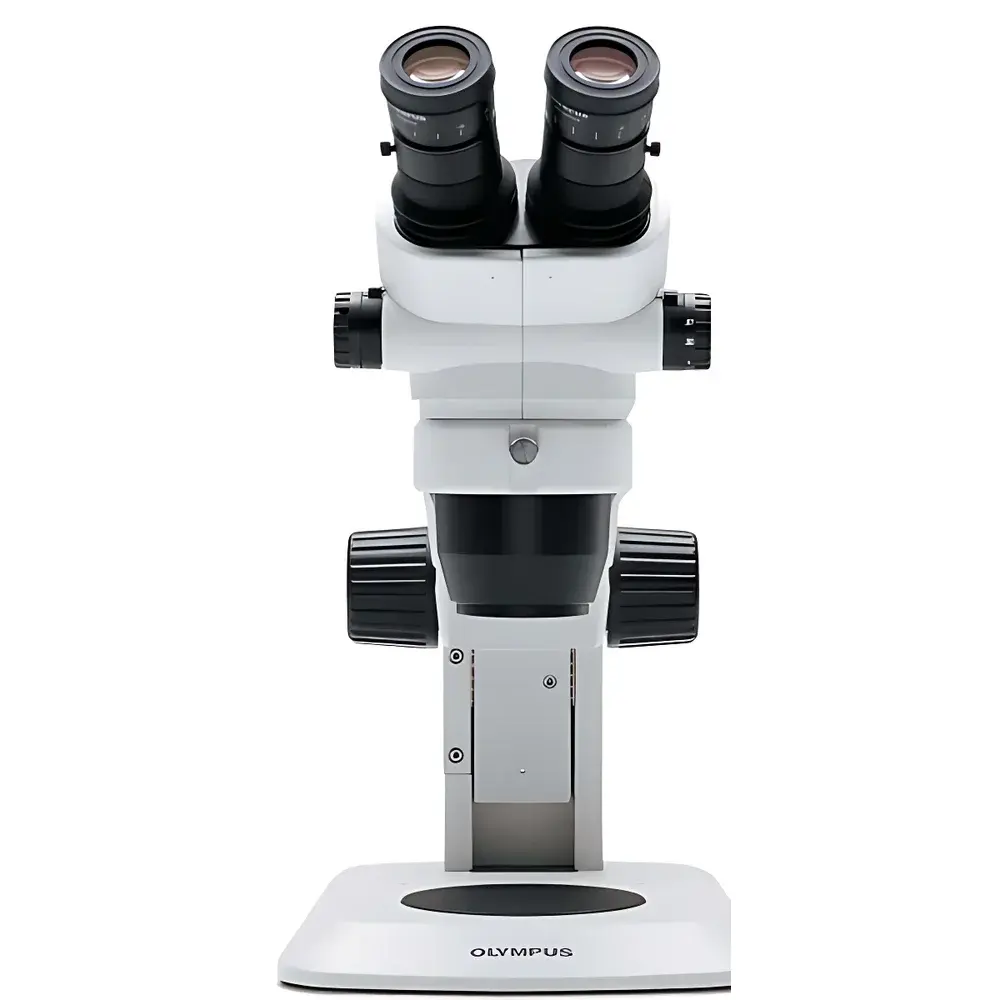
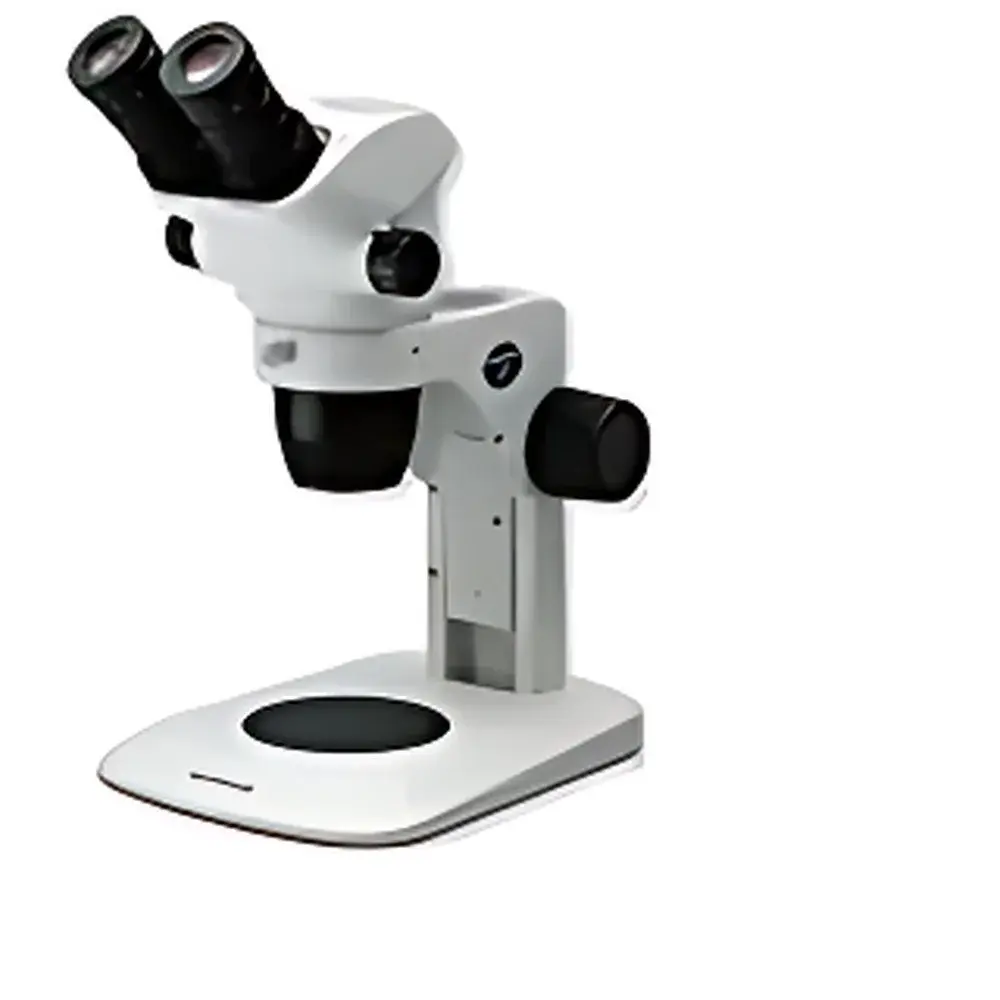
OLYMPUS SZ61 Stereo Microscope
| Brand | OLYMPUS |
|---|---|
| Origin | Japan |
| Model | SZ61 |
| Zoom Ratio | 6.7:1 |
| Magnification Range | 0.67×–4.5× |
| Working Distance | 110 mm |
| Eyepiece Angle | 45° |
| Interpupillary Adjustment Range | 52–76 mm (with WHSZ10× eyepieces) |
| C-Mount Port | 0.5×内置 |
| LED Illumination (Transmitted & Reflected) | 6,000 h avg. lifetime |
| Input Voltage | 100–120 V / 200–240 V AC, 50/60 Hz |
| Weight (Zoom Body) | 1.3 kg |
| Base Compatibility | SZ2-ST (standard), SZ2-ILST (LED illumination base) |
| Objective Mount | M48×0.75 thread |
| Compliance | RoHS-compliant optical components (lead-free glass) |
Overview
The OLYMPUS SZ61 Stereo Microscope is an ergonomically engineered, high-resolution dissecting microscope designed for routine inspection, quality control, and low-magnification observation in industrial, academic, and clinical laboratory environments. Based on Greenough optical architecture—featuring dual, independent objective paths—the SZ61 delivers true stereoscopic vision with exceptional depth perception, edge-to-edge sharpness, and faithful color rendition. Its fixed 110 mm working distance enables unobstructed access to large or bulky specimens, while the 6.7:1 zoom ratio (0.67×–4.5×) provides continuous magnification adjustment without mechanical stage repositioning. All optical elements incorporate lead-free glass formulations compliant with RoHS directives, ensuring environmental safety without compromising transmission efficiency or chromatic fidelity. The integrated electrostatic protection circuitry safeguards sensitive electronic components during operation in static-prone cleanrooms or electronics assembly areas.
Key Features
- Greenough-style dual-path optics delivering natural 3D visualization with high resolution and minimal distortion across the entire field of view
- Fixed 110 mm working distance—optimized for hands-on manipulation, soldering, micro-assembly, and non-contact measurement tasks
- 6.7:1 continuous zoom system with precision-machined gear train, enabling repeatable magnification settings and long-term mechanical stability
- Ergonomic 45° inclined binocular tube with coaxial interpupillary adjustment (52–76 mm range) and WHSZ-series ComfortView eyepieces for extended viewing sessions
- Built-in electrostatic discharge (ESD) protection circuitry—critical for semiconductor handling, PCB inspection, and electrostatic-sensitive device (ESD) workstations
- C-mount port with integrated 0.5× reduction lens for seamless integration with digital imaging systems; supports standard 1/2″ or 2/3″ sensors
- Modular base compatibility: accepts SZ2-ST (standard stand), SZ2-ILST (dual-mode LED base with adjustable transmitted/reflected illumination), and optional fiber-optic light guides (e.g., SZ2-LGB)
Sample Compatibility & Compliance
The SZ61 accommodates a broad range of specimen types—from printed circuit boards and mechanical assemblies to biological tissue sections, botanical samples, and forensic evidence—without requiring coverslips or immersion media. Its open optical path and generous clearance permit use with auxiliary tools (e.g., micromanipulators, pipettes, or soldering irons). The microscope complies with IEC 61000-4-2 (ESD immunity), IEC 61326-1 (EMC for laboratory equipment), and RoHS Directive 2011/65/EU for hazardous substances. Optical components meet ISO 10110-7 standards for surface quality and wavefront error. When configured with the SZ2-ILST LED base and paired with validated imaging software, the system supports GLP/GMP documentation workflows under FDA 21 CFR Part 11 when audit-trail functionality is enabled at the host application level.
Software & Data Management
While the SZ61 itself is an analog optical platform, its C-mount interface is fully compatible with industry-standard machine vision cameras (e.g., FLIR BFS-U3, Basler ace USB3) and third-party acquisition software including Olympus cellSens™, Media Cybernetics Image-Pro® Plus, and open-source platforms such as Micro-Manager. Digital calibration via stage micrometers ensures traceable pixel-to-micron conversion. Metadata embedding (magnification, exposure time, timestamp, operator ID) is supported through camera SDKs and compliant DICOM-SR or TIFF-based export protocols. For regulated environments, integration with LIMS or ELN systems is achieved via standardized APIs or file-watch directory ingestion.
Applications
- Electronics manufacturing: PCB inspection, component placement verification, solder joint evaluation (IPC-A-610 Class 2/3), and counterfeit detection
- Materials science: Surface defect mapping, coating uniformity assessment, fracture analysis, and powder morphology characterization
- Life sciences: Dissection support, embryology staging, histology slide screening, and invertebrate morphology studies
- Forensics: Toolmark comparison, fiber analysis, document examination, and gunshot residue (GSR) particle identification
- Quality assurance: Incoming material inspection, final product release checks, and dimensional verification using calibrated reticles or digital overlays
FAQ
Is the SZ61 compatible with digital cameras from third-party manufacturers?
Yes—the built-in 0.5× C-mount adapter supports standard 1″, 2/3″, and 1/2″ format sensors. Mechanical back-focus adjustment ensures optimal focus plane alignment across varying sensor depths.
Can the SZ61 be used in ESD-controlled environments?
Yes—its integrated electrostatic protection circuitry meets IEC 61000-4-2 Level 3 requirements and is routinely deployed in ISO Class 5 cleanrooms and electronics assembly lines.
What illumination options are available beyond the standard LED base?
Optional fiber-optic illuminators (e.g., SZ2-LGB) provide cold, shadow-free oblique lighting; transmitted-light accessories (SZ2-ILA) enable Köhler illumination for transparent or semi-transparent specimens.
Does Olympus provide calibration documentation for metrological applications?
Olympus supplies factory calibration certificates for optional measuring eyepieces and stage micrometers; traceability to NIST or JCSS-accredited labs is available upon request.
How does the SZ61 compare to the SZ51 model in terms of optical performance?
The SZ61 offers a wider zoom range (6.7:1 vs. 5:1), higher maximum magnification (4.5× vs. 4.0×), and improved chromatic correction—particularly at high magnifications—due to refined objective lens coatings and updated prism design.




