
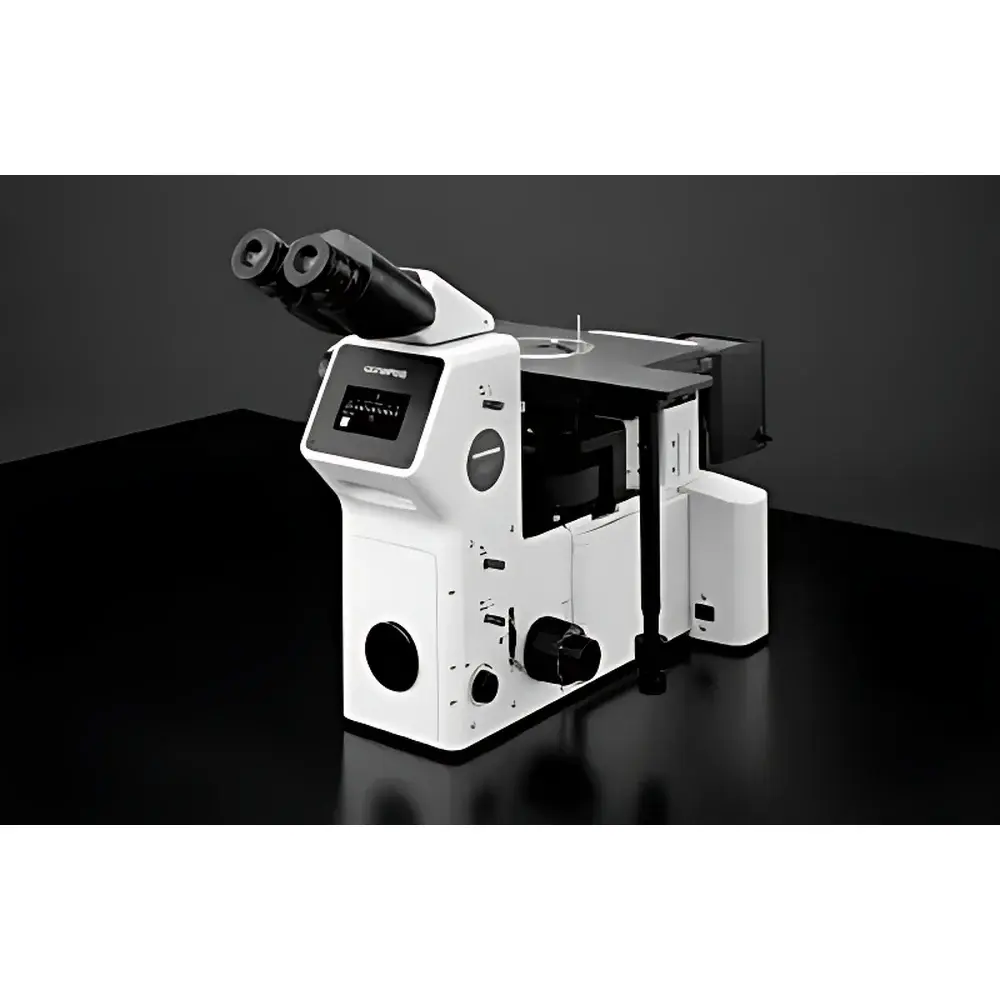
Olympus GX71 Research-Grade Inverted Metallurgical Microscope
| Brand | Olympus |
|---|---|
| Origin | Japan |
| Optical System | UIS2 Infinity-Corrected |
| Observation Modes | Brightfield, Darkfield, DIC, Simple Polarization, Fluorescence |
| Illumination | Reflected 100 W Halogen / 100 W Mercury / 75 W Xenon |
| Focus Mechanism | Manual (9 mm Travel, 0.1 mm/rev Fine Adjustment) |
| Objective Turret | Motorized 6-Position (BF/DIC or BF/DF/DIC) |
| Intermediate Magnification | Built-in Zoom (1×–2×) |
| Eyepiece Field Number | 26.5 mm |
| Stage Travel | 50 × 50 mm |
| Camera Ports | Front (inverted image), Side (inverted image) |
| Weight | 38 kg |
| Dimensions | 280 × 748 × 445 mm (W × D × H) |
Overview
The Olympus GX71 is a research-grade inverted metallurgical microscope engineered for high-precision microstructural analysis of opaque and reflective materials—including metals, alloys, ceramics, composites, and coated surfaces. Its UIS2 infinity-corrected optical system delivers diffraction-limited resolution, exceptional contrast, and chromatic fidelity across all incident-light observation modes. Unlike conventional upright metallurgical systems, the inverted configuration positions the objective lenses beneath the specimen stage—enabling stable, vibration-resistant imaging of large, heavy, or irregularly shaped samples mounted on standard metallographic holders. This architecture supports seamless integration with motorized stages, environmental chambers, and in situ mechanical testing rigs. The GX71’s optical path is optimized for quantitative reflectance microscopy: its parfocal, apochromatically corrected objectives maintain focus and alignment when switching between brightfield, darkfield, differential interference contrast (DIC), simple polarization, and fluorescence modalities—without requiring lens repositioning or recalibration.
Key Features
- UIS2 Infinity-Optimized Optics: Delivers uniform flat-field illumination, minimal spherical and chromatic aberration, and high numerical aperture performance up to 100× magnification—ensuring reproducible measurement accuracy required for ASTM E3, ISO 643, and ASTM E112 grain size analyses.
- Multi-Modal Observation Flexibility: A six-position motorized turret and dedicated mirror unit allow rapid, repeatable switching among brightfield, darkfield, DIC, polarized light, and fluorescence—each mode calibrated to the same optical axis for co-registered imaging.
- High-Intensity Modular Illumination: Dual-reflected light source options (100 W halogen for routine inspection; 100 W mercury or 75 W xenon arc lamps for UV-excited fluorescence) coupled with an optimized Köhler illumination condenser ensure uniform, glare-free illumination across the full 26.5 mm field number.
- Motorized Functionality Suite: Optional motorized objective turrets, filter wheels, and mirror units can be controlled via ergonomic front-panel switches or PC-based software—supporting automated acquisition sequences compliant with GLP/GMP documentation workflows.
- Wide-Field Ergonomic Design: Standard ultra-widefield eyepieces (FN 26.5 mm) reduce eye strain during extended sessions; built-in 1×–2× intermediate zoom enables real-time detail enhancement without compromising parfocality across dual or triple camera ports.
- Modular Mechanical Architecture: Fixed-stage design with 50 × 50 mm XY travel accommodates standard 25 mm and 32 mm metallographic mounts; reinforced base and low center-of-gravity construction minimize drift during long-exposure imaging or time-lapse acquisition.
Sample Compatibility & Compliance
The GX71 is designed for rigorous industrial and academic metallurgical laboratories where sample integrity, measurement traceability, and regulatory compliance are paramount. It supports standardized preparation protocols per ASTM E3 (specimen preparation), ASTM E407 (etchant selection), and ISO 4967 (non-metallic inclusion rating). Its reflected-light configuration eliminates the need for cover slips or mounting media—preserving surface topography critical for phase identification, inclusion analysis, and coating thickness evaluation. When equipped with certified calibration standards (e.g., NIST-traceable stage micrometers and intensity reference slides), the system meets requirements for ISO/IEC 17025 accreditation. Optional DIC and polarization modules facilitate crystallographic orientation mapping in accordance with ASTM E1122, while fluorescence capability enables detection of oxide layers, corrosion products, or fluorescent dye markers in failure analysis workflows.
Software & Data Management
Olympus cellSens™ Digital Imaging Software (v2.4 or later) provides native integration with the GX71’s motorized components, enabling synchronized control of focus, illumination intensity, filter position, and objective selection. The software supports multi-channel Z-stack acquisition, extended depth-of-field (EDF) reconstruction, and precise measurement annotation with audit-trail logging—fully compliant with FDA 21 CFR Part 11 for electronic records and signatures. Raw image data is saved in TIFF or Olympus OIB format with embedded metadata (objective ID, magnification, exposure time, lamp intensity, DIC bias settings), ensuring full experimental reproducibility. For laboratory information management system (LIMS) integration, cellSens offers XML-based export and REST API connectivity—facilitating automated report generation aligned with ISO 15189 quality management requirements.
Applications
- Quantitative metallography: Grain size determination (ASTM E112), inclusion rating (ASTM E45), phase fraction analysis
- Failure analysis: Crack propagation mapping, intergranular corrosion assessment, weld microstructure evaluation
- Coating and surface engineering: Thickness measurement of thermal spray deposits, PVD/CVD layers, and anodized films
- Materials development: In situ thermal cycling observation, creep deformation monitoring, fatigue crack initiation studies
- Quality control in foundries, aerospace component manufacturing, and automotive powertrain production
FAQ
Does the GX71 support both reflected and transmitted light observation?
Yes—the GX71 is configured for reflected-light metallurgical imaging by default but includes a transmitted-light illumination port compatible with 100 W halogen illumination, enabling dual-mode operation on semi-transparent specimens such as thin-sectioned geological samples or polymer composites.
Can the GX71 be integrated into automated inspection workflows?
Absolutely. With optional motorized turrets, filter wheels, and stage controllers—and supported by cellSens automation scripting—the GX71 serves as the imaging core of custom AOI (automated optical inspection) systems compliant with IPC-A-610 or MIL-STD-883H requirements.
Is the UIS2 optical system compatible with third-party objectives?
No—UIS2 is a proprietary Olympus infinity-corrected system requiring UIS2-designated objectives to maintain specified correction, working distance, and parfocality. Non-Olympus objectives may introduce aberrations or mechanical interference.
What safety certifications does the GX71 carry?
The instrument complies with IEC 61000-6-3 (EMC emissions), IEC 61000-6-2 (EMC immunity), and IEC 61010-1 (safety requirements for electrical equipment used in laboratory environments), with CE and UKCA marking for European and UK markets.
How is calibration maintained across observation modes?
Olympus provides factory-calibrated alignment tools (e.g., centering telescopes, DIC shear adjustment wedges) and documented procedures for user-performed verification—ensuring consistent pixel-to-micron scaling and optical axis registration across all five observation methods.




