
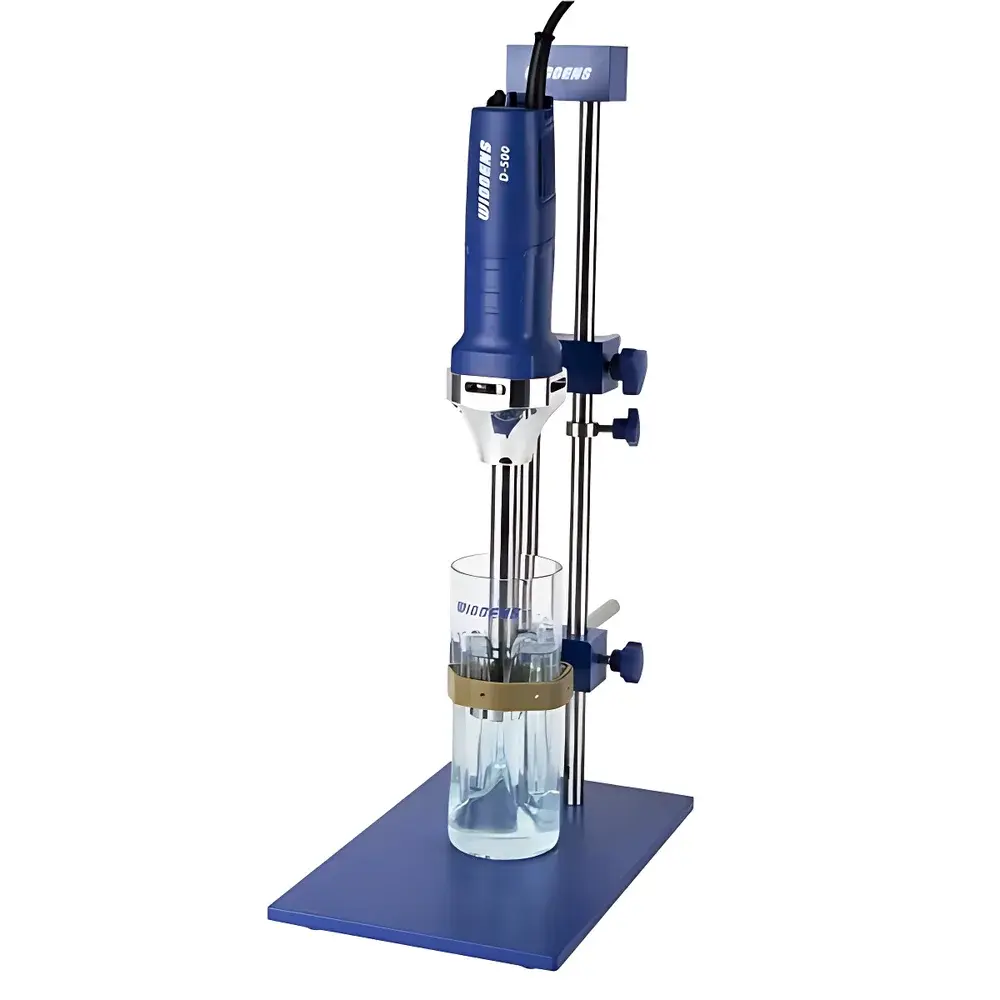
WIGGENS D-500 High-Shear Dispersing and Emulsifying Homogenizer
| Brand | WIGGENS |
|---|---|
| Origin | Germany |
| Model | D-500 |
| Maximum Viscosity Handling | 10,000 cP |
| Tip Speed | ≤ 34.9 m/s |
| Construction Material | 316L Stainless Steel |
| Drive Type | Variable-Speed Electronic Motor |
| Safety Features | Overload Protection, Soft-Start Function, Emergency Safety Switch |
| Regulatory Compliance | CE, RoHS, ISO 9001 Certified Manufacturing Process |
| Intended Use | Laboratory-scale dispersion, emulsification, homogenization, and particle size reduction |
Overview
The WIGGENS D-500 High-Shear Dispersing and Emulsifying Homogenizer is an electronically controlled, benchtop rotor-stator system engineered for precise mechanical energy input into liquid-phase samples. Operating on the principle of high-velocity rotor-stator interaction, the device generates intense hydrodynamic shear forces—comprising cavitation, turbulent flow, and extensional stress—to break down agglomerates, disintegrate particles, and stabilize emulsions at the micro- to submicron scale. Designed for reproducible batch processing in volumes ranging from 10 mL to 2 L (depending on probe geometry and container configuration), the D-500 delivers consistent performance across aqueous, solvent-based, and viscous non-Newtonian systems up to 10,000 cP. Its compact footprint, low mass inertia, and optimized thermal management support extended operation without significant motor heating or torque decay—critical for method transfer between R&D and pilot-scale development.
Key Features
- Variable-speed digital control (0–24,000 rpm) with real-time RPM display and ±1% speed accuracy, enabling fine-tuned optimization of shear intensity for sensitive formulations.
- Interchangeable dispersing heads—including narrow-tip, wide-tip, and high-efficiency tapered geometries—each precision-machined from ASTM A276 Grade 316L stainless steel for corrosion resistance, cleanability, and compliance with USP Class VI biocompatibility requirements.
- Three-tier safety architecture: (1) electronic overload detection that halts operation upon current surge; (2) programmable soft-start to minimize mechanical shock during acceleration; and (3) a recessed, spring-loaded safety switch requiring deliberate actuation before motor engagement.
- Modular probe assembly with tool-free, single-motion release mechanism—enabling full disassembly in under 15 seconds for CIP/SIP validation or residue inspection per FDA 21 CFR Part 11 audit trails.
- Low-noise brushless DC motor with IP54-rated housing, rated for continuous duty at ambient temperatures up to 40°C and relative humidity ≤80% non-condensing.
Sample Compatibility & Compliance
The D-500 accommodates a broad spectrum of sample matrices, including polymer dispersions, pharmaceutical suspensions, cosmetic emulsions, nanoparticle colloids, and food-grade pastes. It supports GMP-aligned workflows through traceable parameter logging (speed, runtime, ambient temperature) when paired with optional WIGGENS DataLink software. All wetted parts comply with EU Regulation (EC) No. 1935/2004 for materials in contact with foodstuffs and meet ISO 8573-1:2010 Class 3 purity standards for compressed-air–assisted cleaning cycles. The unit carries CE marking under Machinery Directive 2006/42/EC and Electromagnetic Compatibility Directive 2014/30/EU, with factory calibration certificates traceable to PTB (Physikalisch-Technische Bundesanstalt) reference standards.
Software & Data Management
While the D-500 operates as a standalone instrument, its RS-232 interface enables integration with WIGGENS LabControl Suite v3.2 for automated protocol execution, time-stamped parameter recording, and export of CSV-formatted datasets compliant with ALCOA+ principles (Attributable, Legible, Contemporaneous, Original, Accurate, Complete, Consistent, Enduring, Available). Audit trail functionality captures operator ID, method version, start/stop timestamps, and any manual overrides—fully satisfying FDA 21 CFR Part 11 electronic record requirements when deployed within validated environments.
Applications
- Preparation of stable oil-in-water and water-in-oil emulsions for dermatological formulations and functional foods.
- Deagglomeration of pigment suspensions prior to spectrophotometric analysis or coating viscosity assessment (ASTM D1210).
- Rapid homogenization of tissue lysates for downstream nucleic acid extraction (ISO/IEC 17025 accredited labs).
- Production of uniform nanosuspensions for preformulation studies (USP light scattering validation).
- In-process quality control of adhesive blends, sealants, and conductive pastes where particle size distribution directly impacts rheological stability.
FAQ
What is the maximum recommended operating time per cycle to maintain thermal stability?
Continuous operation is rated for up to 5 minutes at full speed in ambient conditions ≤25°C; extended runs require ≥2-minute cooldown intervals to preserve bearing life and motor insulation integrity.
Can the D-500 be used with corrosive solvents such as chlorinated hydrocarbons or strong acids?
Yes—provided all wetted surfaces are 316L stainless steel and seals are chemically compatible (e.g., Viton® or EPDM); consult the WIGGENS Chemical Resistance Guide before exposure to aggressive media.
Is validation documentation available for IQ/OQ/PQ protocols?
Factory-supplied Installation Qualification (IQ) templates and Operational Qualification (OQ) test scripts are included with each unit; Performance Qualification (PQ) support is provided via application-specific SOP development services.
Does the D-500 meet GLP requirements for regulated laboratories?
When operated with enabled data logging and user access controls, the system fulfills core GLP criteria for instrument traceability, environmental monitoring, and raw data integrity per OECD Principles of Good Laboratory Practice.



