
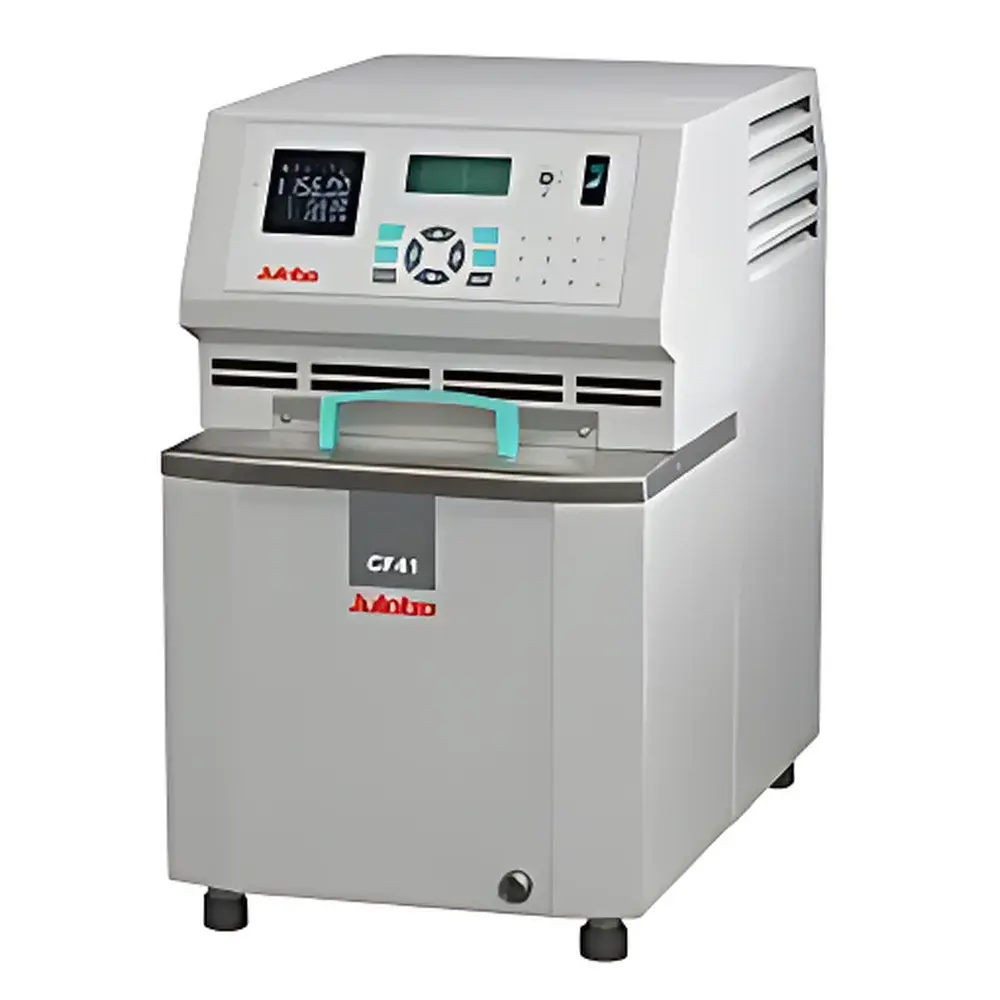
JULABO CF Series Compact Heating and Cooling Circulators
| Brand | JULABO |
|---|---|
| Origin | Germany |
| Model | CF30 / CF40 / CF31 / CF41 |
| Temperature Range | –40 °C to +200 °C |
| Heating Power | 2 kW (all models) |
| Safety Certification | DIN 12876-1 Class III (FL) |
| Temperature Stability | ±0.03 °C (CF30/CF40) |
| Display | LED (CF30/CF40), VFD + LCD dialogue screen (CF31/CF41) |
| Communication Interfaces | RS232 (all), RS485 (CF31/CF41) |
| External Sensor Support | Pt100 (CF31/CF41) |
| Pump Type | Pressure-driven circulation pump (CF30/CF40) |
| Construction | Stainless steel (316L) and chemically resistant PPSU/PPS housing components in fluid path |
| Dimensions | Compact footprint — designed for fume hood integration (no side exhaust) |
Overview
The JULABO CF Series Compact Heating and Cooling Circulators are precision-engineered thermal management systems designed for laboratory-scale external temperature control of analytical instruments, reactors, jackets, and small-volume sample holders. Based on closed-loop liquid circulation thermoregulation, the CF units utilize a dual-mode refrigeration-heating system with hermetically sealed compressors and high-efficiency plate heat exchangers. Operating across an extended temperature range from –40 °C to +200 °C, they deliver stable thermal output without requiring external chiller or heater integration. Their compact form factor (depth < 300 mm) enables direct installation inside chemical fume hoods—eliminating spatial constraints common with traditional bath circulators. All models comply with DIN 12876-1 Class III (FL) safety requirements for flammable liquid handling, featuring leak-tight fluid pathways, overtemperature cut-off, dry-run protection, and integrated pressure monitoring.
Key Features
- 2 kW heating capacity standard across all models—enabling rapid ramp rates and robust thermal recovery under load
- DIN 12876-1 Class III (FL) certified construction: no side exhaust vents, flame-retardant housing, and intrinsically safe electrical design for use with organic solvents
- Microprocessor-based control architecture with dual-stage PID (CF30/CF40) or adaptive Intelligent Cascade Control (ICC) algorithms (CF31/CF41) for dynamic load compensation
- Fluid-contact materials consist exclusively of electropolished stainless steel (AISI 316L) and high-purity, autoclavable PPSU/PPS polymers—ensuring compatibility with aggressive media including acetone, THF, and concentrated acids
- Front-panel interfaces include IP65-rated waterproof membrane keypads (CF30/CF40) or dual-display modules combining high-brightness VFD status readouts with interactive LCD menus (CF31/CF41)
- Standard RS232 interface supports SCPI command set for remote operation; CF31/CF41 add RS485 multi-drop capability and optional Pt100 input for external process temperature feedback
Sample Compatibility & Compliance
The CF Series is engineered for external circulation applications—not immersion baths—making it ideal for jacketed reactors (≤5 L), spectroscopic cells, calorimeter blocks, and microfluidic platforms. Fluid compatibility extends to water, water-glycol mixtures, silicone oils (up to 200 °C), and low-viscosity heat transfer fluids (e.g., Therminol VP-1). All wetted surfaces meet USP Class VI and FDA 21 CFR 177.2600 material compliance standards. The units support GLP/GMP workflows via configurable audit trails (via optional software), event logging with timestamps, and password-protected parameter locking. Electrical safety conforms to IEC 61010-1:2010 Ed.3 and EMC compliance per EN 61326-1:2013.
Software & Data Management
JULABO’s optional LabSoft PC software enables full instrument configuration, real-time graphing, and automated protocol execution—including ramp-hold sequences, multi-step gradients, and alarm-triggered actions. Data export is supported in CSV and Excel-compatible formats with ISO/IEC 17025-compliant metadata tagging (operator ID, timestamp, calibration status). For regulated environments, the software optionally supports 21 CFR Part 11 functionality—including electronic signatures, role-based access control, and immutable audit logs. Remote monitoring via Ethernet (with optional interface module) allows integration into centralized lab infrastructure management systems.
Applications
- Temperature stabilization of HPLC column ovens, GC injectors, and viscometer measurement cells
- Active cooling of laser sources, CCD detectors, and RF amplifiers in analytical instrumentation
- Thermal conditioning of small-scale bioreactors and enzymatic reaction vessels
- Calibration traceability for temperature-sensitive metrology tools (e.g., digital thermometers, RTD probes)
- Process simulation in pharmaceutical development—e.g., accelerated stability testing of formulations under controlled thermal cycling
FAQ
Can the CF series be used as a standalone bath?
No—the CF units are circulation-only systems. They require an external reservoir or jacketed vessel; they do not include an integral bath chamber.
What is the maximum permissible viscosity of circulating fluid?
Up to 50 mm²/s at operating temperature (e.g., silicone oil X200 at 200 °C); higher viscosities require derating of flow rate and thermal power.
Is external temperature feedback mandatory for ICC mode?
No—ICC operates autonomously using internal sensor fusion, but external Pt100 input improves accuracy when controlling remote loads with thermal lag.
Do CF models support continuous unattended operation?
Yes—built-in safety interlocks, redundant temperature monitoring, and configurable alarm relay outputs enable 24/7 operation in validated environments.
How often does the refrigerant circuit require maintenance?
Under normal laboratory conditions, the sealed R-513A/R-1234yf cascade system requires no scheduled refrigerant servicing; annual verification of compressor performance and condenser cleanliness is recommended.
Related Products



