
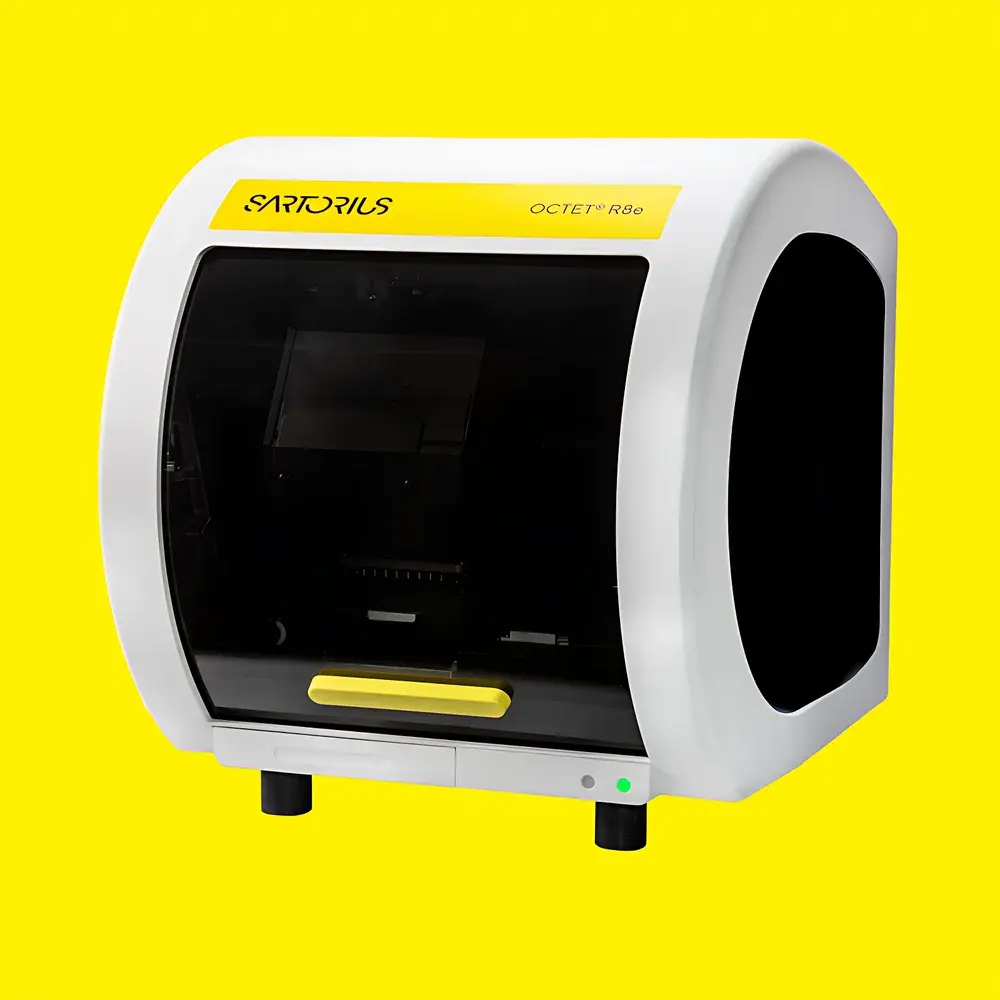
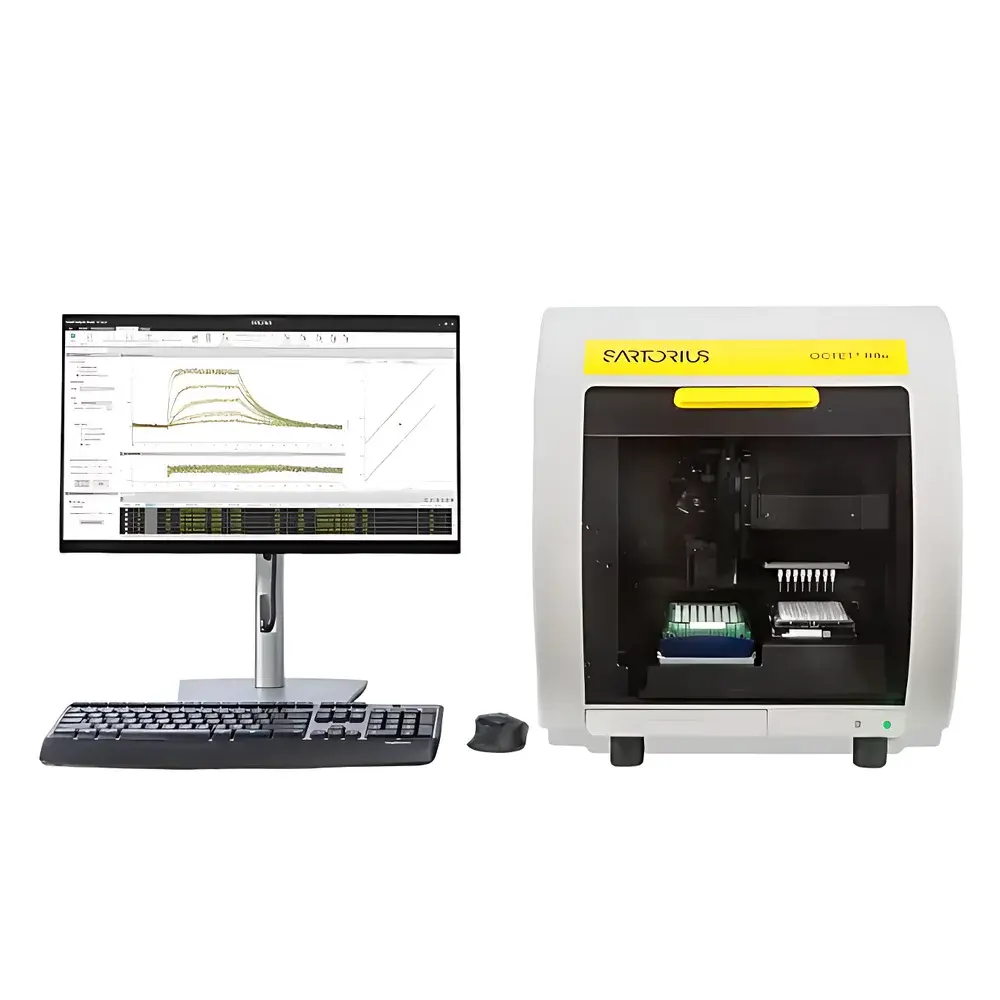
Sartorius Octet® R8e High-Performance Label-Free Molecular Interaction Analyzer
| Brand | Sartorius |
|---|---|
| Origin | Imported |
| Manufacturer Type | Authorized Distributor |
| Instrument Type | Bio-Layer Interferometry (BLI) |
| Channel Configuration | 8-Channel Parallel Detection |
| Sample Format | Compatible with 96-well and 384-well microplates |
| Sample Volume per Well | 40 µL |
| Temperature Control Range | 15–40 °C |
| Regulatory Compliance | 21 CFR Part 11 Ready |
| Unattended Operation Duration | Up to 16 hours |
Overview
The Sartorius Octet® R8e is a high-performance, label-free molecular interaction analyzer engineered for real-time, quantitative analysis of biomolecular binding kinetics and affinity. It leverages Bio-Layer Interferometry (BLI)—a fiber-optic-based optical biosensing technology—to detect changes in interference patterns caused by molecular binding events on the surface of disposable biosensor tips. Unlike traditional labeled methods such as ELISA or SPR, BLI requires no immobilization onto complex sensor chips, minimal sample preparation, and enables direct measurement in crude matrices including cell culture supernatants, lysates, and serum-containing buffers. The Octet® R8e is purpose-built for demanding applications across early-stage drug discovery, bioprocess development, and regulated GxP environments—including GLP and GMP-compliant workflows—where reproducibility, traceability, and audit readiness are non-negotiable.
Key Features
- Enhanced Sensitivity & Low-Abundance Detection: Optimized optical path design and advanced signal processing deliver improved signal-to-noise ratio, enabling robust kinetic characterization of low-molecular-weight analytes (e.g., small molecules, peptides) and low-concentration targets (sub-nM range) without signal amplification or labeling.
- Flexible Throughput Architecture: An 8-channel parallel detection system supports simultaneous analysis across 96-well or 384-well microplate formats, accommodating up to 384 independent interactions per run when using multi-step assay protocols and tip reuse strategies.
- Extended Unattended Operation: Integrated evaporation control—via programmable plate sealing and humidity-regulated chamber environment—maintains sample integrity over runs up to 16 hours, reducing manual intervention and supporting overnight kinetic profiling and multi-cycle regeneration studies.
- Regulatory-Ready Platform: Preconfigured 21 CFR Part 11 compliance options include electronic signatures, role-based user access controls, full audit trail logging, and secure data archiving—validated for use in FDA-submitted dossiers and internal quality systems.
- Robust Tip-Based Workflow: Disposable biosensor tips eliminate cross-contamination risk and enable rapid method transfer between instruments; tip regeneration protocols support ≥5 reuse cycles for cost-efficient screening applications.
Sample Compatibility & Compliance
The Octet® R8e accepts a broad range of sample types without purification or labeling requirements: monoclonal antibodies, Fc-fusion proteins, antigens, cytokines, viral envelope proteins, nucleic acids, and small-molecule compounds. Its open fluidics architecture accommodates viscous or particulate-laden samples (e.g., clarified harvests, unpurified transfection supernatants) via customizable agitation and aspiration parameters. The system conforms to ISO/IEC 17025 principles for testing laboratories and supports alignment with ICH Q5E (comparability), USP <1117> (analytical instrument qualification), and ASTM E2500-13 (verification of automated systems). All firmware, software updates, and calibration procedures follow Sartorius’ documented change control process, ensuring continuous compliance throughout instrument lifecycle.
Software & Data Management
Octet Data Analysis Software v12.x provides integrated tools for global fitting of association/dissociation phases, heterogeneity modeling, concentration-dependent response normalization, and batch-wise comparative analytics. Raw data files (.octet) are stored in vendor-neutral HDF5 format, supporting third-party integration via Python API and export to CSV, Excel, or GraphPad Prism-compatible templates. Audit trails capture every user action—including parameter edits, curve reprocessing, and report generation—with immutable timestamps and operator IDs. Data integrity is further reinforced through optional integration with enterprise LIMS and electronic lab notebook (ELN) platforms via RESTful web services.
Applications
- High-throughput epitope binning and antibody pairing studies
- Binding affinity (KD) and kinetic rate constant (ka/kd) determination for mAb–antigen, receptor–ligand, and protein–protein interactions
- Stability assessment of biotherapeutics under thermal or chemical stress
- In-process monitoring of purification steps (e.g., Protein A elution profiles)
- Comparability analysis across manufacturing lots and platform changes
- Cell-based assay validation using secreted target proteins
FAQ
Is the Octet® R8e compatible with existing Octet assay methods developed on earlier platforms?
Yes—assay protocols, tip types, and data analysis settings are fully backward-compatible with Octet® R8, QKe, and HTX systems, enabling seamless method transfer and cross-site harmonization.
Can the system be qualified for use in GMP environments?
Absolutely—the Octet® R8e supports IQ/OQ/PQ documentation packages, 21 CFR Part 11 configuration checks, and is routinely deployed in QC release testing labs for biosimilars and novel biologics.
What biosensor tip types are supported?
The platform supports all standard Sartorius ForteBio biosensors, including Anti-Human Fc, Streptavidin, Ni-NTA, Aminopropylsilane (APS), and Custom Coating-ready (CC) tips—enabling diverse immobilization chemistries.
Does the system require external calibration standards?
No—system performance verification is performed using built-in optical reference channels and factory-calibrated biosensors; periodic verification uses manufacturer-provided control kits compliant with USP <1058> guidelines.
How is data security managed during remote access or network integration?
All network communications employ TLS 1.2+ encryption; local data storage adheres to NIST SP 800-53 controls; and optional hardware security modules (HSMs) may be deployed for cryptographic key management in highly regulated settings.





