
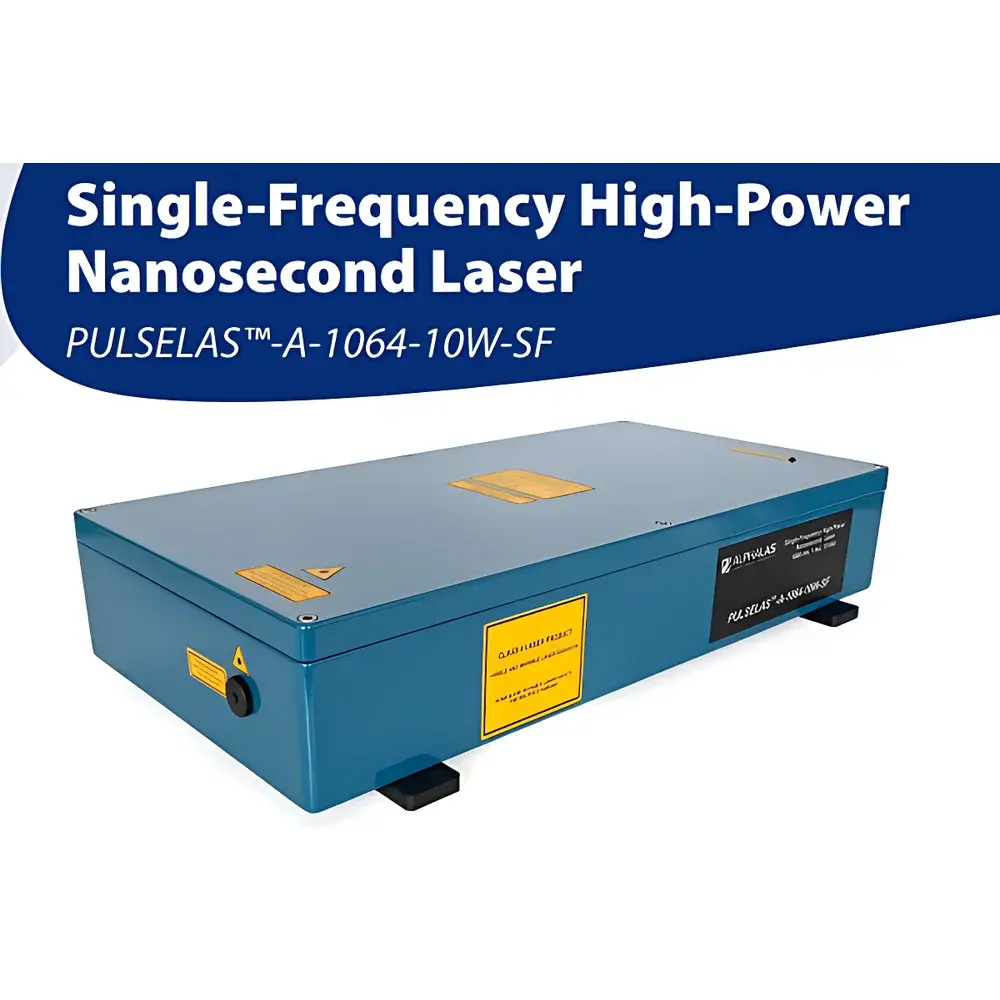
Alphalas PULSELABS-A-1064-10W-SF Single-Frequency Nanosecond Pulsed Laser
| Brand | Alphalas |
|---|---|
| Origin | Germany |
| Model | PULSELABS-A-1064-10W-SF |
| Wavelength | 1064 nm (fundamental), optional harmonics at 532 nm / 355 nm / 266 nm |
| Pulse Energy | 1 mJ @ 1064 nm |
| Average Power | 10 W @ 1064 nm |
| Peak Power | 80 kW @ 1064 nm |
| Spectral Linewidth | < 40 MHz |
| Pulse Duration | Nanosecond range (typ. 10–15 ns) |
| Beam Quality | Near-diffraction-limited (M² < 1.3) |
| Operation Mode | Single longitudinal mode (SLM) |
| Control Interface | Ethernet-enabled remote control |
| Laser Type | Diode-pumped solid-state (DPSS), Q-switched, microchip architecture |
Overview
The Alphalas PULSELABS-A-1064-10W-SF is a high-performance, single-frequency, nanosecond-pulsed diode-pumped solid-state (DPSS) laser engineered for applications demanding exceptional spectral purity, temporal stability, and beam coherence. Based on a monolithic microchip resonator design, it operates in strict single longitudinal mode (SLM) with a spectral linewidth under 40 MHz—enabling near-bandwidth-limited pulse generation and high temporal coherence. Emitting at the fundamental wavelength of 1064 nm, the system delivers up to 1 mJ per pulse at repetition rates scalable to sustain an average output power of 10 W. With peak powers exceeding 80 kW and near-diffraction-limited beam quality (M² < 1.3), this laser is optimized for precision nonlinear optical processes where spatial and spectral fidelity are non-negotiable. Its robust, compact architecture—developed and manufactured in Germany by ALPHALAS GmbH—reflects over two decades of expertise in ultrafast and frequency-stable DPSS laser engineering.
Key Features
- True single-frequency operation with 7.5 m) and minimal phase noise
- Nanosecond pulse duration (typically 10–15 ns), Q-switched via integrated acousto-optic or electro-optic mechanism
- High pulse energy (1 mJ @ 1064 nm) combined with stable 10 W average power output
- Harmonic generation compatibility: integrated or external SHG/THG/FHG modules enable reliable 532 nm, 355 nm, and 266 nm outputs
- Ethernet-based digital interface supporting SCPI command set for full remote control, real-time parameter monitoring, and synchronization with external triggers
- Hermetically sealed, alignment-free microchip cavity—designed for long-term operational stability without active maintenance
- Compliant with IEC 60825-1:2014 Class 4 laser safety standards; includes interlock-ready hardware and TTL-compatible status signals
Sample Compatibility & Compliance
The PULSELABS-A-1064-10W-SF is compatible with standard optical tables, kinematic mounts, and OEM integration platforms. Its low timing jitter (< 500 ps RMS) and pulse-to-pulse energy stability (< ±1.5% over 8 hours) meet requirements for interferometric metrology and time-resolved spectroscopy. The system conforms to CE marking directives (EMC 2014/30/EU, LVD 2014/35/EU), RoHS 2011/65/EU, and laser safety standards IEC 60825-1:2014. For regulated environments—including GLP-compliant laboratories and ISO/IEC 17025-accredited testing facilities—the laser supports audit-ready operation logs when paired with Alphalas’ optional LabView or Python SDKs. While not FDA-cleared as a medical device, its performance parameters align with ASTM E2912–22 guidelines for pulsed laser source characterization in materials processing validation.
Software & Data Management
Alphalas provides native drivers and application software suites compatible with Windows, Linux, and macOS. The embedded Ethernet controller enables seamless integration into automated test benches via TCP/IP or UDP protocols. All operational parameters—including pulse energy, repetition rate, temperature setpoints, and diagnostic sensor readings—are accessible through a RESTful API and SCPI-compliant command line. Data logging supports CSV export with timestamps traceable to internal RTC (real-time clock), satisfying basic 21 CFR Part 11 data integrity expectations when deployed behind institutional authentication layers. Optional firmware updates include enhanced trigger delay compensation and harmonic power stabilization algorithms—distributed exclusively through Alphalas’ secure customer portal.
Applications
- High-resolution laser spectroscopy requiring narrow linewidth and long coherence length
- Efficient second-, third-, and fourth-harmonic generation in nonlinear crystals (e.g., BBO, LBO, KDP)
- Fabrication of fiber Bragg gratings (FBGs) using phase-mask or point-by-point inscription techniques
- Atmospheric lidar and differential absorption lidar (DIAL) systems for trace gas detection
- Optical coherence tomography (OCT) source development and swept-source calibration
- Precision interferometry, including gravitational wave detector prototype testing and cavity ring-down spectroscopy
- Lithography and holographic recording where spatial coherence and pulse consistency directly impact pattern fidelity
FAQ
Is this laser truly single longitudinal mode (SLM)?
Yes—the PULSELABS-A-1064-10W-SF employs a monolithic microchip cavity with intracavity etalon filtering to enforce stable SLM operation, verified by scanning Fabry–Pérot interferometer measurements.
Can the 1064 nm output be frequency-doubled internally?
The base model emits at 1064 nm only; however, Alphalas offers factory-integrated harmonic modules (PULSELABS-HG series) for 532 nm, 355 nm, and 266 nm—each maintaining SLM characteristics and pulse energy > 40% of fundamental.
What cooling method does the laser require?
It uses conductive cooling via integrated thermoelectric coolers (TECs) and requires a stabilized ambient temperature environment (20–25 °C) with adequate airflow; no external chiller or water loop is needed.
Does the laser support external triggering and synchronization?
Yes—TTL-compatible sync input/output ports enable master-slave configuration with jitter < 1 ns, suitable for pump-probe experiments and multi-laser timing networks.
Is technical documentation available in English?
Full English-language user manual, safety instructions, dimensional drawings, and compliance certificates are provided digitally upon purchase and updated quarterly via Alphalas’ customer support portal.




