

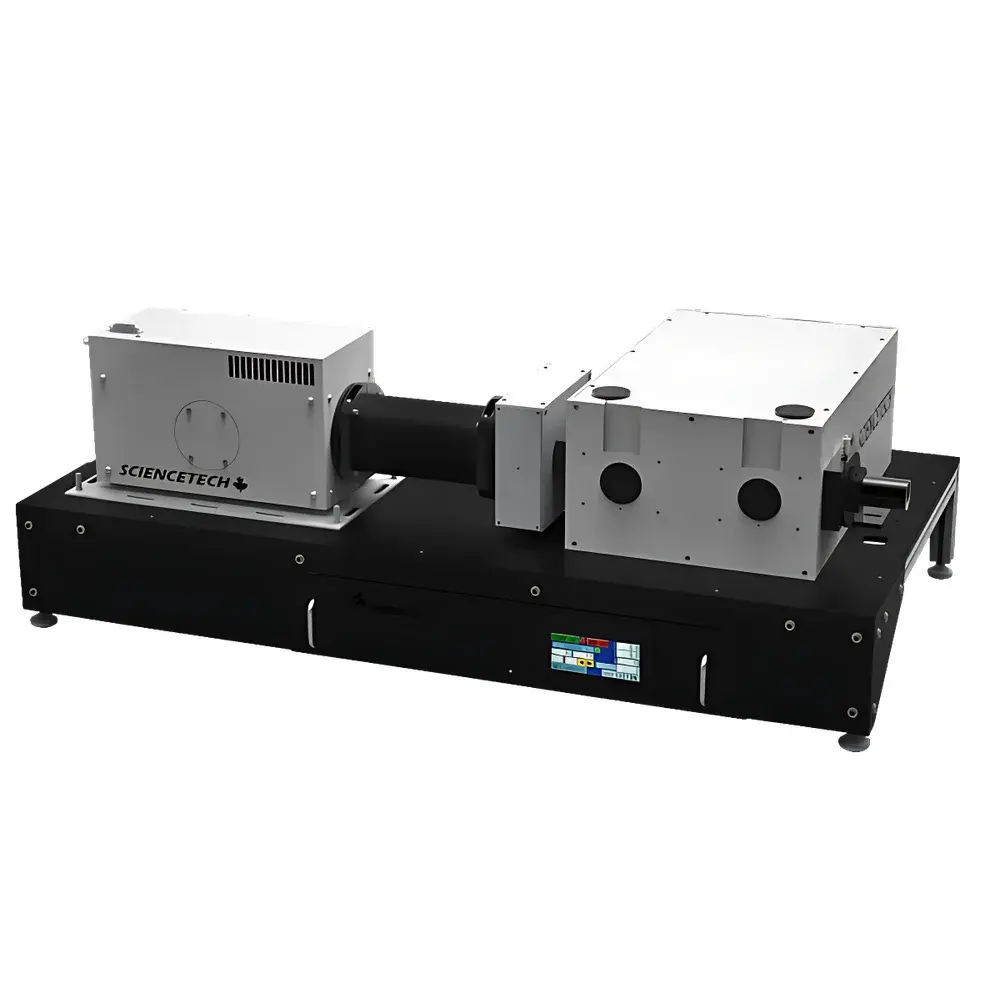
Sciencetech TLS 72-X300 High-Power Tunable Monochromatic Light Source with Xenon Lamp
| Brand | Sciencetech |
|---|---|
| Origin | Canada |
| Model | TLS 72-X300 |
| Light Source Type | 300 W Xenon Arc Lamp |
| Monochromator Type | 9072S (1/8 m focal length) |
| Wavelength Range | 300–1800 nm |
| Optical Resolution | 0.5 nm @ 300–700 nm, 0.7 nm @ 700–1800 nm |
| Grating | Dual-plane ruled grating, 30 × 30 mm, 1200 grooves/mm @ 300 nm / 600 grooves/mm @ 1000 nm |
| Wavelength Repeatability | ±0.1 nm |
| Wavelength Accuracy | ±0.2 nm |
| Filter Wheel | Computer-controlled 6-position |
| Beam Output | Collimated, 1-inch diameter |
| Illumination Mode | Internal illumination |
Overview
The Sciencetech TLS 72-X300 is a research-grade tunable monochromatic light source engineered for high-precision spectroscopic and photochemical applications requiring stable, spectrally selective irradiation across the UV-Vis-NIR range. Built around a 300 W short-arc xenon lamp—selected for its continuous spectral output from 200 nm to over 2500 nm—and integrated with the 9072S 1/8-meter Czerny-Turner monochromator, this system delivers calibrated, narrowband light with exceptional wavelength fidelity and long-term radiometric stability. The optical architecture employs plane ruled gratings (30 × 30 mm, dual groove density: 1200 gr/mm optimized for UV–visible and 600 gr/mm for NIR), enabling resolution of ≤0.5 nm in the visible region and ≤0.7 nm up to 1800 nm. Designed for integration into vacuum chambers, cryostats, or custom optical benches, the TLS 72-X300 supports both collimated 1-inch beam output and fiber-coupled configurations via optional adapters, ensuring compatibility with ellipsometers, photodetectors, lock-in amplifiers, and quantum efficiency measurement platforms.
Key Features
- Stable 300 W xenon arc lamp with >2000-hour lifetime and low spatial drift, optimized for uniform spectral radiance across 300–1800 nm
- 9072S monochromator featuring kinematic grating mount, precision worm-gear drive, and absolute encoder feedback for sub-0.1 nm repeatability
- Computer-controlled 6-position filter wheel for automatic order-sorting, stray-light suppression, and harmonic rejection (e.g., blocking 2nd-order UV lines when selecting visible bands)
- Collimated 1-inch output beam with divergence <1.5 mrad; optional focusing lens kits and SMA-905 fiber coupling interfaces available
- Fully programmable operation via RS-232 and USB 2.0; native support for LabVIEW™, Python (PyVISA), and MATLAB® instrument control toolboxes
- Internal illumination geometry minimizes ambient light leakage and enables direct sample chamber integration without external beam routing
Sample Compatibility & Compliance
The TLS 72-X300 is routinely deployed in ISO/IEC 17025-accredited laboratories for calibration traceability to NIST SRM standards. Its spectral output is validated per ASTM E275 (Standard Practice for Calibration of Spectrophotometers) and supports compliance with IEC 60904-8 (Photovoltaic devices – Spectral response measurements) and JIS C 8912 (Solar cell quantum efficiency testing). The system meets Class 3B laser safety requirements when operated with appropriate interlocks and beam enclosures (IEC 60825-1:2014). All firmware and motion control logic are designed to support GLP/GMP audit trails when paired with Sciencetech’s optional DataLog Pro software—enabling timestamped parameter logging, user authentication, and electronic signature capability compliant with FDA 21 CFR Part 11 Annex 11 requirements.
Software & Data Management
Sciencetech provides the TLS Control Suite v4.2—a platform-independent application supporting Windows, Linux, and macOS—for full instrument orchestration. The suite enables automated wavelength sweeps, intensity normalization against reference photodiode readings, and real-time spectral power density (W/nm) mapping. Raw spectral data export adheres to ASTM E131-22 format (.csv and .jdx), facilitating import into OriginLab, Igor Pro, or Python-based analysis pipelines. For high-throughput labs, the SDK includes comprehensive API documentation (C/C++, .NET, Python bindings) and example scripts for integrating TLS 72-X300 into automated test sequences alongside source meters, lock-in amplifiers, or hyperspectral cameras. Audit logs record every command execution, motor position, filter selection, and lamp operating hour—retained for ≥12 months with configurable backup to network drives or cloud storage endpoints.
Applications
- External quantum efficiency (EQE) and incident photon-to-current efficiency (IPCE) mapping of perovskite, organic, and multi-junction solar cells
- Time-resolved absorption and transient reflectance spectroscopy (TAS/TRTS) under controlled excitation wavelengths
- Photoelectrochemical (PEC) cell characterization—including band-edge determination and charge-transfer kinetics studies
- Fluorescence excitation spectroscopy for quantum dot, dye, and 2D material photophysics
- Calibration of CCD/CMOS array detectors, photomultiplier tubes, and pyroelectric sensors across UV–NIR
- Accelerated aging and spectral responsivity testing of UV-curable resins, OLED emissive layers, and optical filters
FAQ
What is the typical warm-up time required to achieve spectral stability?
The xenon lamp requires 15–20 minutes of continuous operation to reach thermal equilibrium; spectral output stabilizes to within ±0.5% irradiance variation after this period.
Can the TLS 72-X300 be upgraded with an automated shutter or intensity modulation?
Yes—optional motorized shutters (10 ms opening/closing time) and analog-intensity controllers (0–10 V input, 0–100% lamp power modulation) are available as factory-installed accessories.
Is ozone generation a concern when operating below 220 nm?
No—the standard configuration operates from 300 nm onward; for deep-UV extension, a vacuum-purged or nitrogen-purged monochromator path (TLS-72-X300-VU option) must be specified at time of order.
How is wavelength calibration maintained over time?
The system includes a built-in Hg–Ne spectral lamp for periodic auto-calibration; users may also perform manual calibration using certified emission lines from mercury, argon, or neon sources per ISO 17025 procedures.
Does Sciencetech provide application-specific validation reports?
Upon request, Sciencetech issues IQ/OQ documentation packages—including mechanical inspection records, spectral verification reports, and electrical safety test summaries—aligned with GxP laboratory implementation protocols.



