
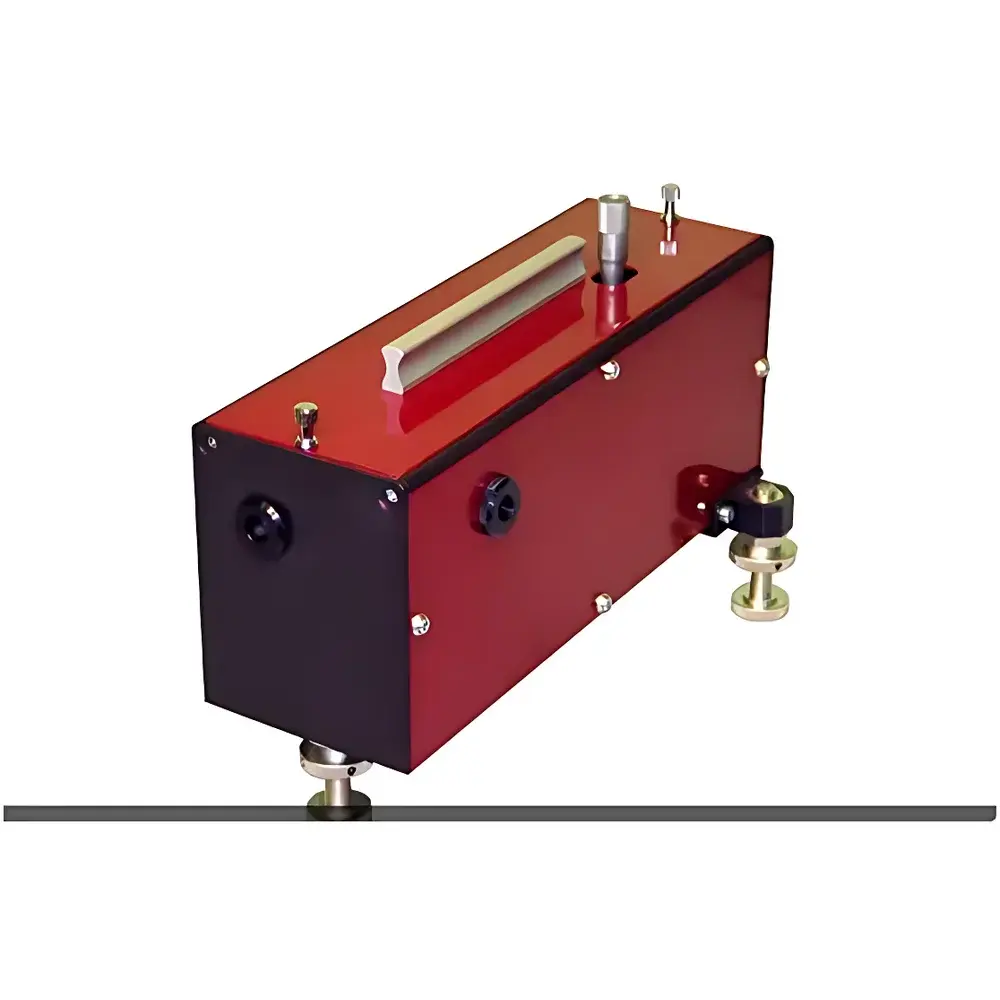
Avesta AFsG Frequency Doubling and Quadrupling Module
| Origin | USA |
|---|---|
| Manufacturer Type | Authorized Distributor |
| Origin Category | Imported |
| Model | AFsG |
| Price Range | USD 1,400 – 7,000 (est.) |
| Core Component | Solid-State Ultrafast Laser Harmonic Generation System |
Overview
The Avesta AFsG is a high-precision, all-solid-state frequency conversion module engineered for ultrafast laser systems operating in the 820–1600 nm spectral range. It implements critically phase-matched second-harmonic generation (SHG) and fourth-harmonic generation (FHG) via nonlinear optical crystals—typically BBO or LBO—within a thermally stable, kinematically aligned optomechanical housing. Unlike broadband parametric devices, the AFsG delivers discrete, narrowband harmonic output with minimal temporal pulse distortion, making it suitable for time-resolved spectroscopy, attosecond science, and pump-probe experiments requiring sub-100 fs pulse fidelity at visible and deep-UV wavelengths. The module operates on the principle of sum-frequency generation: SHG produces output at exactly half the input wavelength (e.g., 1030 nm → 515 nm), while FHG cascades SHG followed by sum-frequency mixing of the fundamental and second-harmonic fields (e.g., 1030 nm + 515 nm → 343 nm), enabling direct access to the 205–400 nm range without intermediate amplification stages.
Key Features
- High-conversion-efficiency SHG (20–50%) and FHG (3–10%), optimized for both oscillator- and amplifier-grade ultrafast sources
- Low beam divergence (<1.5 mrad typical) and negligible spatial walk-off due to precision crystal cut-angle alignment and collimated beam path design
- Thermally passive architecture—no active cooling required—ensuring long-term pointing stability and zero thermal lensing under continuous operation
- Modular optics sets enable wavelength-range customization; users specify central input wavelength during ordering to receive pre-aligned, anti-reflection-coated crystal assemblies
- Input compatibility with linearly polarized, horizontally oriented femtosecond pulses (≥50 fs duration); output polarization is orthogonally maintained (SH: vertical; FH: horizontal)
- Ruggedized aluminum housing (480 × 222 × 192 mm) with kinematic mounts, vacuum-compatible flanges, and SMA/FC fiber ports for OEM integration
Sample Compatibility & Compliance
The AFsG is compatible with Ti:sapphire oscillators, Yb-doped fiber amplifiers (e.g., 1030–1080 nm), and Cr:forsterite or Er:fiber sources across the 820–1600 nm band. Input beam requirements include M² 10¹⁰ shot lifetime at 1 kHz repetition rates. The module conforms to IEC 60825-1:2014 Class 4 laser product safety requirements when integrated into user-defined enclosures. Documentation supports GLP-compliant lab validation, including traceable calibration certificates for harmonic output power linearity and spectral bandwidth verification.
Software & Data Management
While the AFsG is a passive optical module requiring no embedded firmware or drivers, Avesta provides a comprehensive technical integration toolkit—including LabVIEW VIs, Python API wrappers (via PyVISA), and MATLAB instrument control scripts—for automated wavelength tuning and harmonic power monitoring when paired with external power meters or spectrometers. All delivered units include full optical alignment logs, crystal acceptance test reports (including SHG efficiency vs. input energy curves), and compliance documentation for FDA 21 CFR Part 11–aligned electronic record retention when used in regulated QC environments.
Applications
- Ultrafast transient absorption spectroscopy in the UV–visible range (205–400 nm), particularly for studying photoinduced charge transfer in perovskite and organic semiconductor thin films
- Pump-probe studies of carrier dynamics in 2D materials (e.g., MoS₂, WS₂) using tunable 410–800 nm SHG as probe and fundamental IR as pump
- Generation of seed pulses for optical parametric amplifiers (OPAs) and high-harmonic generation (HHG) in gas-phase targets
- Time-resolved photoluminescence (TRPL) and two-photon fluorescence microscopy where deep-UV excitation improves spatial resolution and reduces autofluorescence background
- OEM integration into industrial laser micromachining platforms requiring stable, maintenance-free UV sources for glass and polymer ablation
FAQ
What input pulse duration range is supported?
The AFsG is validated for input pulses ≥50 fs (FWHM). Pulse broadening remains <100 fs for SHG and <1000 fs for FHG under specified energy and dispersion conditions.
Can the AFsG be used with amplified systems delivering >10 mJ pulse energy?
No. Maximum input pulse energy is 10 mJ. For higher-energy applications (>50 mJ), Avesta recommends the AMG series with enlarged beam apertures and cryo-cooled crystal options.
Is vacuum compatibility available?
Yes. Standard housings feature CF-35 or KF-25 vacuum flanges; custom UHV versions (10⁻⁹ mbar) are available with bakeable seals and non-outgassing adhesives.
Does the module support automated wavelength tuning?
Not natively—but motorized crystal rotation stages (e.g., Thorlabs K10CR1) can be integrated using Avesta’s mechanical interface drawings and alignment protocols.
Are calibration certificates included?
Yes. Each unit ships with a NIST-traceable power calibration report, spectral bandwidth measurement, and SHG/FHG efficiency map referenced to input pulse energy and central wavelength.




