
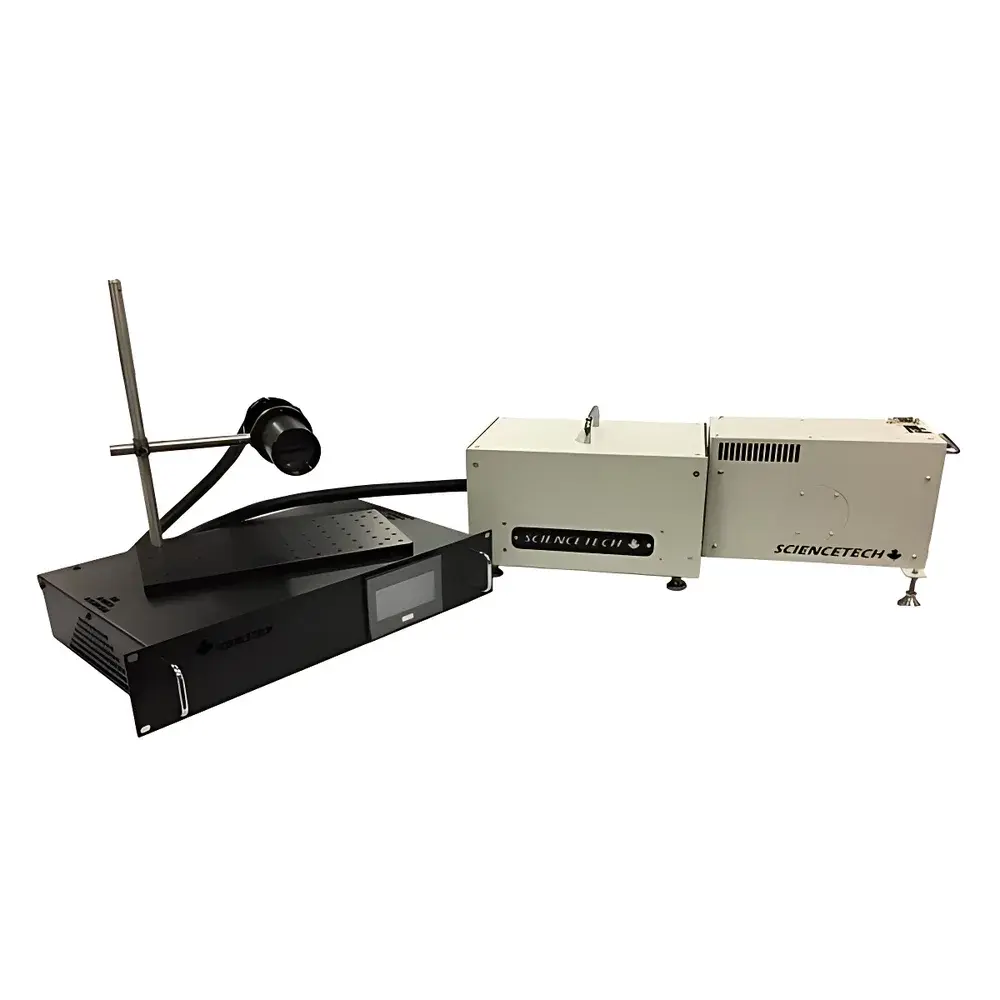
Sciencetech A4-LA125 Fiber-Optic Solar Simulator
| Brand | Sciencetech |
|---|---|
| Origin | Canada |
| Model | A4-LA125 |
| Illumination Area | 25 mm × 25 mm |
| Irradiance Level | Up to 4 suns (AM1.5G) |
| Working Distance | 125–175 mm |
| ASTM Class | AAA |
| Spectral Range | 350–1800 nm (standard spectral match: 400–1100 nm) |
| Light Source | 1000 W xenon arc lamp |
| Fiber Bundle Length | 1.22 m (4 ft) |
| Power Supply | 611-1k, 110–130 V / 9 A or 220–240 V / 6 A |
| Weight | 20 kg |
Overview
The Sciencetech A4-LA125 Fiber-Optic Solar Simulator is a high-precision, modular light source engineered for laboratory-grade photovoltaic (PV) characterization, photochemical kinetics, and photobiological studies. Unlike conventional solar simulators that require sample placement directly at the output aperture, the A4-LA125 delivers calibrated, spectrally matched illumination remotely—via a robust 1.22-meter optical fiber bundle—enabling flexible integration into custom experimental setups, gloveboxes, vacuum chambers, or spatially constrained test benches. Its core optical architecture employs a stabilized 1000 W xenon short-arc lamp coupled with precision AM1.5G broadband filtering and collimating optics, achieving full compliance with ASTM E927-10, IEC 60904-9 Ed. 3, and JIS C 8912 standards for Class AAA performance in spectral match, spatial uniformity (<2% RMS), and temporal stability (<0.5% over 10 s). The system operates across a broad spectral range of 350–1800 nm, with certified spectral match (400–1100 nm) optimized for silicon-based PV devices, while optional atmospheric filters (AM1.0D, AM1.5D, AM2.0) support terrestrial and extraterrestrial irradiance modeling.
Key Features
- Fiber-coupled delivery enabling remote, flexible illumination without repositioning samples or instruments
- AAA-class certification per ASTM E927-10 for spectral match (Class A), spatial uniformity (Class A), and temporal stability (Class A)
- Adjustable irradiance up to 4 suns (400 mW/cm²) on a 25 mm × 25 mm target area, with real-time intensity control via integrated touchscreen interface
- Integrated shutter with programmable exposure timing (0–10,000 s) and repeatable cycling for controlled dose delivery
- Modular filter selection: standard AM1.5G; optional UV-blocking, IR-cut, or narrowband spectral filters for application-specific spectral tailoring
- Self-contained power supply (model 611-1k) with dual-voltage compatibility (110–130 V / 9 A or 220–240 V / 6 A) and forced-air thermal management
- Compact footprint (76.8 × 21.6 × 38.3 cm) and lightweight design (20 kg) suitable for benchtop deployment and integration into automated test stations
Sample Compatibility & Compliance
The A4-LA125 accommodates diverse sample geometries—including flexible thin-film PV cells, dye-sensitized solar modules, organic photovoltaics (OPV), photocatalytic reactors, and biological tissue cultures—without mechanical interference from the light source. Its fiber-optic output eliminates heat transfer and electromagnetic interference at the sample plane, critical for temperature-sensitive photochemical assays or low-noise electrical measurements. All configurations are validated per ASTM E927-10 and IEC 60904-9 Ed. 3 for Class AAA performance. Optional traceable calibration reports include NIST-traceable spectral irradiance data and spatial uniformity maps. The system supports GLP-compliant operation when paired with Sciencetech’s optional PC-based control software, which logs timestamped irradiance profiles, shutter actuation events, and environmental parameters (ambient temperature/humidity) for audit-ready documentation.
Software & Data Management
The A4-LA125 features an embedded Linux-based touchscreen controller (7-inch capacitive display) for standalone operation, supporting intuitive configuration of irradiance setpoints, shutter sequences, and timer-based exposure protocols. For advanced automation, Sciencetech provides a native Windows-compatible SDK (C++, Python, LabVIEW drivers) enabling full remote control via Ethernet or USB. Software capabilities include synchronized data acquisition with external IV tracers or spectroradiometers, automated spectral calibration routines, and export of irradiance time-series in CSV or HDF5 formats. Audit trails comply with FDA 21 CFR Part 11 requirements when configured with user authentication, electronic signatures, and immutable log archiving—making it suitable for regulated R&D environments operating under ISO/IEC 17025 or GMP frameworks.
Applications
- Quantitative efficiency testing (Jsc, Voc, FF, η) of single-junction and multi-junction photovoltaic devices under standardized AM1.5G illumination
- Kinetic studies of photocatalytic degradation (e.g., TiO₂-mediated oxidation), photoelectrochemical water splitting, and solar fuel synthesis
- Photostability assessment of coatings, polymers, textiles, and pigments per ISO 4892-2 and ASTM G154 accelerated weathering protocols
- In vitro photobiological safety evaluation (ISO 15064, IEC 62471) and circadian rhythm research using tunable spectral output
- Calibration and validation of reference cells, pyranometers, and quantum sensors in metrology laboratories
FAQ
What is the maximum irradiance achievable with the A4-LA125 on a 25 mm × 25 mm area?
Up to 4 suns (400 mW/cm²) when equipped with the standard AM1.5G filter and operated at full lamp power.
Can the fiber output be coupled into a monochromator or integrating sphere?
Yes—the 1.22 m fiber bundle terminates in a standard SMA 905 connector, compatible with most commercial monochromators, spectroradiometers, and integrating spheres with matching input optics.
Is spectral recalibration required after filter changes?
Yes—each filter insertion alters the spectral distribution; Sciencetech recommends post-filter spectral verification using a calibrated spectroradiometer and provides factory calibration certificates for each delivered configuration.
Does the system support continuous-wave (CW) and pulsed illumination modes?
The A4-LA125 operates exclusively in CW mode; however, its integrated shutter enables precise pulse generation down to 10 ms resolution for transient photocurrent or photovoltage measurements.
What maintenance is required for the 1000 W xenon lamp?
Lamp lifetime is rated at ≥1000 hours under stable current regulation; replacement requires realignment of the ellipsoidal reflector and spectral recalibration—services available through Sciencetech’s authorized support network.





