
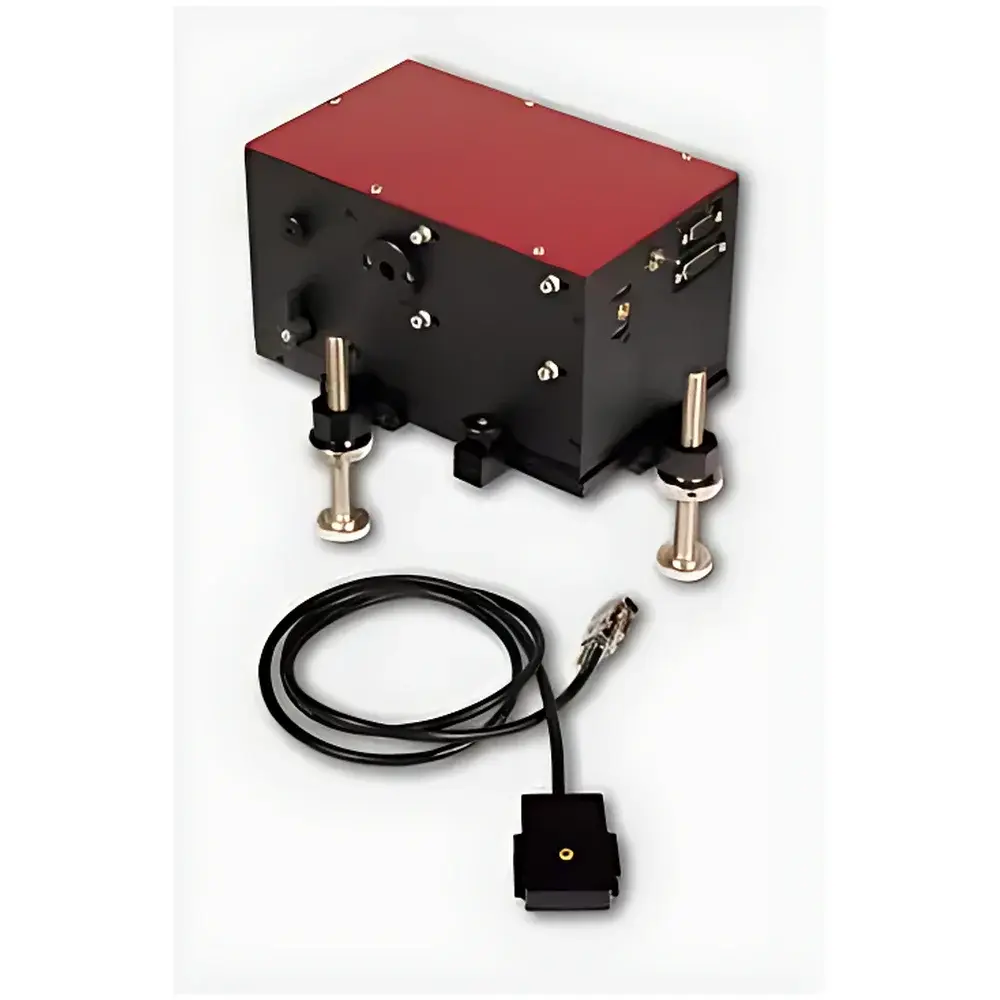
AVESTA AA20-DD Femtosecond Scanning Autocorrelator
| Origin | Russia |
|---|---|
| Manufacturer Type | Authorized Distributor |
| Origin Category | Imported |
| Model | AA20-DD |
| Price Range | USD 0–7,200 (FOB) |
| Wavelength Options | 450–700 nm (AA-20DDV), 700–1300 nm (AA-20DD), 1300–2000 nm (AA-20DDR), 450–2000 nm (AA-20DD+R+V) |
| Pulse Duration Range | 20–6000 fs (standard) |
| Repetition Rate Support | >10 kHz (standard) |
| Scan Frequency | 0.1–20 Hz |
| Linearity Error | <1% |
| Optical Architecture | All-reflective, collinear interferometric & intensity autocorrelation |
| Detection Mechanism | Two-photon conductivity in semiconductor detector |
| Input Polarization | Linear, horizontal (vertical on request) |
| Interface | USB 2.0 |
| Compliance | CE-marked |
Overview
The AVESTA AA20-DD is a precision scanning autocorrelator engineered for direct, real-time measurement of ultrashort laser pulse durations in the femtosecond regime. Based on the principle of second-harmonic generation (SHG) in non-linear optical crystals—specifically, collinear interferometric autocorrelation—the instrument reconstructs pulse width by spatially delaying one arm of a split beam and measuring the two-photon absorption signal as a function of optical path difference. This approach provides fringe-resolved autocorrelation traces, enabling unambiguous determination of pulse duration without assumptions about pulse shape (e.g., sech² or Gaussian). Designed for laboratory integration into ultrafast laser development, oscillator characterization, and dispersion management workflows, the AA20-DD delivers high reproducibility (<1% linearity error) and mechanical stability across its full 850 ps scan range. Its all-reflective optical design eliminates chromatic aberration, ensuring consistent performance across broad spectral bands—from visible (450 nm) to mid-infrared (2000 nm)—with modular crystal and detector swaps supporting application-specific configurations.
Key Features
- All-reflective, alignment-free optical architecture minimizes wavefront distortion and eliminates wavelength-dependent focus shifts
- Fringe-resolved autocorrelation output enables full temporal reconstruction and phase-sensitive diagnostics (e.g., pre-chirp identification)
- Motorized delay stage with sub-micron positioning resolution and smooth, backlash-free translation over ±425 ps (850 ps total scan)
- Dual-mode operation: interferometric (coherent) and intensity (non-coherent) autocorrelation selectable via crystal orientation
- USB 2.0 interface with vendor-provided Windows-compatible software (including LabVIEW drivers for custom automation)
- Optional fiber-coupled input (FC/PC or FC/APC) ensures compatibility with free-space and fiber-based ultrafast sources
- Modular wavelength coverage: interchangeable SHG crystals and detectors support 450–700 nm (BBO), 700–1300 nm (LBO), and 1300–2000 nm (AgGaSe₂) configurations
- Integrated power monitoring and polarization control (horizontal linear standard; vertical available upon request)
Sample Compatibility & Compliance
The AA20-DD accommodates free-space and fiber-coupled inputs from Ti:sapphire oscillators, Yb-fiber lasers, OPA systems, and Cr:forsterite amplifiers operating at repetition rates from 10 Hz to >10 MHz. Minimum input pulse energy thresholds are calibrated per configuration: ≥1 nJ for 50–300 fs pulses (thin crystal), ≥5 nJ for 300 fs–1 ps (thin crystal), and ≥50 nJ for 1–250 ps (thick crystal). The system complies with IEC 61000-6-3 (EMC emission) and IEC 61010-1 (safety for laboratory equipment). Data acquisition adheres to ALCOA+ principles—raw autocorrelation traces include embedded timestamps, instrument ID, calibration metadata, and user-defined notes—enabling audit-ready documentation for ISO/IEC 17025, FDA 21 CFR Part 11, and GLP environments when paired with validated software workflows.
Software & Data Management
The native AVESTA Autocorrelator Control Suite (v3.2+) runs on Windows 7–11 and provides real-time trace visualization, automatic FWHM calculation (Gaussian/sech² fitting), baseline correction, and noise suppression algorithms. Export formats include CSV (raw delay vs. signal), PNG/SVG (publication-ready plots), and HDF5 (structured metadata + trace arrays). LabVIEW, Python (PyVISA), and MATLAB APIs allow integration into automated test benches—for example, closed-loop dispersion compensation using feedback from sequential autocorrelation measurements. All acquired datasets retain cryptographic hash signatures and immutable acquisition logs, satisfying traceability requirements for regulated QC/QA labs.
Applications
- Characterization of mode-locked oscillators (Ti:sapphire, Yb-doped fiber, Cr:ZnSe) and amplifier systems
- Quantitative evaluation of dispersion introduced by mirrors, prisms, grating compressors, and photonic crystal fibers
- Validation of pulse compression efficiency in chirped-pulse amplification (CPA) and OPCPA architectures
- In-situ monitoring of pulse broadening in multiphoton microscopy beam paths
- Development and testing of novel ultrafast fiber lasers (e.g., Er-doped, Tm-doped, supercontinuum sources)
- Time-domain metrology for attosecond science infrastructure requiring precise pump-probe synchronization
FAQ
What pulse durations can the AA20-DD measure?
Standard configuration measures 20–6000 fs; with the optional -30PS module, the upper limit extends to 30 ps.
Is fiber coupling supported?
Yes—FC/PC and FC/APC adapters are available; custom connectors (e.g., SMA905, ST) can be integrated upon request.
Does the system require external triggering?
No—internal hardware synchronization ensures stable scan timing across repetition rates from 10 Hz to >10 MHz.
Can I use my own analysis software?
Yes—full API access (LabVIEW, Python, MATLAB) enables custom fitting routines, batch processing, and integration with existing lab management systems.
How is calibration maintained over time?
The delay stage includes factory-calibrated encoder feedback; users may perform periodic verification using a stabilized HeNe laser (632.8 nm) and known-path-difference reference points.




