
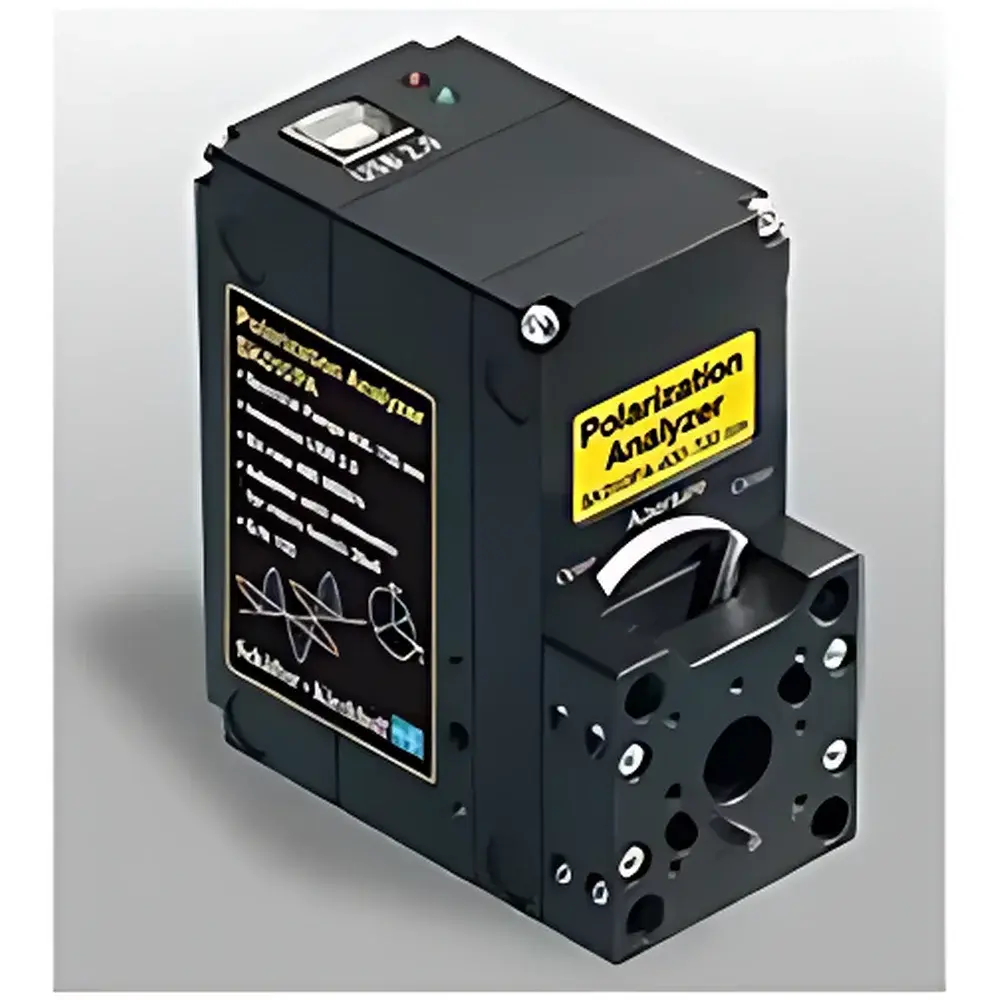
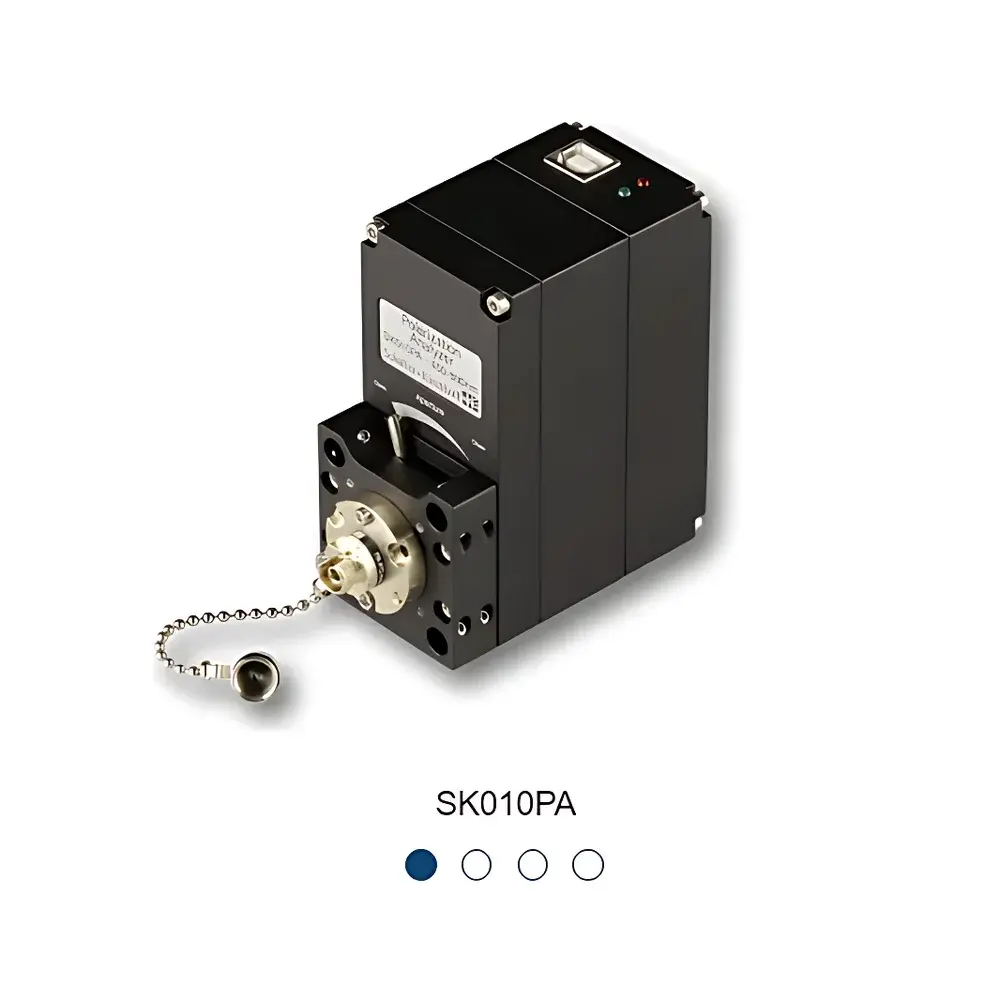
Systec SK101PA Polarization Analyzer
| Brand | Systec |
|---|---|
| Origin | Germany |
| Model | SK101PA |
| Wavelength Range Options | 375–450 nm (VISUV), 400–700 nm (UVIS), 450–800 nm (VIS), 700–1100 nm (NIR), 1100–1600 nm (IR) |
| Interface | USB 2.0 |
| Power Supply | Bus-powered via USB |
| Fiber Adapters | FC-APC (standard), FC-PC, DIN AVIO, ST (optional) |
| Free-space Beam Diameter | Up to 4 mm |
| Optical Power Range | 0.01–50 mW |
| Sampling Rate | 15 Hz |
| SOP Accuracy | ±0.2° |
| PER Accuracy | ±0.5 dB |
| DOP Accuracy | ±5% |
| Warm-up Time | 5 min |
| Dimensions (W×L×H) | 40 × 70 × 82 mm |
| Sample Compatibility | Free-space beams & polarization-maintaining (PM) fiber outputs (FC/APC, SMA-905 HP, etc.) |
| Software | Dedicated Windows-based application for SOP tracking, PM-fiber alignment, and Poincaré sphere visualization |
Overview
The Systec SK101PA Polarization Analyzer is a compact, USB-powered metrology instrument engineered for high-fidelity characterization of the polarization state of laser radiation in both free-space and fiber-coupled configurations. Based on the well-established four-channel Stokes polarimetry principle, the device captures real-time measurements of all four Stokes parameters (S₀–S₃) to fully reconstruct the incident light’s polarization state—including degree of polarization (DOP), ellipticity, orientation angle, and handedness—without mechanical moving parts. Its solid-state optical architecture ensures long-term stability and immunity to vibration-induced drift, making it suitable for integration into laser development labs, fiber-optic component testing stations, and production-line QC environments where repeatable, traceable polarization metrics are required per ISO/IEC 17025 or IEC 61290-13 standards.
Key Features
- Full Stokes vector acquisition at 15 Hz sampling rate, enabling dynamic monitoring of polarization fluctuations during laser warm-up, mode hopping, or thermal transients.
- Simultaneous display of polarization state on the Poincaré sphere and as a time-resolved polarization ellipse, with real-time annotation of linear polarization fraction (LPF) and principal axis orientation.
- Native support for polarization-maintaining (PM) fiber alignment workflows: automatic identification of slow/fast axis orientation relative to connector keying (e.g., FC-APC key slot), with angular resolution better than ±0.2°.
- Modular optical interface design: ships with FC-APC adapter as standard; optional adapters include FC-PC, ST, DIN AVIO, SMA-905 (5°/8° angled), and high-power variants compatible with >1 W CW lasers.
- Free-space measurement mode accommodates collimated beams up to 4 mm diameter; optional micro-positioning stages (φ12/25/32/45/55 mm apertures) enable precise beam centering and spatial alignment without external optics.
- Bus-powered operation via USB 2.0 eliminates need for external power supplies or grounding loops—critical for low-noise electro-optic test benches.
Sample Compatibility & Compliance
The SK101PA supports both free-space and fiber-delivered laser sources across five calibrated spectral bands: VISUV (375–450 nm), UVIS (400–700 nm), VIS (450–800 nm), NIR (700–1100 nm), and IR (1100–1600 nm). Each wavelength variant undergoes factory calibration using NIST-traceable reference polarizers and quarter-wave plates. The analyzer complies with CE marking requirements for electromagnetic compatibility (EN 61326-1) and safety (EN 61010-1). Its measurement uncertainty budget—validated per ISO 5725-2—accounts for detector nonlinearity, temperature-induced birefringence in internal optics, and polarization-dependent loss (PDL) of input adapters. For regulated environments, raw Stokes data export supports audit-ready documentation aligned with FDA 21 CFR Part 11 when used with validated software configurations.
Software & Data Management
The included Windows-based control application provides a deterministic, low-latency interface for real-time SOP visualization, batch data logging (CSV/HDF5), and automated report generation. All acquired Stokes vectors are timestamped with microsecond precision and stored with metadata including wavelength band, adapter type, power reading, and environmental temperature (measured internally). The software implements GLP-compliant features: user access levels, electronic signatures, and immutable audit trails for parameter changes or calibration events. Export modules support direct integration with MATLAB, Python (via PyVISA), and LabVIEW for custom algorithm development—e.g., real-time DOP threshold triggering or PM-fiber beat-note phase tracking.
Applications
- Laser diode and DPSS laser qualification: SOP stability assessment over temperature and current sweeps.
- Polarization-sensitive interferometry setup alignment, including Mach–Zehnder and Sagnac configurations.
- Characterization of PM fiber pigtails, waveplates, isolators, and polarization beam splitters per Telcordia GR-1221-CORE.
- Monitoring polarization extinction ratio (PER) degradation in fiber amplifiers and modulators under accelerated aging tests.
- Research in quantum optics requiring precise initialization of photonic qubit states (e.g., |H⟩/|V⟩ encoding).
- Educational labs demonstrating Mueller matrix formalism and depolarization mechanisms in scattering media.
FAQ
Is the SK101PA compatible with single-mode and multimode fibers?
Yes—the analyzer accepts light from both SMF-28 and MMF (e.g., 50/125 µm) via appropriate adapters; however, accurate SOP reconstruction assumes spatially coherent, well-collimated input. Multimode inputs require mode-stripping or spatial filtering for reliable Stokes analysis.
Can the device measure depolarized light from broadband sources?
It is optimized for quasi-monochromatic laser sources. Broadband measurements require spectral filtering; unfiltered broadband light yields averaged Stokes parameters that do not represent instantaneous SOP.
Does the software support remote operation via Ethernet or GPIB?
No—communication is USB 2.0 only. However, the DLL API enables integration into host systems running on remote PCs via shared network drives or virtual machine passthrough.
What is the minimum measurable power level for reliable SOP determination?
At 633 nm, the lower limit is 0.01 mW (10 µW) with SNR > 40 dB; performance degrades below this due to photon shot noise dominance in the detector array.
How often does the unit require recalibration?
Factory calibration remains valid for 24 months under normal lab conditions (23 ± 5°C, <60% RH, no mechanical shock); annual verification against a reference polarizer is recommended for ISO 17025-accredited labs.




