
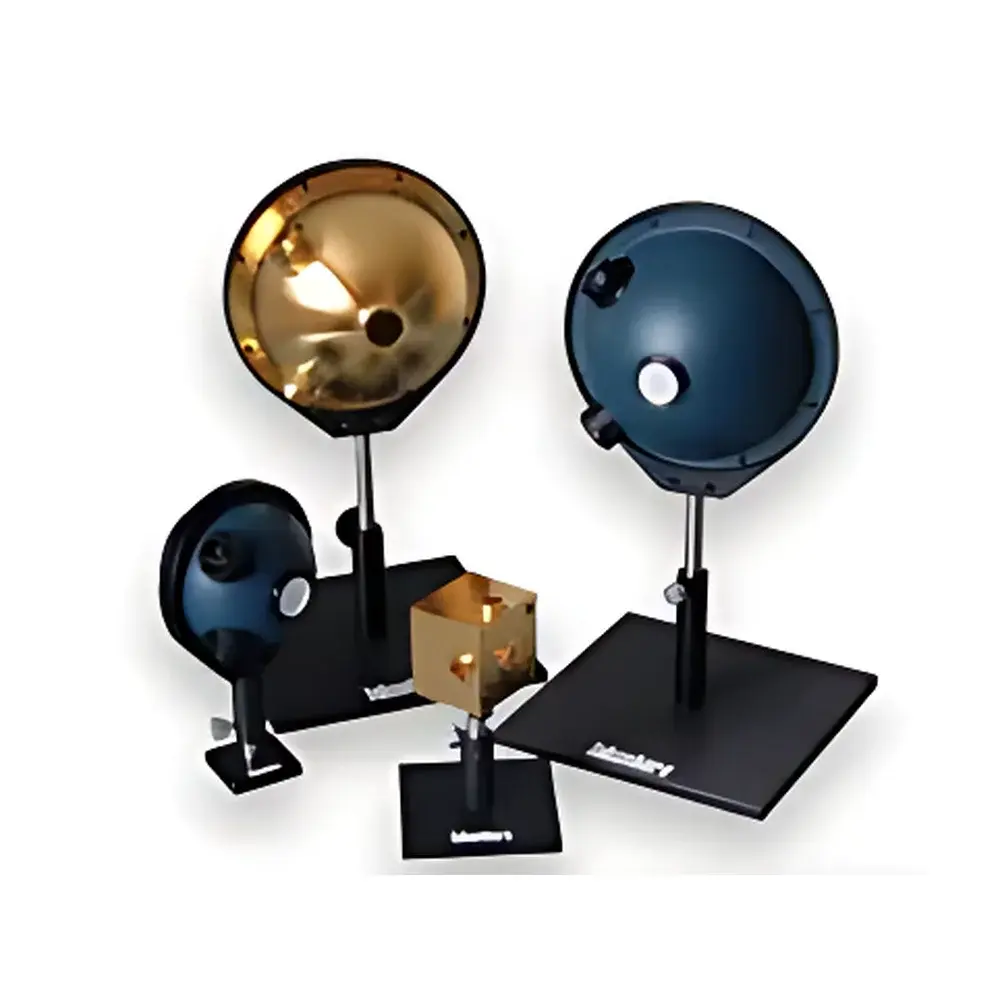
Labsphere Infragold Laser Power Measurement Integrating Sphere
| Brand | Labsphere |
|---|---|
| Model | Infragold |
| Origin | USA |
| Component Type | Optical Element |
| Coating | Infragold® (700 nm – 20 µm) |
| Cooling | Water-cooled (max. 2 kW/cm² power density) |
| Detector Ports | 2 fixed, expandable to 4 |
| Compliance | ASTM E275, ISO 9001-certified manufacturing |
| Optional Configurations | Dual-detector, spectrometer-coupled, polarizer-filtered attenuation |
Overview
The Labsphere Infragold Laser Power Measurement Integrating Sphere is an engineered optical solution for absolute radiant power measurement of highly collimated or spatially divergent laser sources—including laser diodes, CW and pulsed Nd:YAG, CO₂, and high-power near- to mid-infrared lasers. Based on the fundamental principle of diffuse reflectance integration, the sphere uniformly scatters incident radiation across its inner surface coated with Labsphere’s proprietary Infragold® spectral coating—a durable, spectrally neutral, high-reflectance (>97% avg. from 700 nm to 20 µm) material optimized for thermal stability under intense irradiation. Unlike conventional photodiode-based sensors, this integrating sphere decouples measurement accuracy from beam geometry, enabling reliable power quantification independent of incident angle (up to ±40° half-angle), polarization state, or spatial profile—critical for R&D labs, laser manufacturing QA, and defense-grade calibration facilities.
Key Features
- Water-cooled spherical housing constructed from aluminum alloy with dual 1/4″-28 NPT coolant ports; compatible with tap water, ethylene glycol/water mixtures, or recirculating chillers (max. 15 psi operating pressure, 35 psi safety relief)
- Infragold® coating applied via vacuum-spray process, certified for long-term reflectance stability under thermal load up to 2 kW/cm² power density
- Integrated laser target plate positioned at the primary input port to absorb and isotropically scatter first-surface energy—minimizing localized heating and ensuring uniform sphere illumination
- Two standard detector ports (typically configured for thermopile or photodiode-based sensors); optional expansion to four ports supports concurrent broadband power + spectral analysis (e.g., power meter + fiber-coupled spectrometer)
- Filter-compatible design enables neutral-density or polarization-compensating filter insertion upstream of the sphere entrance to suppress detector saturation or mitigate polarization bias
- Modular mechanical interface allows direct coupling to Labsphere’s calibrated reference detectors (e.g., P/N 7Z02160, 7Z02161) traceable to NIST standards
Sample Compatibility & Compliance
The Infragold integrating sphere accommodates continuous-wave (CW) and pulsed laser sources across UV–Vis–NIR–MIR bands (700 nm – 20 µm). Its geometric insensitivity ensures valid measurements for multimode beams, elliptical profiles, and non-Gaussian distributions without realignment. Each unit undergoes factory verification per ASTM E275 (“Standard Practice for Calibration of Integrating Sphere Systems”) and is manufactured in an ISO 9001-certified facility. For regulated environments—including FDA-regulated medical laser device validation or aerospace laser safety testing—the system supports full audit trail documentation when paired with compliant data acquisition hardware meeting 21 CFR Part 11 requirements. Traceable calibration certificates (including spectral responsivity curves and angular acceptance data) are supplied with every shipment.
Software & Data Management
While the sphere itself is a passive optical component, it is fully interoperable with industry-standard power meter platforms (e.g., Ophir StarLite, Thorlabs PM100D, Newport 1918-C) and spectral analyzers (e.g., Ocean Insight QE Pro, Hamamatsu C12666MA). Labsphere provides detailed mechanical drawings, port alignment specifications, and coating reflectance datasets (CSV format) for integration into custom LabVIEW, Python (PyVISA), or MATLAB-based measurement automation frameworks. When used with compliant DAQ systems, full electronic records—including timestamped power readings, coolant temperature logs, and detector linearity corrections—can be archived in accordance with GLP/GMP documentation protocols.
Applications
- Calibration and output verification of industrial CO₂ and fiber lasers (≤2 kW/cm²)
- Characterization of high-brightness laser diode arrays in semiconductor packaging and photonic IC testing
- Measurement of M² factor input beams prior to focusing optics in ultrafast laser systems
- Thermal load profiling of laser-target interaction in materials processing R&D
- Reference standard for ISO 11554-compliant laser power meter accreditation labs
- Multi-wavelength laser source validation in quantum optics setups requiring simultaneous power + spectral fidelity assessment
FAQ
What is the maximum allowable input power density for continuous operation?
The Infragold sphere is rated for up to 2 kW/cm² at the laser target plate under active water cooling with ≤15 psi inlet pressure and adequate flow rate (≥0.5 GPM recommended).
Can this sphere be used for pulsed lasers?
Yes—provided pulse energy and peak power remain within the thermal time constant limits of the Infragold coating and target plate; typical use includes Q-switched Nd:YAG (1064 nm) and TEA CO₂ lasers.
Is NIST-traceable calibration included?
Each sphere ships with a factory calibration report referencing NIST-traceable transfer standards; optional on-site or third-party recalibration services are available through Labsphere’s Metrology Division.
How does the sphere handle polarization-dependent measurement error?
Polarization bias is mitigated via internal multiple-scattering and optional upstream broadband neutral-density filters; measurement uncertainty due to polarization remains <±0.5% for linearly polarized inputs across the specified spectral range.
What coolant types are validated for long-term use?
Deionized water, 30/70 ethylene glycol/water mixture, and inhibited propylene glycol solutions are approved; glycol-based coolants require periodic pH monitoring and inhibitor replenishment per manufacturer guidelines.




