
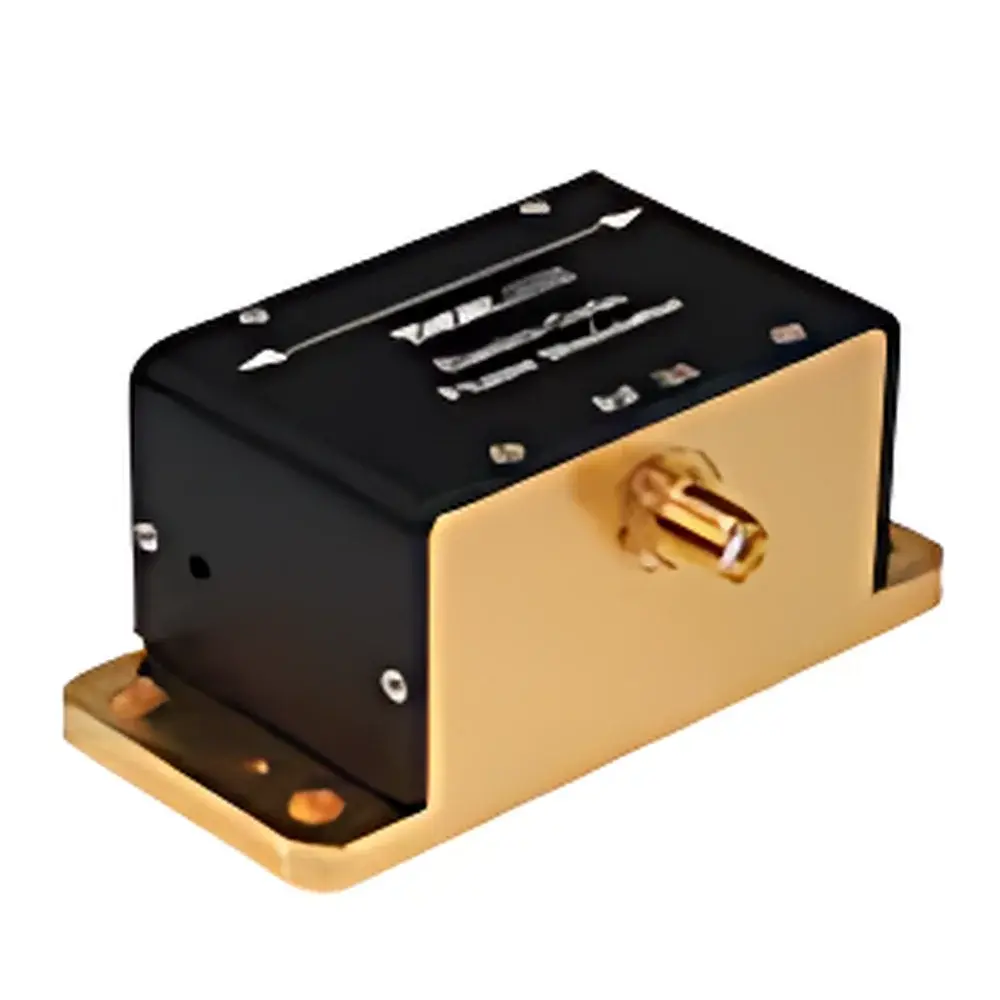
Thorlabs EO-AM-NR Electro-Optic Amplitude Modulator
| Brand | Thorlabs |
|---|---|
| Origin | USA |
| Model | EO-AM-NR |
| Type | Lithium Niobate (LiNbO₃) DC-Coupled Electro-Optic Amplitude Modulator |
| Wavelength Range | 400–1650 nm (C1–C4 options) |
| Aperture | 2 mm |
| Input Interface | SMA Female |
| Bandwidth | DC to 100 MHz |
| Half-Wave Voltage (Vπ) | 360 V @ 1064 nm (typ.) |
| Max. Optical Power Density | 2 W/mm² @ 532 nm, 4 W/mm² @ 1064 nm |
| Compatible High-Voltage Driver | Thorlabs HVA200 (±200 V, 100 mA, 1 MHz BW, BNC I/O) |
Overview
The Thorlabs EO-AM-NR is a high-performance, DC-coupled electro-optic amplitude modulator engineered for precision control of laser beam intensity in research and industrial optical systems. Based on the linear electro-optic (Pockels) effect in z-cut lithium niobate (LiNbO₃), it enables analog modulation of optical power with exceptional linearity, low insertion loss, and broad spectral coverage across four wavelength bands (C1: 400–600 nm; C2: 600–900 nm; C3: 900–1250 nm; C4: 1250–1650 nm). Its monolithic crystal design—free of anti-reflection coatings on the input/output faces—ensures high damage threshold and stable operation under continuous-wave (CW) and pulsed illumination. The device operates in transmission geometry with a 2 mm clear aperture, supporting collimated free-space beams while maintaining spatial mode fidelity. Unlike AC-coupled or resonant modulators, the EO-AM-NR’s DC-coupled architecture permits true zero-frequency (static) bias control and arbitrary waveform modulation—including ramp, step, and low-frequency (<1 Hz) intensity stabilization—making it suitable for applications requiring long-term drift compensation and closed-loop feedback integration.
Key Features
- DC-coupled electro-optic amplitude modulation with full static bias control
- Lithium niobate (LiNbO₃) crystal platform offering high electro-optic coefficient (r₃₃ ≈ 30 pm/V) and excellent thermal stability
- Four interchangeable wavelength configurations (C1–C4) covering UV-visible to near-infrared spectrum
- 2 mm clear aperture optimized for Gaussian beam handling up to TEM₀₀ modes with M² < 1.1
- SMA female RF input connector enabling direct integration with standard signal generators and lock-in amplifiers
- Low Vπ of 360 V @ 1064 nm (typical), ensuring compatibility with commercially available high-voltage amplifiers such as the Thorlabs HVA200
- High optical damage threshold: 2 W/mm² @ 532 nm, 4 W/mm² @ 1064 nm (measured at 10 ns pulse width, 10 Hz rep rate)
- Robust mechanical housing with kinematic mounting interface (8-32 UNC threaded holes) for alignment stability in vibration-sensitive environments
Sample Compatibility & Compliance
The EO-AM-NR is designed for use with free-space, collimated laser beams and requires no fiber coupling—eliminating polarization-dependent loss (PDL) and modal dispersion issues inherent in fiber-pigtailed alternatives. It supports both linearly polarized input light aligned to the crystal’s extraordinary axis and maintains extinction ratios >25 dB across its operational bandwidth when paired with a matched polarizer. The device complies with RoHS Directive 2011/65/EU and meets CE marking requirements for electromagnetic compatibility (EMC Directive 2014/30/EU). While not certified for medical or aerospace-grade qualification, its construction adheres to ISO 9001-compliant manufacturing practices at Thorlabs’ US-based facilities. For GLP/GMP-aligned optical test setups, the modulator’s repeatability (±0.5% intensity deviation over 8-hour continuous operation at constant Vbias) supports traceable calibration protocols per ISO/IEC 17025.
Software & Data Management
Although the EO-AM-NR itself is a passive optical component without embedded firmware, its performance is fully integrable into automated optical test benches via compatible drivers and control software. When used with the Thorlabs HVA200 high-voltage amplifier, users can leverage standard SCPI command sets through USB or analog voltage inputs for programmable bias and modulation. Third-party platforms—including LabVIEW (with NI DAQmx drivers), Python (via PyVISA), and MATLAB (Instrument Control Toolbox)—support real-time waveform generation, closed-loop intensity stabilization, and time-resolved photodetection synchronization. The HVA200’s BNC-monitor output provides a scaled-down replica of the high-voltage output (40:1 ratio, ±6% tolerance), enabling oscilloscope-based verification of drive signals without loading the HV path. All calibration data—including measured Vπ vs. wavelength curves and temperature-dependent drift coefficients—is provided in NIST-traceable PDF documentation shipped with each unit.
Applications
- Laser intensity stabilization in ultra-stable interferometers (e.g., gravitational wave detection prototype systems)
- Q-switching and cavity dumping in solid-state and fiber lasers
- Optical coherence tomography (OCT) reference arm modulation for phase-sensitive signal recovery
- Quantum optics experiments requiring precise photon number control (e.g., heralded single-photon source gating)
- Time-resolved spectroscopy with sub-nanosecond intensity switching for pump-probe delay scanning
- Calibration of photodetectors and power meters using known modulation depth and duty cycle
- Integration into OEM laser systems requiring compact, field-replaceable amplitude control modules
FAQ
What is the difference between the EO-AM-NR and EO-PM-NR models?
The EO-AM-NR is configured for amplitude modulation via transverse electrode geometry and a polarizer-analyzer pair, whereas the EO-PM-NR is optimized for pure phase modulation with longitudinal electrodes and no intrinsic polarization dependence.
Can the EO-AM-NR be used with femtosecond pulses?
Yes—its DC-coupled design and broadband LiNbO₃ response support pulses down to ~100 fs duration; however, group velocity dispersion must be compensated externally for transform-limited operation.
Is temperature stabilization required for long-term Vπ stability?
For applications demanding better than ±1% intensity stability over >1 hour, active temperature control (±0.1°C) is recommended, as Vπ exhibits a temperature coefficient of ~0.02%/°C near 25°C.
Does the EO-AM-NR require impedance matching at the RF input?
No—the SMA input is internally terminated to 50 Ω; users should ensure source impedance matches to avoid signal reflection and standing waves above 10 MHz.
Can multiple EO-AM-NRs be cascaded for higher extinction ratio?
Yes—cascading two units with orthogonal polarizations achieves >45 dB extinction, though insertion loss accumulates (~0.3 dB per stage, excluding polarizer losses).




