
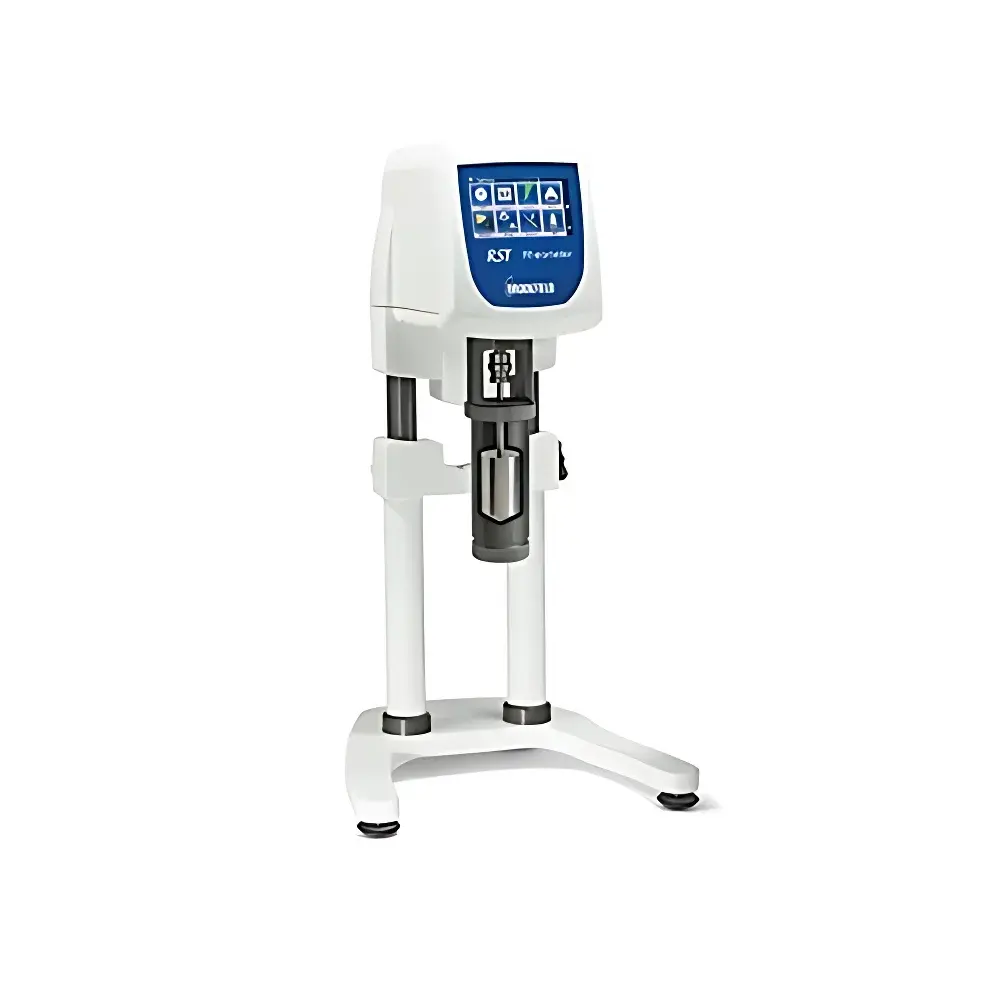
Brookfield RST-CC Coaxial Cylinder Rheometer
| Brand | Brookfield |
|---|---|
| Origin | USA |
| Model | RST-CC |
| Torque Range | 0.15 µN·m to 100 mN·m |
| Speed Range | 0.01–1,300 rpm |
| Viscosity Range | 0.005–54.1 MPa·s (5–54.1 × 10⁶ cP) |
| Temperature Control Options | −20 °C to 200 °C (with fluid bath), −20 °C to 180 °C (Peltier air/oil), 40 °C to 250 °C (electric heater) |
| Compliance | FDA 21 CFR Part 11–ready (via Rheo 3000 software) |
| Interface | USB, RS-232 |
| Display | LCD touchscreen with graphical real-time plot |
| Memory | 11 programmable test slots |
| Auto-rotor ID | Barcode-enabled coaxial cylinder detection |
| Temperature Accuracy | ±0.1 °C (with calibrated bath) |
| Units Supported | cP, Pa·s, dyn/cm², Pa, °C, °F |
Overview
The Brookfield RST-CC Coaxial Cylinder Rheometer is a precision-controlled rotational rheometer engineered for fundamental and applied viscoelastic characterization of complex fluids under controlled shear stress or shear rate conditions. Based on Couette flow geometry, the instrument measures torque response of a sample confined between two concentric cylindrical surfaces — an outer stationary cup and an inner rotating bob — enabling direct calculation of shear stress (τ), shear rate (γ̇), and dynamic viscosity (η = τ/γ̇). This geometry provides high sensitivity at low shear rates and excellent reproducibility across wide viscosity spans, making it especially suitable for quality control laboratories, formulation development teams, and academic rheology research where structural breakdown, yield behavior, and time-dependent flow properties must be quantified rigorously.
Key Features
- True stress-controlled and rate-controlled operation modes, supporting steady-state flow curves, oscillatory amplitude sweeps (G′, G″), and time-sweep tests (thixotropy, recovery)
- Automatic rotor identification via integrated barcode scanner — eliminates manual input errors and ensures traceability of geometry-specific calibration factors
- Modular temperature control architecture: compatible with multiple thermal units including FTKY3 fluid-circulating jacket (−20 °C to 180 °C), Peltier-based air/oil systems, and high-temperature electric heaters (up to 250 °C)
- High-resolution torque transducer (0.15 µN·m resolution) and ultra-low-speed motor (0.01 rpm minimum) for accurate measurement of weakly structured gels and highly viscous polymer melts
- 11-user-programmable memory slots enable storage of multi-step test protocols — ideal for standardized QC workflows per ASTM D2196, ISO 3219, or USP <911>
- Integrated LCD touchscreen with real-time graphical display of viscosity, shear stress, and temperature — no external PC required for basic operation
Sample Compatibility & Compliance
The RST-CC accommodates samples ranging from low-viscosity solvents (e.g., ethanol, acetone) to highly structured pastes (e.g., toothpaste, battery slurries, ceramic inks) and thermoplastic melts (e.g., polyethylene, polycarbonate). Its coaxial cylinder geometry ensures uniform shear field distribution and minimal wall-slip artifacts — critical for non-Newtonian materials exhibiting particle migration or surface depletion. The system supports GLP/GMP-compliant environments through optional Rheo 3000 software, which implements electronic signatures, audit trails, role-based user access controls, and data encryption aligned with FDA 21 CFR Part 11 requirements. All firmware and calibration records are timestamped and exportable in CSV or PDF formats for regulatory submission.
Software & Data Management
Rheo 3000 software (optional) transforms the RST-CC into a fully networked laboratory instrument. It enables remote operation, automated report generation, statistical analysis (e.g., %RSD across replicates), and compliance-ready documentation. Raw torque and angular velocity data are captured at up to 100 Hz sampling rate, allowing post-hoc derivation of complex moduli in oscillatory mode. Export formats include ASTM-compliant .csv, Excel-compatible .xlsx, and instrument-agnostic .txt files. The software also supports method locking, version-controlled SOP deployment, and integration with LIMS via ODBC drivers — facilitating seamless alignment with enterprise-level QA/QC infrastructure.
Applications
- Formulation optimization of coatings, adhesives, and inks — evaluating sag resistance, leveling behavior, and spray atomization stability
- Pharmaceutical suspension and gel characterization per USP <911> and EP 2.9.35 guidelines
- Food texture profiling: yogurt syneresis, chocolate tempering kinetics, and starch gelatinization enthalpy mapping
- Electrochemical material screening: cathode/anode slurry rheology for lithium-ion battery manufacturing
- Polymer processing simulation: melt elasticity (die swell), extensional viscosity estimation via filament stretching analogues
- Geotechnical fluid testing: drilling mud yield point and thixotropic recovery under downhole temperature profiles
FAQ
What temperature control options are available for the RST-CC, and how do they differ in application scope?
The RST-CC supports four distinct thermal management paths: fluid-circulating jackets (FTKY3) for broad-range sub-zero to high-temperature work; Peltier-air modules for rapid ambient-to-moderate heating without external utilities; Peltier-oil variants for improved thermal coupling with viscous samples; and electric heaters for extreme-condition studies above 200 °C.
Is the RST-CC compliant with pharmaceutical regulatory standards?
Yes — when used with Rheo 3000 software, the system meets FDA 21 CFR Part 11 requirements for electronic records and signatures, including user authentication, audit trail logging, and data integrity safeguards essential for GxP environments.
Can the RST-CC perform oscillatory rheology measurements?
Yes — the instrument supports amplitude sweep, frequency sweep, and time sweep modes in oscillatory mode, delivering storage modulus (G′), loss modulus (G″), and tan δ values for linear viscoelastic region (LVR) determination and structural resilience assessment.
How does the coaxial cylinder geometry compare to cone-and-plate in terms of sample volume and edge effects?
Coaxial cylinders require larger sample volumes (typically 15–25 mL) but eliminate truncation errors and edge fracture concerns common in cone-and-plate geometries — particularly advantageous for filled or particulate-laden systems where gap uniformity is critical.
Does the RST-CC support third-party automation integrations?
Yes — via RS-232 and USB virtual COM port protocols, the instrument can interface with robotic liquid handlers, environmental chambers, or PLC-based production line controllers using standard SCPI command sets.



