
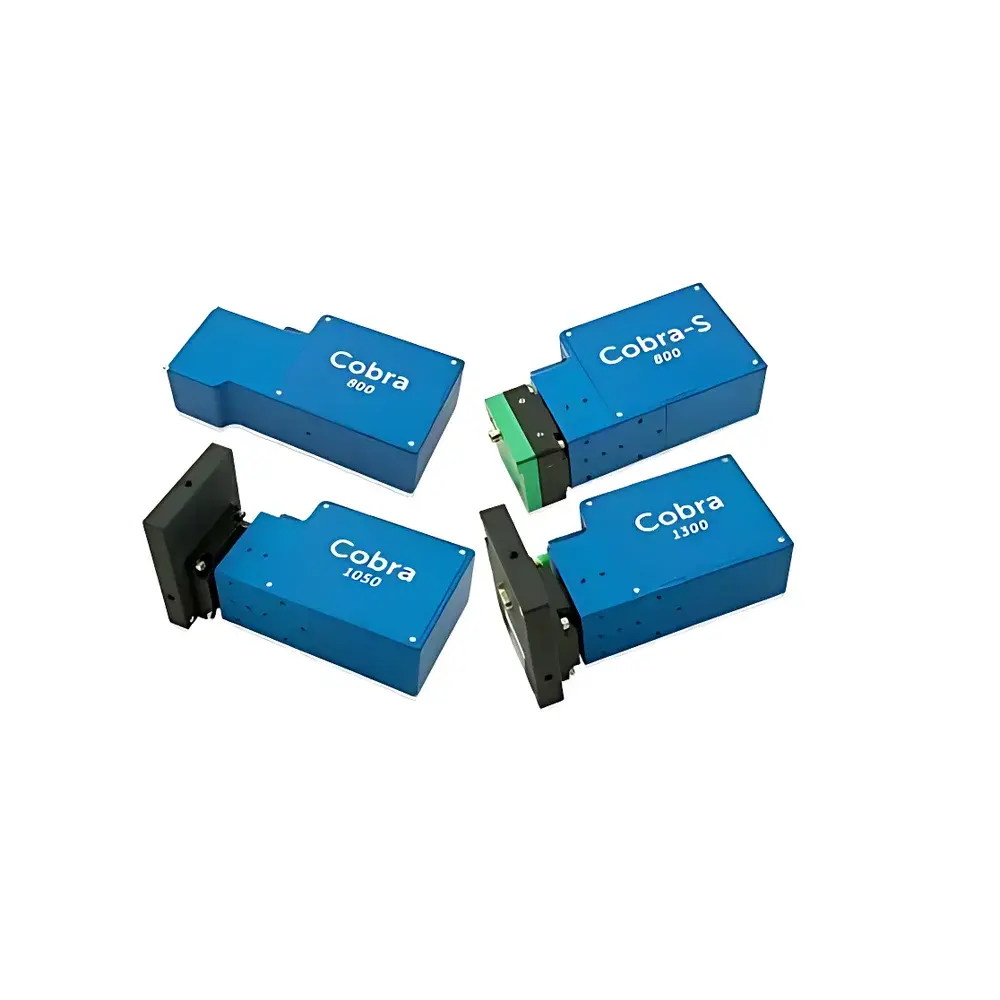
Wasatch Photonics Cobra800 Spectral Domain Optical Coherence Tomography (SD-OCT) Spectrometer
| Brand | Wasatch Photonics |
|---|---|
| Origin | USA |
| Model | Cobra800 |
| Wavelength Range | 750–950 nm (configurable) |
| Spectral Resolution | 0.04–0.15 nm |
| Maximum Line Rate | 250 kHz |
| Pixel Count | 2048 or 4096 |
| Interface | USB 3.0 (up to 130 kHz) or Camera Link (up to 250 kHz) |
| Imaging Depth | 1.0–4.0 mm (depth dependent on bandwidth and center wavelength) |
| Dimensions | 31 × 13.5 × 8 cm (main unit) |
| Weight | 5.0 kg / 1.4 kg |
Overview
The Wasatch Photonics Cobra800 is a high-performance, compact spectral domain optical coherence tomography (SD-OCT) spectrometer engineered for precision biomedical imaging, industrial metrology, and advanced research applications. Based on volume phase holographic (VPH) grating technology—manufactured in-house by Wasatch Photonics—the Cobra800 delivers exceptional optical throughput, minimal polarization sensitivity, and intrinsic thermal stability. Unlike conventional ruled or replica gratings, VPH gratings provide near-theoretical diffraction efficiency (>90% typical), low stray light (<0.1%), and negligible ghosting—critical for maintaining signal-to-noise ratio (SNR) and axial resolution in SD-OCT systems. The spectrometer operates on the principle of spectral interferometry: broadband light from a superluminescent diode (SLD) or swept-source is dispersed across a high-speed line-scan camera, enabling real-time Fourier-domain reconstruction of depth-resolved reflectivity profiles. Its optimized optical layout minimizes aberrations and path-length mismatch, supporting <6 dB roll-off at 2.5 mm depth—a benchmark for high-fidelity retinal and cellular imaging.
Key Features
- Proprietary volume phase holographic (VPH) transmission grating with >90% peak diffraction efficiency and <0.1% stray light
- Modular, drop-in integration architecture compatible with industry-standard OCT engine designs (e.g., Thorlabs, Princeton Instruments, Basler, e2v)
- Configurable spectral coverage: 80 nm to 300 nm bandwidth options across 750–950 nm range; extended variants available at 1050 nm and 1300 nm
- High-speed acquisition support: up to 250 kHz line rate via Camera Link interface; USB 3.0 option for cost-sensitive or portable deployments (≤130 kHz)
- Pixel-optimized optical design accommodating both 2048-pixel and 4096-pixel linear CMOS/CCD sensors (e.g., e2v OctoPlus, Basler Sprint, Dalsa Pirhana, Sensors Unlimited GL2048)
- Ruggedized aluminum housing with passive thermal management—no active cooling required for stable operation over ambient temperature ranges (15–30 °C)
- Factory-calibrated wavelength mapping and intensity response correction delivered with each unit
Sample Compatibility & Compliance
The Cobra800 spectrometer is designed for use in Class I laser-based SD-OCT systems compliant with IEC 60825-1:2014 and ANSI Z136.1-2022 safety standards. Its optical architecture supports sample arm configurations using single-mode fiber (SMF-28 or similar) with FC/APC or SMA905 connectors. The device meets RoHS 3 and REACH regulatory requirements for materials compliance. For regulated environments—including clinical OCT development and GMP-aligned manufacturing—the Cobra800 supports traceable calibration documentation and optional IQ/OQ protocols. While the spectrometer itself is not an FDA-cleared medical device, it is widely deployed in ISO 13485-certified OEM systems intended for ophthalmic, dermatological, and endoscopic imaging. Its mechanical and electrical interfaces are fully compatible with GLP/GMP data integrity frameworks when integrated with FDA 21 CFR Part 11-compliant acquisition software.
Software & Data Management
Wasatch Photonics provides the Cobra Control Suite—a vendor-neutral, cross-platform application programming interface (API) supporting Windows, Linux, and macOS. The suite includes native drivers for LabVIEW, MATLAB, Python (via ctypes and NumPy), and C/C++. Real-time spectral acquisition, dark-current subtraction, flat-field correction, and wavelength calibration interpolation are implemented in firmware-level FPGA logic (on Camera Link models) or optimized CPU routines (USB 3.0). Raw spectral data is output in IEEE 754-compliant 16-bit unsigned integer format, enabling seamless ingestion into third-party OCT reconstruction pipelines (e.g., OCTPro, OCTAV, custom CUDA-accelerated FFT engines). Metadata embedding—including timestamp, exposure time, gain setting, and grating serial number—is supported via standardized TIFF and HDF5 container formats. Audit trails, user authentication, and electronic signatures can be implemented externally through integration with enterprise LIMS or ELN platforms.
Applications
- Ophthalmology: High-resolution retinal layer segmentation, optic nerve head topography, and choroidal imaging at axial resolutions ≤5 µm (in tissue)
- Dermatology & Oncology: Non-invasive assessment of epidermal thickness, tumor margin delineation, and microvasculature mapping using 1300 nm variants
- Materials Science: Subsurface defect detection in polymers, composites, and thin-film coatings; layer-thickness metrology with ±0.2 µm repeatability
- Developmental Biology: Live-embryo imaging in zebrafish and mouse models with motion artifact suppression enabled by 250 kHz line rates
- Industrial Process Monitoring: In-line quality control of coated wires, battery electrode layers, and pharmaceutical tablet film integrity
- Academic Research: Dual-band OCT, polarization-sensitive OCT (PS-OCT), and angiography (OCTA) system prototyping with customizable spectral response
FAQ
What distinguishes the Cobra800 from other SD-OCT spectrometers?
Its monolithic VPH grating—fabricated in-house using proprietary photopolymer chemistry—delivers superior diffraction efficiency, lower polarization dependence, and higher thermal stability than epoxy-replicated or ruled gratings.
Can the Cobra800 be integrated into an existing OCT system?
Yes. It is designed as a drop-in optical module with standardized flange mounts (C-mount or SM1-threaded), fiber-coupled input, and industry-standard camera interfaces (Camera Link or USB 3.0). Mechanical and optical alignment tolerances follow ISO 10110-19 guidelines.
Is factory recalibration required after installation?
No. Each unit ships with a full spectral calibration certificate (wavelength accuracy ±0.02 nm, intensity uniformity ±2.5%) and embedded correction coefficients. Field recalibration is optional and supported via Wasatch’s Calibration Utility.
Does Wasatch Photonics offer OEM volume pricing and NRE support?
Yes. Dedicated engineering resources are available for co-development, mechanical integration assistance, and production test fixture design. Lead times for bulk orders (≥10 units) are typically 8–12 weeks from PO confirmation.
Are software updates and firmware patches provided post-purchase?
Yes. Registered users receive automatic notifications and free access to all non-breaking software releases, security patches, and driver updates for the lifetime of the product generation.




