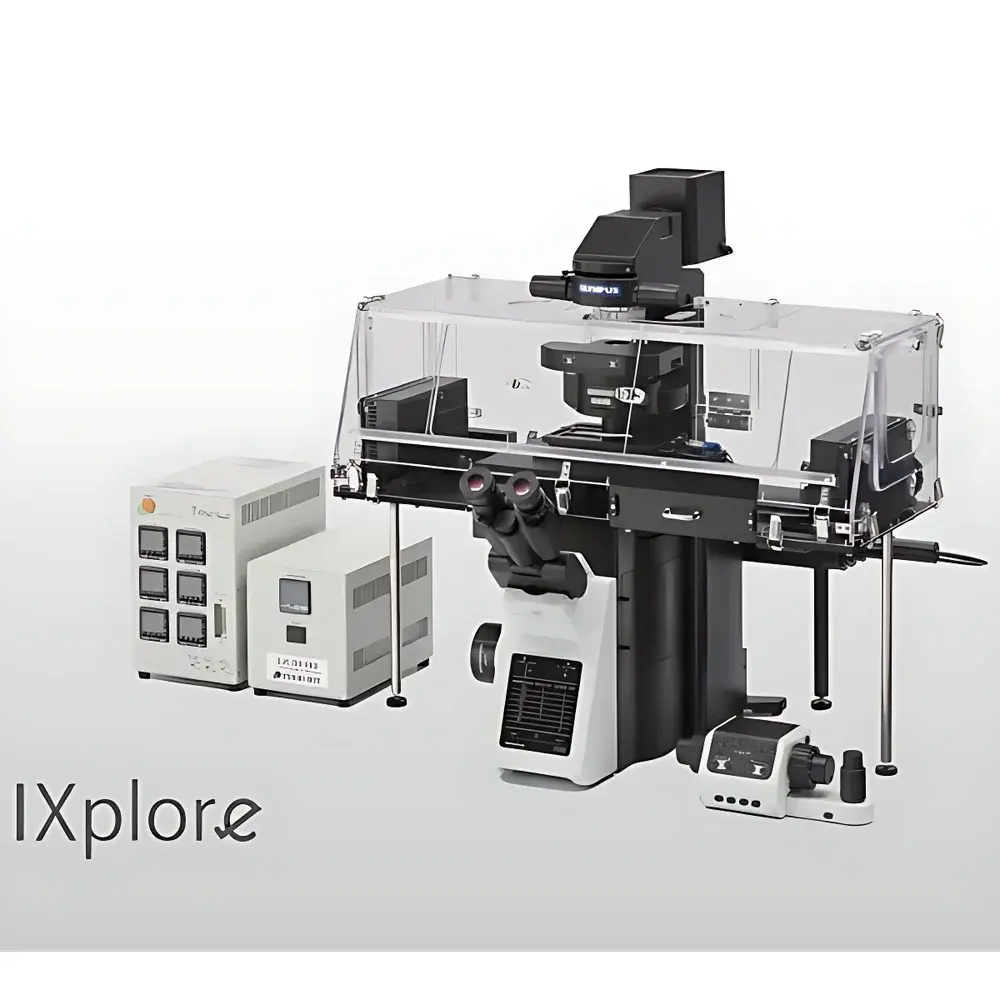
Olympus/EVIDENT IXplore Live Live-Cell Imaging Microscopy System
| Brand | Olympus/EVIDENT |
|---|---|
| Origin | Japan |
| Model | IXplore Live |
| Category | Imported Instrument |
| Distribution Type | Authorized Distributor |
| Pricing | Available Upon Request |
Overview
The Olympus/EVIDENT IXplore Live is a high-performance, inverted live-cell imaging microscopy system engineered for quantitative, long-term observation of dynamic biological processes under physiological conditions. Built upon the robust IXplore platform, it integrates precision mechanical architecture with advanced optical and computational imaging technologies to address core challenges in time-lapse microscopy: focus drift, spherical aberration in thick specimens, phototoxicity mitigation, and reproducible multi-dimensional data acquisition. Its measurement principle relies on widefield fluorescence and phase contrast microscopy enhanced by hardware-stabilized optics, adaptive focus maintenance (TruFocus), and GPU-accelerated computational image restoration—enabling reliable subcellular resolution imaging over hours or days without manual intervention.
Key Features
- Rigid Mechanical Platform: The IXplore Live features an optimized cast-aluminum frame and low-thermal-expansion Z-drive mechanism, minimizing mechanical drift and thermal-induced focus shift—critical for stable z-stack and time-lapse acquisition across extended durations.
- TruFocus Real-Time Focus Stabilization: A dedicated infrared-based autofocus system continuously monitors and corrects axial position at up to 10 Hz, maintaining optimal focus even during temperature fluctuations or stage movement.
- Silicone Oil Immersion Objectives: Proprietary UPLSAPO series objectives (e.g., 60×/1.30 NA, 40×/1.25 NA) utilize silicone oil (refractive index ≈ 1.40), closely matching that of living tissue (≈ 1.38). This minimizes spherical aberration at depth, enabling high-resolution imaging up to 100 µm into intact spheroids or organotypic cultures without oil replenishment.
- GPU-Accelerated TruSight Deconvolution: Implements a constrained iterative deconvolution algorithm leveraging CUDA-enabled GPUs to suppress out-of-focus blur, enhance signal-to-noise ratio, and recover spatial resolution beyond the diffraction limit—without increasing illumination intensity.
- Large-Field Uniform Illumination: Integrated Köhler illumination with fly-eye lens arrays and motorized mirror units ensures consistent fluorescence excitation intensity across fields up to 22 mm diagonal—fully compatible with modern sCMOS sensors (e.g., 2048 × 2048 pixels).
Sample Compatibility & Compliance
The IXplore Live supports standard tissue culture formats including 35–150 mm dishes, multi-well plates (6–384-well), chambered coverslips, and perfusion-compatible microfluidic devices. Environmental control integration (stage-top incubators, CO2 controllers, humidity modules) enables strict maintenance of physiological parameters (37°C, 5% CO2, >95% RH). The system complies with ISO 13485 design controls for medical device-related research applications and supports audit-ready metadata logging per GLP/GMP-aligned workflows. All software operations—including acquisition parameter logging, user authentication, and macro execution—are traceable and exportable for regulatory documentation.
Software & Data Management
Powered by cellSens Dimension v3.x, the system delivers intuitive yet rigorous experimental control via the Graphical Experiment Manager (GEM). GEM enables fully automated multidimensional acquisition (X-Y-Z-T-λ-position), synchronized with external triggers (e.g., perfusion pumps, electrophysiology rigs). Key capabilities include:
- Real-time 2D deblurring preview during focusing;
- Macro-driven post-acquisition TruSight deconvolution applied batch-wise across datasets;
- Cell tracking and motility analysis using object-based segmentation and trajectory reconstruction;
- Confluence quantification from both phase contrast and fluorescence channels;
- Export of OME-TIFF compliant files with embedded metadata (OME-XML schema) for FAIR data principles adherence.
The software meets FDA 21 CFR Part 11 requirements for electronic records and signatures when deployed with role-based access control and audit trail activation.
Applications
The IXplore Live is routinely deployed in academic and industrial life science laboratories for:
- Long-term mitotic tracking and lineage tracing in stem cell differentiation assays;
- Real-time monitoring of intracellular calcium dynamics using GCaMP or Fluo-4 reporters;
- 3D migration analysis in tumor spheroid invasion models;
- High-content screening of drug-induced phenotypic changes in primary neurons or iPSC-derived cardiomyocytes;
- Quantitative assessment of organelle morphology and trafficking (e.g., mitochondria fission/fusion, lysosomal pH gradients) under metabolic perturbation.
FAQ
Does the IXplore Live support environmental chamber integration?
Yes—standard interfaces for third-party stage-top incubators (e.g., Tokai Hit, OkoLab) and gas mixing modules are provided, with full synchronization via TTL or analog I/O.
Can TruSight deconvolution be applied to previously acquired datasets?
Yes—batch processing is supported through the cellSens macro editor, allowing retrospective enhancement of archived TIFF or ND2 files.
Is the silicone oil immersion objective compatible with aqueous mounting media?
Silicone oil objectives are designed exclusively for silicone immersion; use with water or glycerol will induce severe spherical aberration and is not recommended.
What camera interfaces are supported?
The system supports USB 3.0 and Camera Link interfaces, with native drivers for Hamamatsu ORCA-Fusion BT, Photometrics Prime BSI, and Andor Zyla 4.2 PLUS sCMOS cameras.
How is focus stability validated for GLP-compliant studies?
TruFocus performance is documented in the system’s IQ/OQ protocol suite, including Z-drift measurements over 24 h at multiple temperatures and magnifications—traceable to NIST-traceable interferometric calibration standards.