
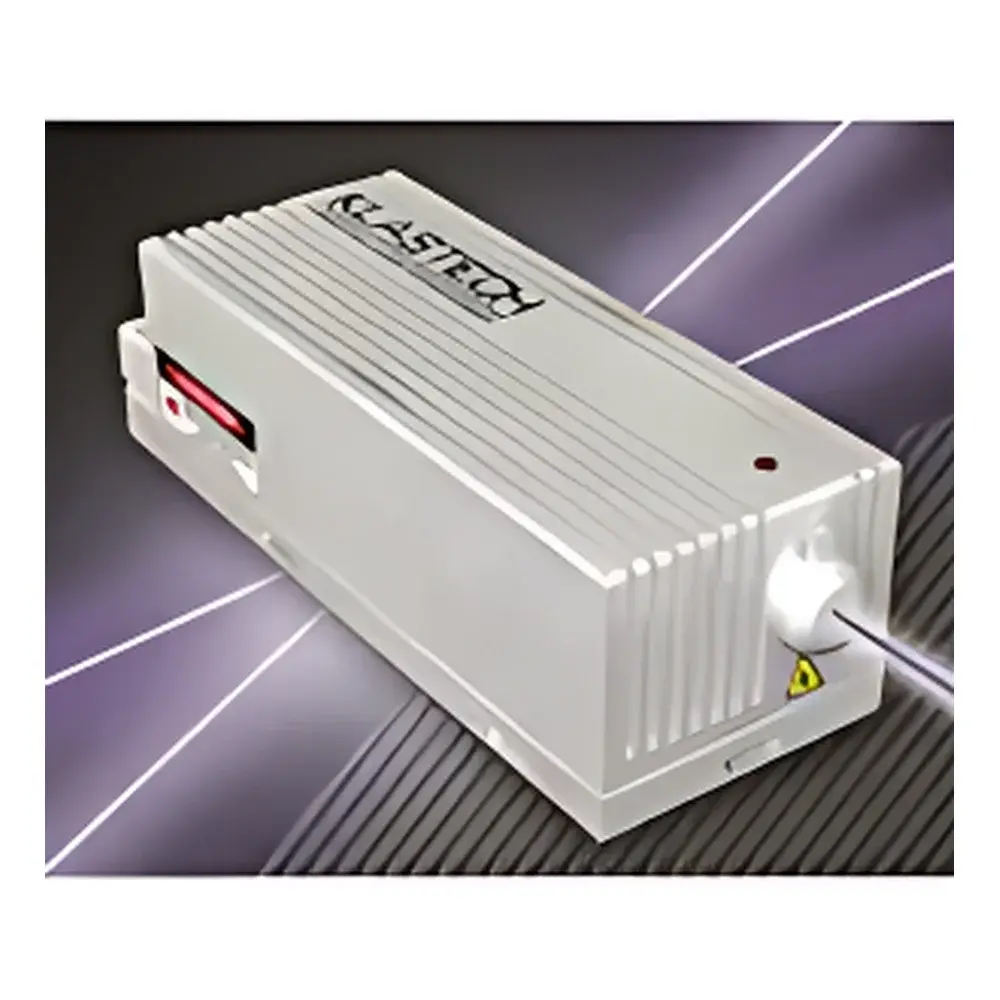
Verve® 266nm DPSS Ultraviolet Laser System
| Origin | USA |
|---|---|
| Manufacturer Type | Authorized Distributor |
| Origin Category | Imported |
| Model | Verve® 266nm |
| Pricing | Available Upon Request |
| Output Wavelength | 266 nm |
| Output Power Options | 25 mW, 50 mW, 100 mW |
| Beam Diameter (1/e²) | 1.0 mm |
| Transverse Mode | TEM₀₀, M² < 1.25 |
| Longitudinal Mode | Single-Frequency (Single Longitudinal Mode) |
| Spectral Linewidth | < 1 MHz |
| Coherence Length | > 100 m |
Overview
The Verve® 266nm DPSS Ultraviolet Laser System is a solid-state, diode-pumped, frequency-quadrupled Nd:YAG laser engineered for high-stability, narrow-linewidth ultraviolet emission at 266 nm. Based on intracavity fourth-harmonic generation in a monolithic resonator architecture, this system delivers diffraction-limited beam quality and exceptional temporal coherence—critical for applications demanding precise photon–matter interaction in the deep-UV spectral region. Unlike lamp-based or excimer sources, the Verve® 266nm provides continuous-wave (CW) or quasi-CW operation with superior pointing stability (< 3 µrad/°C), low amplitude noise (< 0.3% RMS, 10 Hz–10 MHz), and long-term power drift < ±1% over 8 hours. Its compact, air-cooled design meets Class 3B laser safety requirements per IEC 60825-1 and incorporates integrated interlock circuitry compliant with ANSI Z136.1.
Key Features
- Diode-pumped solid-state (DPSS) architecture with all-solid-state frequency conversion—no consumables, no gas replenishment, and no high-voltage discharge components.
- Single-frequency operation with linewidth < 1 MHz and coherence length exceeding 100 meters—enabling interferometric-grade measurements and stable holographic recording.
- TEM₀₀ output with M² < 1.25 and 1/e² beam diameter of 1.0 mm—optimized for efficient coupling into single-mode optical fibers and high-numerical-aperture microscope objectives.
- Three calibrated output power options (25 mW, 50 mW, 100 mW) selectable via factory configuration—each validated using NIST-traceable thermal power sensors.
- Integrated digital control interface (RS-232 and USB 2.0) supporting remote power modulation, TTL-triggered enable/disable, and real-time status monitoring (temperature, current, output lock status).
- Hermetically sealed, vibration-damped housing with passive thermal management—designed for integration into cleanroom-compatible optical tables and semiconductor metrology platforms.
Sample Compatibility & Compliance
The Verve® 266nm laser is routinely deployed in ISO Class 5–7 cleanroom environments for non-contact inspection of silicon wafers, photomasks, and compound semiconductor substrates. Its 266 nm wavelength lies within the absorption band of SiO₂, photoresists (e.g., Shipley UVIII, AZ® series), and many polymer waveguide materials—making it suitable for maskless lithography alignment, defect scattering analysis, and UV-induced fluorescence mapping. The system conforms to key regulatory frameworks including FDA 21 CFR Part 11 (when paired with compliant data acquisition software), ISO 13406-2 (for visual display ergonomics during operator alignment), and SEMI F47-0218 (voltage sag immunity for semiconductor manufacturing tools). All optical interfaces comply with FC/PC or SMA905 standards; optional fiber-coupled variants support SMF-28 or UV-grade fused silica delivery.
Software & Data Management
The laser operates natively with VerveControl™ Suite v3.2—a Windows-based application enabling full parameter scripting, automated power ramping profiles, and timestamped event logging. Audit trails record every power change, mode-lock event, and thermal recalibration cycle with user ID and system clock synchronization. Export formats include CSV (for LIMS integration), HDF5 (for MATLAB/Python post-processing), and XML metadata compliant with ASTM E2412-22 (Standard Practice for Data Exchange in Analytical Chemistry). When used with third-party DAQ systems (e.g., National Instruments PXIe-6363), the laser’s analog modulation input supports closed-loop intensity stabilization referenced to external photodiode feedback—meeting GLP/GMP documentation requirements for QC laboratories.
Applications
- Semiconductor wafer inspection: High-resolution dark-field imaging of sub-100 nm surface defects via 266 nm Rayleigh scattering contrast enhancement.
- Fiber Bragg grating (FBG) inscription: Precise phase-mask exposure with < 5 nm spatial jitter, enabling telecom-grade grating reflectivity control and dispersion compensation design.
- UV resonance Raman spectroscopy: Excitation of electronic transitions in aromatic amino acids (Trp, Tyr), nucleic acid bases, and transition metal complexes—minimizing fluorescence background interference.
- Ultraviolet holography: Recording of volume-phase holograms in dichromated gelatin (DCG) and photopolymer media with diffraction efficiency > 92% and angular selectivity < 0.05°.
- Time-resolved photoluminescence decay studies: Pump-probe configurations requiring picosecond-level timing jitter between 266 nm pump and tunable visible probe pulses.
FAQ
Is the Verve® 266nm laser compatible with vacuum environments?
Yes—optional vacuum-compatible variants (with CF-35 flange mounting and outgassing-certified adhesives) are available upon request. Standard units are rated for ambient operation only.
What maintenance intervals are recommended for long-term stability?
No scheduled maintenance is required. Annual performance verification (power stability, beam profile, spectral purity) is recommended using calibrated reference detectors and wavemeters.
Can the laser be integrated into an existing OEM instrument platform?
Yes—the system provides TTL, analog voltage, and RS-232 interfaces with detailed OEM integration manuals and SDKs for C/C++, LabVIEW, and Python.
Does the laser meet FDA laser product reporting requirements for U.S. market placement?
Yes—it carries FDA accession number KXXXXXX and includes full compliance documentation (laser classification report, variance letter, and manufacturing site audit summary).
Is there a version with active wavelength stabilization?
A variant with Pound–Drever–Hall (PDH) locking to a UV transmission etalon is available as a custom option (lead time: 16 weeks).





