
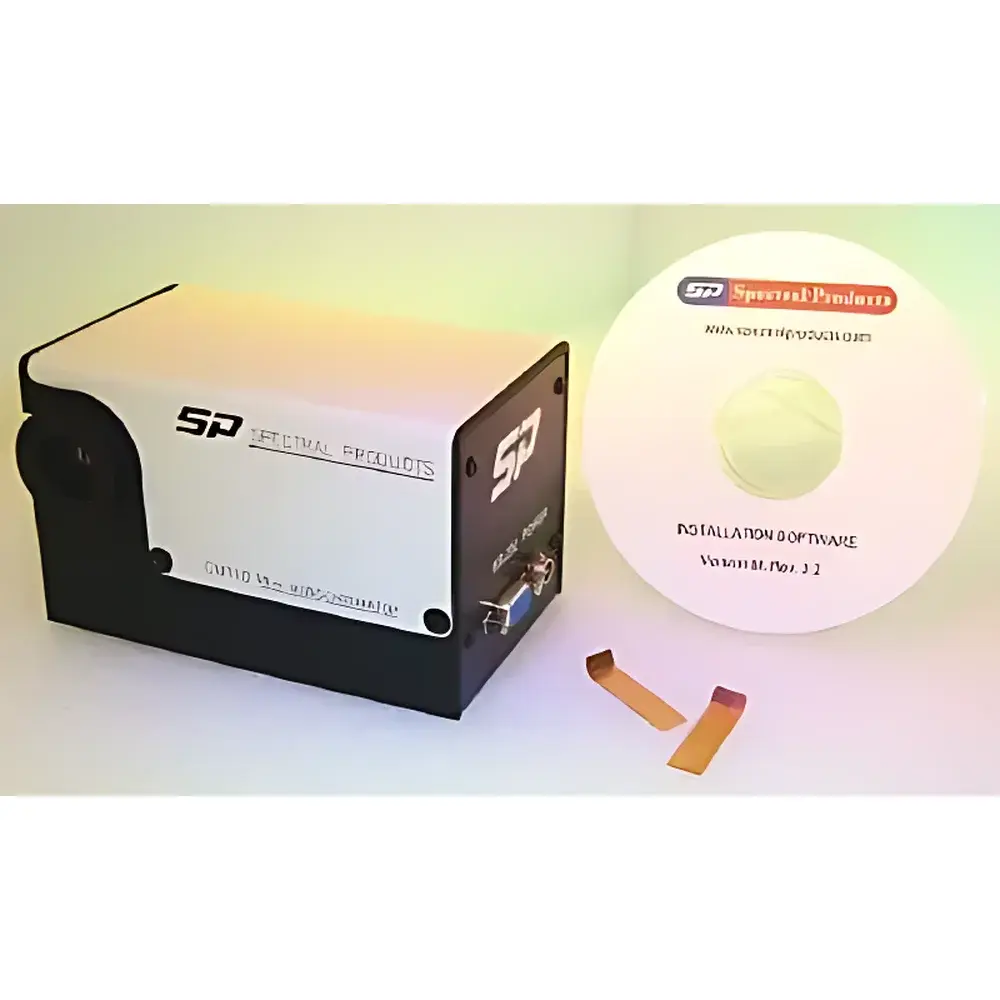
English Product Name
| Origin | Taiwan |
|---|---|
| Manufacturer Type | Distributor |
| Domestic Origin | Yes |
| Model | M11-S |
| Pricing | Upon Request |
| Focal Length | 110 mm |
| Numerical Aperture | f/3.9 |
| Wavelength Accuracy | ±0.6 nm |
| Wavelength Repeatability | 0.2 nm |
| Scanning Speed | >100 nm/s |
| Stray Light | <1×10⁻⁵ |
| Slit Options | 0.125, 0.15, 0.30, 0.6, 1.2, and 2.4 mm (height) × 4.0 mm (width) |
| Resolution (typ.) | <1 nm |
| Grating Size | 30 × 30 mm |
| Drive Mechanism | Microprocessor-controlled worm gear with backlash compensation |
| Interface | RS-232 serial |
| Software | Native control software + LabVIEW drivers |
| Power Supply | 110/220 V AC module |
| Warranty | 1 year |
Overview
The SP M11-S is a compact, high-performance Czerny-Turner monochromator engineered for precision spectral isolation in demanding optical laboratory environments. With a focal length of 110 mm and an f/3.9 numerical aperture, it delivers optimized throughput and resolution across ultraviolet (UV), visible (VIS), and near-infrared (NIR) spectral regions (typically 190–1100 nm, dependent on grating selection). Its optical architecture employs a dual-grating turret design—enabling seamless switching between gratings without realignment—thereby extending usable spectral coverage while maintaining mechanical stability and wavelength fidelity. The instrument operates on the principle of angular dispersion: incident polychromatic light is collimated, diffracted by a ruled or holographic grating, and then focused onto an exit slit, where narrowband spectral components are spatially isolated. This fundamental configuration supports both monochromator (fixed input/fixed output slit) and spectrograph (multi-channel detection at exit plane) modes, making it adaptable to diverse photometric and spectroscopic workflows.
Key Features
- Compact footprint: 5.25 × 3.25 × 3.25 inches (133 × 83 × 83 mm), ideal for space-constrained optical tables and OEM integration.
- Dual-grating turret accommodates two 30 × 30 mm gratings; enables rapid, repeatable switching between UV-optimized, VIS-balanced, or NIR-enhanced dispersion profiles.
- Backlash-compensated microprocessor-controlled drive system ensures bidirectional scanning with high positional repeatability (±0.2 nm) and long-term mechanical stability under thermal or vibrational stress.
- Wavelength calibration traceable to NIST-traceable standards; factory-aligned and verified prior to shipment using certified spectral sources (e.g., Hg/Ar lamps).
- Adjustable entrance and exit slits with six standard widths (0.125–2.4 mm); slit height fixed at 4.0 mm for consistent beam geometry and stray-light control.
- Stray light suppression <1×10⁻⁵ (measured at 546 nm with 10 nm bandwidth, using 1200 g/mm grating), achieved through optimized baffling, black-anodized internal surfaces, and holographic grating options.
- Flexible optical path configuration: standard straight-through layout or optional 90° folded path—facilitating alignment in multi-stage optical setups or fiber-coupled systems.
Sample Compatibility & Compliance
The M11-S is compatible with standard optical components including quartz, fused silica, and CaF₂ entrance windows (UV-grade), as well as silicon, InGaAs, or PMT-based detectors mounted at the exit port. It interfaces directly with spectrometers, fluorometers, radiometers, and custom-built optical benches. While not a standalone analytical instrument, its optical performance supports compliance-critical applications when integrated into validated systems—e.g., UV-Vis absorbance measurements per ASTM E275, fluorescence intensity quantification per ISO 17025–accredited protocols, or process monitoring aligned with ICH Q2(R2) guidelines for method verification. The RS-232 interface enables audit-ready command logging; optional IEEE-488 (GPIB) support facilitates integration into automated test systems compliant with FDA 21 CFR Part 11 requirements for electronic records and signatures.
Software & Data Management
The M11-S ships with native Windows-based control software supporting full parameterization: wavelength setpoint, scan range/direction, step size (in nm, cm⁻¹, eV, or Å), slit width, and grating selection. All commands follow ASCII-based SCPI-like syntax for reproducible scripting. LabVIEW™ drivers (32/64-bit, Windows) are provided for embedded system development and integration with NI PXI platforms. Data export is supported in CSV and ASCII formats, enabling direct ingestion into MATLAB®, Python (NumPy/Pandas), or LIMS environments. Firmware updates are performed via serial interface; configuration files are stored non-volatilely and survive power cycles. No cloud connectivity or telemetry is implemented—ensuring data sovereignty and compatibility with air-gapped laboratory networks.
Applications
The M11-S serves as a core dispersive element in multiple analytical configurations: excitation source filtering for steady-state and time-resolved fluorescence spectroscopy; wavelength selection in UV-Vis-NIR absorbance and reflectance measurements; spectral calibration reference in detector characterization labs; line isolation for laser-induced breakdown spectroscopy (LIBS) signal conditioning; and spectral bandpass definition in industrial colorimetry and LED spectral power distribution (SPD) analysis. Its robust mechanical design and low thermal drift make it suitable for continuous-duty process monitoring in pharmaceutical manufacturing (e.g., inline reaction monitoring) and semiconductor metrology (e.g., thin-film thickness verification via interference fringe analysis).
FAQ
What grating options are available for the M11-S?
Standard gratings include 300, 600, 1200, and 1800 grooves/mm, blazed for UV (250 nm), VIS (500 nm), or NIR (750 nm) regions. Custom holographic or ruled gratings can be specified upon order.
Can the M11-S be used with fiber-optic input?
Yes—via optional SMA905 or FC/PC couplers mounted to the entrance port; collimation optics must be selected based on fiber NA and core diameter.
Is remote firmware update supported?
Firmware updates require local serial connection and vendor-provided utility; no over-the-air or network-based update capability is implemented.
Does the unit comply with CE or RoHS directives?
All electronics and mechanical assemblies meet CE marking requirements (EMC Directive 2014/30/EU, LVD Directive 2014/35/EU) and RoHS 2011/65/EU substance restrictions.
What is the maximum allowable input irradiance?
For continuous-wave sources: ≤1 W/cm² at entrance slit (unfiltered); pulsed lasers require consultation regarding thermal lensing and grating damage thresholds.




