
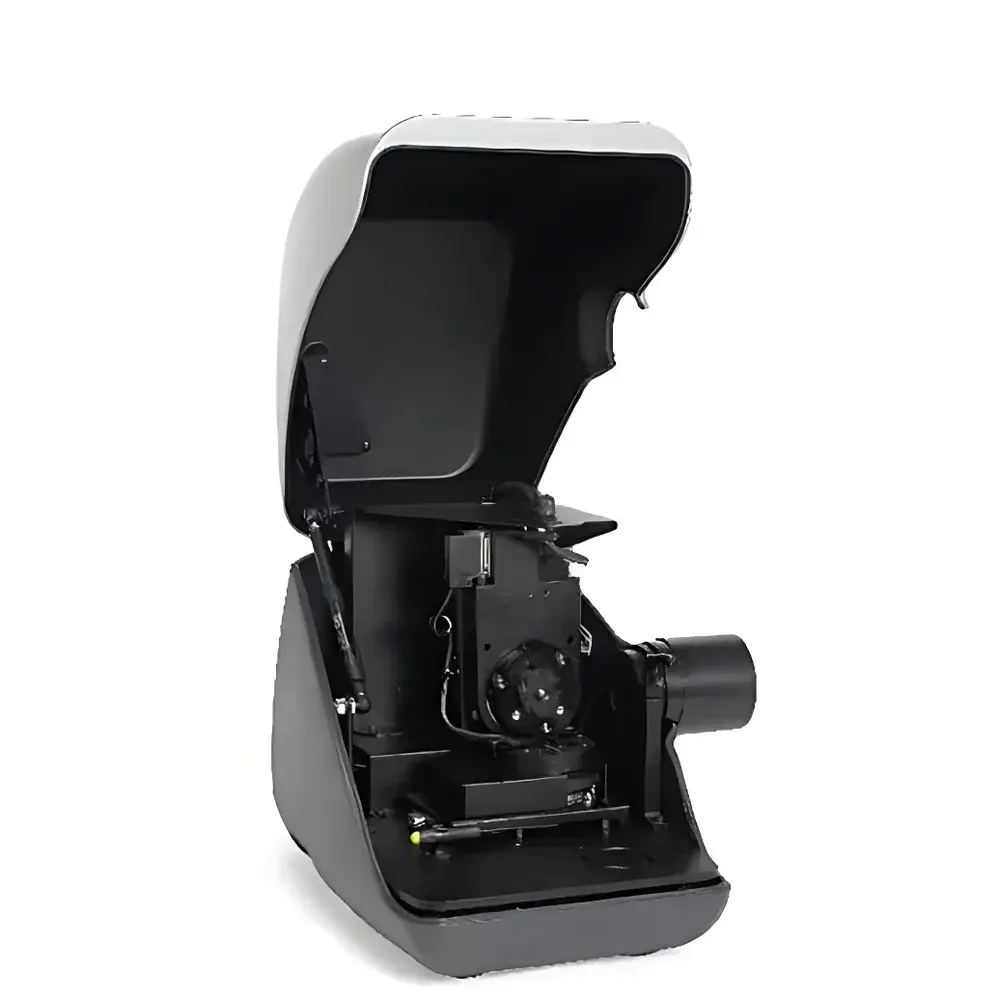
Labsphere LSA 3000 Single-LED Spatial Radiant Intensity Distribution Analyzer
| Brand | Labsphere |
|---|---|
| Origin | USA |
| Model | LSA 3000 |
| Component Category | Optical Instrument System |
| Compliance | ASTM E2617, CIE S 025/E:2015, IES LM-79-19 (spatial extension), ISO/CIE 13370 |
| Software Integration | Labsphere TeraLED™ v5.0+ |
| Motion Control | Dual-axis goniometric stage (θ: ±90°, φ: 0–360°) |
| Angular Resolution | Adjustable from 0.1° to 5.0° |
| Detector | Calibrated silicon photodiode + optional integrated spectroradiometer (e.g., CAS 140D or I2000) |
| Measurement Modes | Absolute radiant intensity (W/sr), luminous intensity (cd), spectral radiant intensity (W/sr/nm), chromaticity (CIE 1931 x,y), CCT, CRI/Rf, Rg |
| Data Output Format | IESNA LM-63, EULUMDAT (.ldt), CSV, XML |
Overview
The Labsphere LSA 3000 Single-LED Spatial Radiant Intensity Distribution Analyzer is a precision-engineered goniophotometric system designed for full-hemispherical characterization of individual LED devices under controlled thermal and electrical conditions. Based on the fundamental principle of rotating-dut goniometry—where the device under test (DUT) remains stationary while a calibrated detector traverses defined angular trajectories—the LSA 3000 captures spatially resolved radiant and photometric data across the complete 2π steradian far-field hemisphere. Unlike integrating sphere-based methods that average directional output, this system preserves angular fidelity critical for optical design validation, beam shaping verification, and compliance with photometric standards such as IES LM-79-19 Annex B and CIE S 025/E:2015. Its architecture supports both absolute radiometric calibration traceable to NIST standards and photometric scaling via V(λ)-matched detection, enabling quantitative evaluation of luminous intensity distribution (LID), spectral radiant intensity distribution (SRID), and correlated color temperature (CCT) variation across solid angle.
Key Features
- Dual-axis automated goniometric stage with high-resolution stepper motors (angular repeatability ±0.05°) enabling precise positioning in polar (θ) and azimuthal (φ) coordinates
- Modular detector interface accommodating interchangeable sensors: broadband photodiodes for luminous intensity (cd), thermopile detectors for radiant flux (W), and fiber-coupled spectroradiometers (e.g., Instruments I1000/I2000 or CAS 140D) for spectral intensity (W/sr/nm)
- User-definable angular step resolution—from 0.1° fine-scan mode for near-field beam profiling to 5.0° coarse mode for rapid qualification—optimized for throughput without compromising data integrity
- Thermally stabilized DUT mount with active heat-sink interface and optional current-controlled driver integration (DC or pulsed) to maintain junction temperature stability during extended measurement sequences
- Compliance-ready firmware architecture supporting audit trails, user access levels, and electronic signatures aligned with GLP/GMP and FDA 21 CFR Part 11 requirements when operated with TeraLED™ software
- Native export to industry-standard photometric file formats including IESNA LM-63-19, EULUMDAT (.ldt), and CIE 137-2005-compliant XML for direct import into optical design tools (e.g., LightTools, TracePro, Zemax OpticStudio)
Sample Compatibility & Compliance
The LSA 3000 accommodates a broad range of single-die LED packages—including surface-mount (SMD), ceramic-based high-power emitters, COB arrays (as discrete units), and miniature through-hole devices—via configurable mechanical fixtures and electrical contact modules. All measurements adhere to internationally recognized metrological frameworks: radiant intensity data complies with ASTM E2617 (Standard Test Method for Spectral Irradiance and Radiance Using Spectroradiometers), photometric intensity conforms to IES LM-79-19 Section 8 (Spatial Intensity Distribution), and chromaticity mapping follows CIE S 025/E:2015 (LED Measurement Standard). The system’s calibration chain is maintained through annual NIST-traceable recalibration services offered by Labsphere Metrology Services, ensuring long-term measurement consistency across laboratories and supply-chain tiers.
Software & Data Management
Controlled exclusively through Labsphere TeraLED™ v5.0 or later, the LSA 3000 integrates real-time acquisition, post-processing, and reporting within a validated software environment. TeraLED™ provides synchronized control of DUT drive electronics, goniometer motion, and spectral acquisition—enabling simultaneous capture of intensity, spectrum, and chromaticity at each angular node. Data management includes automated generation of polar plots, Cartesian intensity maps, CIE 1931 chromaticity overlays, and CCT deviation heatmaps. All raw datasets are stored with embedded metadata (timestamp, operator ID, calibration certificate ID, ambient temperature/humidity), supporting full traceability. Audit logs record every parameter change, measurement initiation, and export event—essential for quality systems operating under ISO/IEC 17025 or automotive AEC-Q102 validation protocols.
Applications
- Far-field spatial characterization of mid-power and high-brightness LEDs for automotive headlamp, streetlight, and architectural lighting design
- Validation of optical lens and reflector performance by comparing simulated vs. measured LID patterns
- Quantification of angular-dependent color shift (e.g., blue-pump + phosphor LEDs exhibiting CCT drift beyond ±30°)
- Supporting DOE SSL Program requirements for LM-80 and TM-21 lifetime extrapolation via baseline spatial-spectral fingerprinting
- Development and verification of ANSI C78.377 chromaticity quadrangles and ENERGY STAR® spectral quality thresholds
- Research into directional emissivity effects in micro-LED and UV-C LED arrays
FAQ
Does the LSA 3000 support automated thermal management during measurement?
Yes—the system integrates with optional junction temperature monitoring modules and programmable constant-current drivers to maintain thermal equilibrium per IES TM-21 and JEDEC JESD51-1 protocols.
Can it measure non-LED sources such as laser diodes or OLED tiles?
It is optimized for Lambertian and quasi-Lambertian emitters; laser diodes require additional collimation and safety interlocks not included in standard configuration.
Is third-party spectrometer integration supported?
Yes—via USB or Ethernet API, provided the spectrometer offers SCPI command compatibility and calibrated spectral responsivity data in .cal format.
What is the typical measurement time for a full 2π hemispherical scan at 0.5° resolution?
Approximately 18–24 minutes, depending on integration time per point and spectrometer dwell settings.
How is calibration traceability documented?
Each system ships with a NIST-traceable calibration certificate covering angular position accuracy, detector responsivity, and V(λ) mismatch correction factors—valid for 12 months under normal use conditions.




